


Can You Get a Cosmetology License Without Going to Beauty School? Apprenticeships and Alternative Paths Explained
Key Takeaways
- State Rules Control: There is no national cosmetology license. Some states permit registered apprenticeships, while others require applicants to complete a state-approved school program.
- Apprenticeships Require More Time: Apprenticeships commonly require substantially more hours than school programs. Georgia requires 3,000 apprentice hours instead of 1,500 school hours, while California requires 3,200 on-the-job hours plus 220 hours of related training instead of 1,000 school hours.
- Exam Results Vary: Some California reporting periods have shown lower written-exam pass rates among cosmetology apprentices than school-trained candidates. However, these results are not national averages and vary by year, exam, program, and candidate group.
- License Mobility Is Complicated: Apprenticeship training does not automatically prevent you from transferring your license, but another state may review your training hours, examination history, work experience, and license status before granting a new license.
- Online Study Is Not a Complete Licensing Route: Some approved programs may deliver theory courses online, but online coursework by itself does not replace the state-recognized practical training needed for initial licensure.
If you are passionate about hair, skin, and nails, turning that passion into a career is an exciting goal. However, looking into traditional programs can quickly feel overwhelming. Tuition at some private beauty schools can exceed $15,000, while completing the required hours may take anywhere from several months to more than a year, depending on your state, school schedule, and attendance.
It is completely natural to wonder whether there is a faster or less expensive route into the industry. Many aspiring artists search for ways to earn a cosmetology license without spending years in a traditional classroom. But can you legally skip beauty school altogether? The answer depends on your state, the alternative training routes it recognizes, and the trade-offs you are willing to make.
Can You Legally Skip Beauty School?
There is no single national cosmetology license in the United States. Instead, each state has its own licensing authority that determines which services cosmetologists may perform, how much training applicants need, which examinations they must pass, and whether an apprenticeship can replace cosmetology school.
Before choosing a training path, review your state's specific cosmetology licensing rules and hour requirements. The state where you plan to work determines whether your education qualifies you for the licensing examination.
Completing a state-approved cosmetology program is the standard route in most states. Some states also permit applicants to train through a formally registered apprenticeship under a licensed professional. These opportunities are not available everywhere, and the permitted occupations, training hours, registration requirements, and supervision rules vary considerably.
Two states show how different the requirements can be:
- Georgia: The Georgia State Board of Cosmetology and Barbers requires 1,500 hours completed over at least nine months for a school-based cosmetology program. As an alternative, Georgia permits a Master Cosmetologist apprentice to complete 3,000 hours over at least 18 months, according to the state's official apprenticeship rules.
- Arkansas: Arkansas requires applicants following its standard initial-license route to complete 1,500 hours in a licensed school of cosmetology. The current licensing materials from the Arkansas Department of Health Cosmetology Section do not provide a salon-apprenticeship substitute for those school hours.
This means “getting a cosmetology license without school” does not mean avoiding education or supervised training. In a state that recognizes apprenticeships, it means completing your required education through a different regulated environment.
How a Cosmetology Apprenticeship Works
A cosmetology apprenticeship is the most common alternative to a school-based program. Instead of completing most of your training in a classroom and student clinic, you receive supervised on-the-job training in an approved salon.
A legal apprenticeship is not simply an entry-level salon job. The apprentice, supervising licensee, establishment, and sometimes a separate program sponsor may need approval before training begins. Hours completed before registration may not count toward licensure.
Requirements also extend beyond working with clients. For example, the California Board of Barbering and Cosmetology requires apprentices to complete at least 3,200 hours of on-the-job training over two years. Cosmetology apprentices must also complete at least 220 hours of related training provided by their program sponsor.
The Benefits of Learning in a Salon
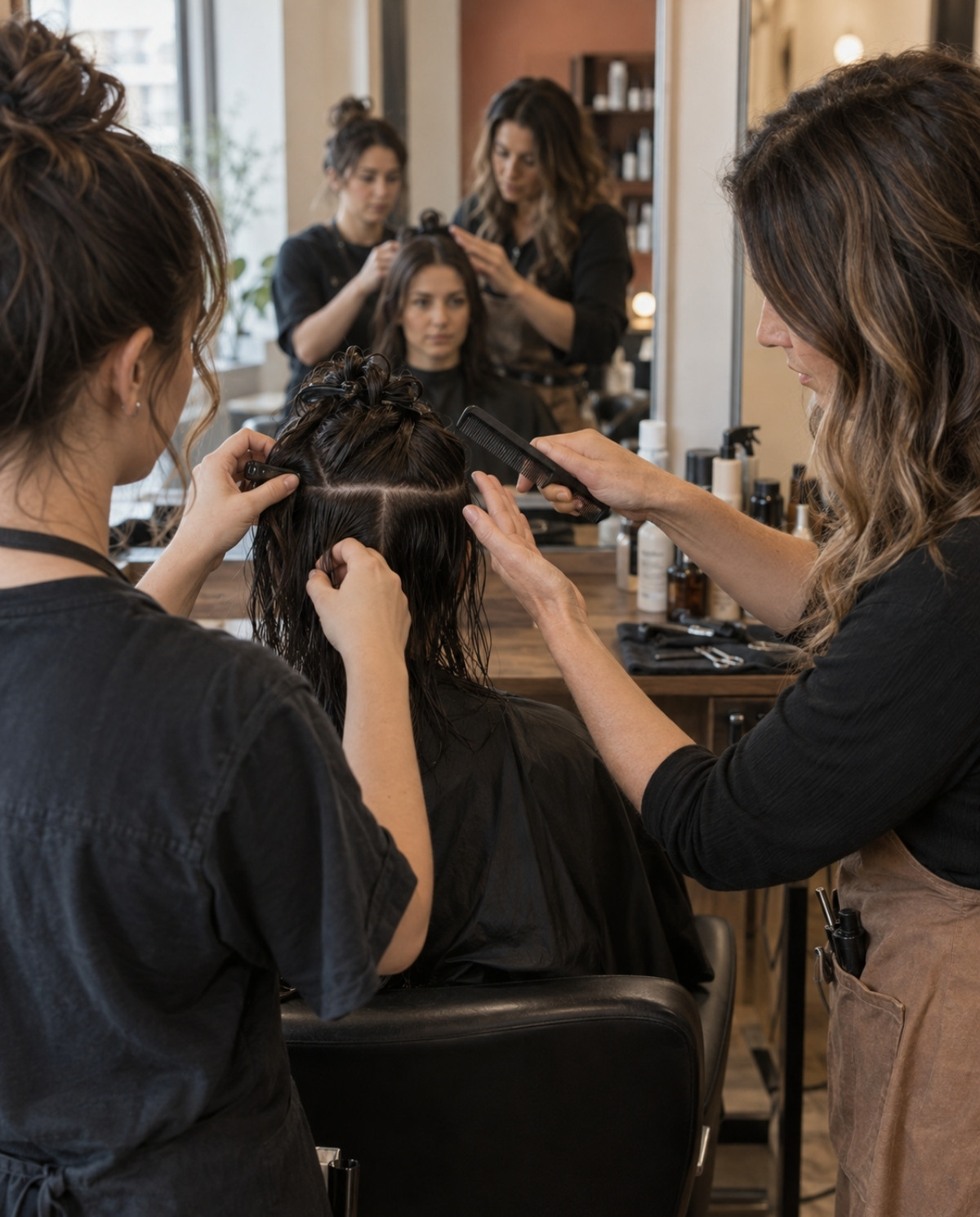
The strongest advantage of an apprenticeship is exposure to a real salon environment. Apprentices may learn how appointments are scheduled, how consultations are conducted, how products are recommended, and how salon professionals manage their time throughout the day.
Working around paying clients can also help an apprentice develop communication skills and understand how long services take outside a classroom exercise. Depending on the program and state rules, apprentices may gradually perform services under the direct supervision of their designated trainer.
A legitimate apprenticeship normally combines paid employment with supervised training and related instruction. The U.S. Department of Labor describes apprenticeship generally as a model that combines paid on-the-job training with classroom instruction. However, the exact wage, schedule, benefits, and training costs depend on the employer, program, and applicable state and federal laws.
An apprenticeship may therefore reduce the need to stop working completely while pursuing a license. It can also help an apprentice begin forming professional relationships in the local beauty industry.
The Risks and Limitations
The quality of an apprenticeship depends heavily on its structure, program sponsor, and supervising licensee. A highly skilled cosmetologist is not automatically an experienced teacher, and a busy salon may not always provide the same predictable lesson schedule as a school.
Apprentices should not assume that every task performed in a salon will count as approved training. Cleaning work areas, preparing supplies, and observing services may be part of salon life, but state boards generally require documented training across specific subjects and services.
Theory preparation is another important consideration. Cosmetologists need more than technical speed. They must understand infection control, product safety, hair and scalp conditions, chemical services, skin and nail fundamentals, client protection, and the laws governing their work. An effective apprenticeship should explain how this knowledge will be taught and how the apprentice will prepare for the licensing examination.
Before registering, ask the program the following questions:
- Must the apprentice and salon receive state approval before hours can begin?
- Who records the training hours, and how often are they reported to the state?
- What happens to completed hours if the supervisor leaves or the salon closes?
- Can the hours be transferred to another approved salon or program?
- How are theory, sanitation, chemical safety, and state-law subjects taught?
- Does the program include textbooks, classroom instruction, or exam-preparation support?
- What wages, tuition charges, registration fees, tool costs, and examination fees apply?
- How much of the apprentice's schedule is devoted to actual training?
These details matter because states may limit how hours can be combined or transferred. Georgia, for example, states that apprentice hours cannot be combined with school hours. Changing supervisors or salons may also require new paperwork before additional hours can be credited.
What Exam Data Can and Cannot Tell You
Some official reports suggest that apprentices may face additional challenges on written licensing examinations, but the results should be interpreted carefully.
In one set of California Board apprenticeship meeting materials, cosmetology apprentices had a lower written-exam pass rate than applicants trained through school programs during the period examined. However, the results changed across reporting periods and differed by license type, examination, program, and language.
These figures should not be treated as a permanent California rate or a national average. They also do not prove that apprentices failed because of specific gaps in chemistry or sanitation. Exam statistics show a difference in outcomes, but they do not establish the cause of that difference.
A prospective apprentice should ask the sponsor for recent program-specific exam results, how many candidates were included, and whether the figures represent first-time test takers or all attempts. If you want to understand what may be tested, our cosmetology state board exam breakdown explains the typical written and practical testing process.
Can You Earn a Cosmetology License Online?
If you are already managing a job or taking care of family, flexibility may be one of your biggest concerns. Online courses can make part of the learning process more convenient, but they should not be confused with a complete licensing pathway.

What You May Be Able to Complete Online
Some state-approved schools offer hybrid programs in which part of the theory curriculum is delivered online. Depending on state rules and school approval, online subjects may include anatomy, infection control, chemistry, product knowledge, business practices, and state law.
The availability of online instruction does not mean every online hour will automatically count toward a license. Distance education must be part of a program recognized by the state licensing authority, and schools may be required to track participation, assignments, examinations, and completed hours.
Before enrolling, verify the following directly with the school and state board:
- The school is approved by the state licensing authority.
- The specific cosmetology program qualifies graduates for licensure.
- The state permits the advertised theory hours to be delivered online.
- The program includes the required supervised practical training.
- The program meets the requirements of the state where you plan to apply for a license.
What You Cannot Replace With Online Study
Cosmetology is a hands-on occupation. Students and apprentices need supervised practice in sanitation, client protection, tool handling, hair cutting, styling, chemical application, and other services included within their state's cosmetology scope of practice.
For this reason, an online certificate by itself should not be treated as a cosmetology license or as proof that you have completed a state-approved licensing program. Practical training must be completed through a school, apprenticeship, or another pathway specifically recognized by the licensing authority.
Not every online beauty course is fraudulent. Some provide legitimate continuing education, product education, business training, or examination preparation. The problem arises when a provider suggests that a low-cost online certificate alone will authorize a person to perform regulated cosmetology services.
Before paying, contact the state board and ask whether the exact provider and program qualify applicants for initial licensure. Do not rely only on phrases such as “accredited,” “board-ready,” “internationally certified,” or “professional certification.”
Which Route Gets You Licensed Faster?
When people search for the quickest way to get a cosmetology license, they sometimes assume an apprenticeship is faster because it allows them to enter a salon immediately. However, beginning work in a salon is not the same as becoming fully licensed.
A full-time school program is often the faster route because its schedule is designed around accumulating approved training hours. Depending on the state's requirement and the school's weekly schedule, a full-time cosmetology program may take roughly 8 to 15 months. Part-time attendance usually takes longer, and absences, holidays, school closures, transfer issues, and scheduling changes can delay completion.
If you need help estimating the timeline, our guide to full-time and part-time cosmetology school schedules explains how required hours translate into months.
An apprenticeship often requires substantially more hours and may include a minimum calendar period. Georgia requires 3,000 apprentice hours over at least 18 months. California requires 3,200 on-the-job hours over two years, along with 220 hours of related training. An apprentice must also remain within the permitted weekly schedule and keep the registration in good standing.
That does not make school faster in every individual case. A part-time student may take longer than a full-time apprentice, and requirements vary by state. However, for someone who can attend school full time, the school route is often the more direct path to examination eligibility.
How Apprenticeship Training Affects License Transfer
Moving to another state can be more complicated than many new cosmetologists expect. There is no universal reciprocity rule, and states use terms such as reciprocity, endorsement, transfer, and examination differently.
Completing an apprenticeship does not automatically lock your license to the state where you trained. Once you are licensed, another state may consider several factors:
- Whether your current license is active and in good standing;
- The number and type of training hours you completed;
- Whether you passed a written or practical examination;
- How long you have worked as a licensed cosmetologist;
- Whether your original state's requirements are considered substantially equivalent;
- Whether you must pass a state-law examination or complete additional training.
Some states may place more weight on licensed work experience after training, while others closely compare the applicant's original education with their own hour requirements. That is why apprentices should keep copies of their apprenticeship registration, curriculum, hour reports, related-training records, examination results, original license, and employment history.
The Cosmetology Licensure Compact is intended to make multistate practice easier among participating states. However, the official Compact website states that multistate licenses are not yet being issued.
Once the Compact becomes operational, eligibility is expected to focus on holding an active, unencumbered cosmetology license in the applicant's home compact state and meeting the required application conditions. The Compact allows each member state to set its own education or training requirements; it does not establish one national hour standard or limit eligibility only to beauty school graduates.
If you expect to relocate, research the destination state's endorsement rules before beginning either school or apprenticeship training. No training route guarantees automatic acceptance in every state.
The Real Cost of School and Apprenticeship Training
The main reason people consider skipping school is usually cost. An apprenticeship may reduce tuition expenses and allow someone to earn wages while training, but that does not necessarily make it free.
Depending on the program, an apprentice may still be responsible for:
- State registration and permit fees;
- Related classroom instruction;
- Textbooks and online learning materials;
- Tools, products, uniforms, and protective equipment;
- Examination and initial-license fees;
- Transportation and childcare;
- Additional training if the apprentice changes programs or moves to another state.
Ask for a complete written breakdown of wages, fees, tools, class requirements, refund terms, and expected weekly hours before signing an apprenticeship agreement. You should also confirm whether you will be treated as an employee and how compensation will be calculated.
School programs have their own costs, including tuition, kits, application fees, and living expenses during training. However, students enrolled in an eligible program at a participating institution may qualify for federal student aid.
Accreditation by itself does not guarantee access to Pell Grants or federal loans. The school and program must meet federal eligibility requirements, the institution must participate in the applicable federal-aid programs, and the individual student must qualify.
Prospective students can use the official Federal Student Aid school search to check whether a school has a federal school code and compare available information. They should also ask the school's financial-aid office which programs are eligible before completing the FAFSA.
A salon apprenticeship generally does not provide Pell Grants or federal student loans in the same way as an eligible school program. However, apprentices may have access to state workforce programs, employer assistance, veterans' benefits, scholarships, or other program-specific funding. Availability depends on the individual program and applicant.
Instead of comparing tuition alone, calculate the complete financial picture:
- Total tuition or related-instruction charges;
- Tools, books, uniforms, registration, examination, and licensing fees;
- Expected apprenticeship wages;
- Transportation and childcare expenses;
- The number of months before you can become licensed;
- Available grants, scholarships, or workforce assistance;
- The potential cost of additional training after moving to another state.
Choosing the Right Training Path

Choosing between school and an apprenticeship is an important career decision. Neither route is automatically right for everyone.
A state-approved beauty school may be a better fit if you want a structured curriculum, scheduled theory instruction, regular access to instructors, dedicated examination preparation, and a potentially shorter full-time path to licensing.
A registered apprenticeship may be worth considering if your state permits it, you have found a reputable sponsor, you need to earn income while training, and you learn well in a working salon environment. However, you should understand the longer hour requirement, reporting responsibilities, related classroom instruction, and possible complications if you change salons or move to another state.
Whichever route you choose, verify the program directly with the state board before paying fees or beginning training. A promise from a school, salon, mentor, or online provider does not override licensing law.
Frequently Asked Questions
Can I Apply With an ITIN Instead of a Social Security Number?
It depends on the state. The California Board of Barbering and Cosmetology, for example, accepts a valid Individual Taxpayer Identification Number in place of a Social Security Number on licensing applications.
An ITIN is issued for federal tax purposes and does not by itself provide immigration status or employment authorization. Applicants should separately verify that they are legally authorized to work and should check their state board's current identification requirements before applying.
Does a Criminal Record Automatically Disqualify You?
Not necessarily. Rules vary by state and by offense. The Texas Department of Licensing and Regulation, for example, reviews criminal convictions case by case. It may consider the nature of the offense and how much time has passed.
Texas applicants can also request a criminal history evaluation letter before investing time and money in training. Applicants in other states should ask their licensing board whether a similar pre-application review is available.
Can I Transfer a License Earned Through an Apprenticeship?
Possibly. Completing an apprenticeship does not automatically prevent you from becoming licensed in another state. The destination board may review your active license, training records, examinations, work experience, and disciplinary history.
If your qualifications are not considered equivalent, you may need additional education, documented work experience, or another examination. Check the destination state's requirements before moving and keep complete copies of your apprenticeship and employment records.
Do Salon Apprentices Receive Federal Financial Aid?
A standalone salon apprenticeship generally does not provide access to Pell Grants or federal student loans in the same way as an eligible college or career-school program. However, apprentices may qualify for employer support, state workforce funding, veterans' benefits, scholarships, or assistance connected with a separate educational provider.
Likewise, not every beauty school participates in federal student aid. Students should confirm both institutional and program eligibility before assuming that FAFSA funding will be available.
Can I Work on Clients While Completing an Apprenticeship?
In states that permit cosmetology apprenticeships, apprentices may generally perform approved services under the supervision required by the state and program. California, for example, permits apprentices to work on paying clients under the direct supervision of their designated trainer in the approved establishment listed on the apprentice license.
You cannot simply work independently while counting those hours toward a future license. The apprentice registration, supervisor, salon, duties, and training records must comply with state requirements.
What Happens If I Change Salons During My Apprenticeship?
The answer depends on state rules. You may need to end the existing training arrangement, obtain a record of completed hours, register with a new supervising licensee, and receive approval before additional hours begin.
Do not assume your hours will transfer automatically. Contact the state board before leaving the original program and obtain official copies of every training record.
Ready to Master Your Craft?
If you prefer a structured path with dedicated theory instruction, supervised practical training, and preparation for the licensing process, beauty school may be the right choice for you.
At Atlanta Beauty Academy, our curriculum is designed to help students develop practical salon skills while building a strong foundation in safety, sanitation, hair care, chemical services, and professional practices. With more than 20 years of experience, we prepare students for a range of opportunities in salons, spas, and the wider beauty industry.
Fill out our contact form below to schedule a campus tour, review the program requirements, and explore the training path that fits your goals.