


How to Transfer Your Cosmetology License to Another State: Reciprocity, Endorsement, and Extra Hours Explained

Key Takeaways
- Reciprocity vs. Endorsement: State boards do not use these terms consistently. Both generally describe a pathway for obtaining a destination-state license based on an existing out-of-state credential, but the documents, examinations, and experience required vary by state.
- The Multistate Compact: Twelve states have enacted the Cosmetology Licensure Compact, but the compact is not yet operational and multistate licenses are not currently available.
- Bridging Hour Gaps: Moving to a state with higher school-hour requirements does not automatically mean returning to school. Some boards accept an active out-of-state license, previous examinations, or verified work experience instead of requiring applicants to make up every hour.
- Administrative Pitfalls: Many boards require license certification or other official records to come directly from the issuing board, school, or examination provider. However, document rules and processing times differ by state.
Packing up your life and moving to a new city is thrilling. You get a fresh start and the chance to grow a brand-new client base behind the chair. However, hitting a bureaucratic wall when moving your credentials can instantly derail your plans.
If you have spent late nights staring at state board portals, feeling overwhelmed by contradictory guidelines, you are not alone. Most stylists share the same worries. You may be concerned about losing hundreds of hours and thousands of dollars spent in school, getting trapped in paperwork, or facing months without income while waiting for approval.
Transferring your credentials does not have to feel like starting over. Once you understand how the destination board evaluates your existing license, education, examinations, and work history, the path forward becomes much clearer.
Understanding Reciprocity and Endorsement Across State Lines
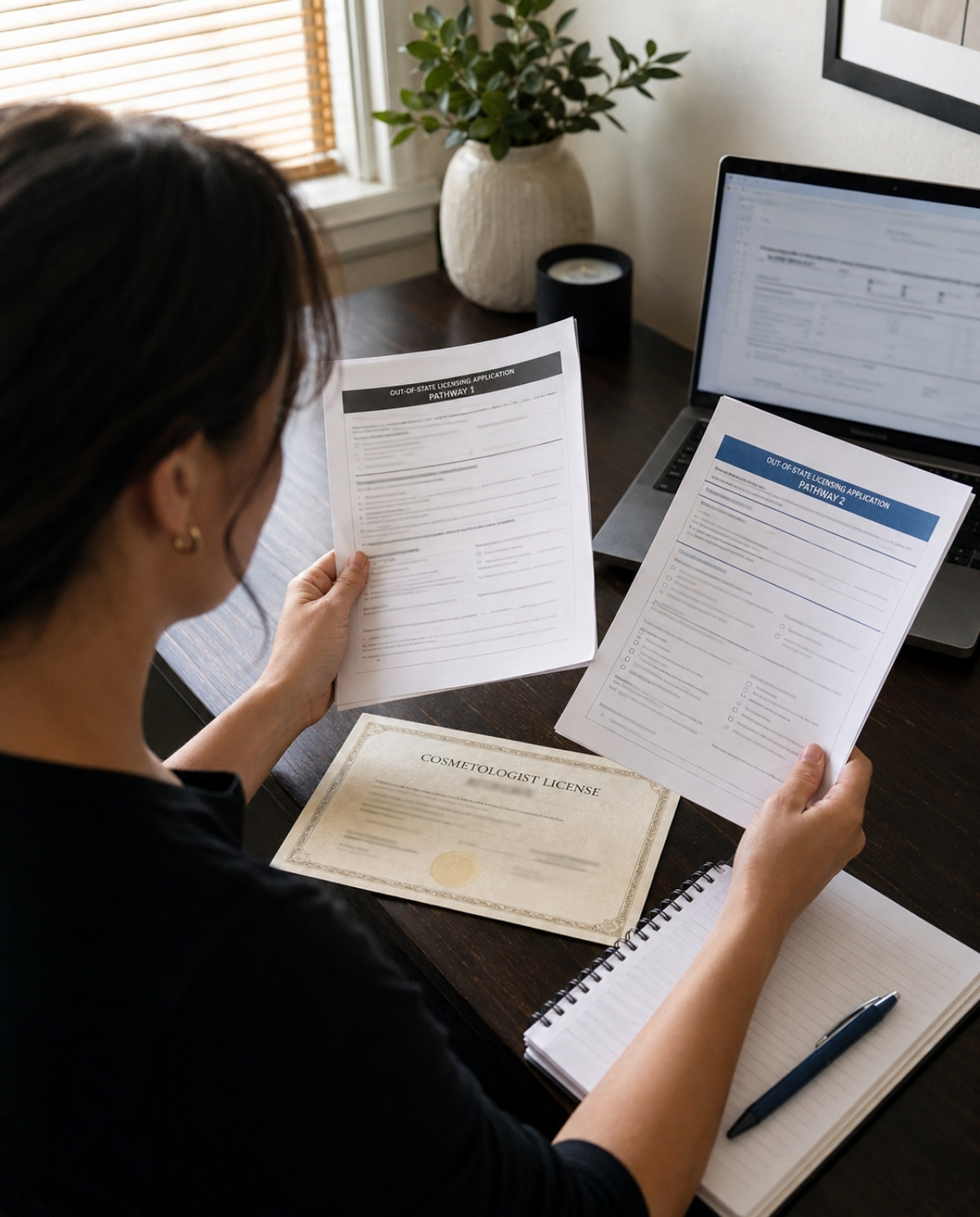
When researching how to handle a cosmetology license transfer from state to state, you will frequently encounter two terms: reciprocity and endorsement. Although these terms are sometimes presented as completely separate processes, state boards do not use them consistently.
Reciprocity may refer to a state recognizing a license issued by another jurisdiction. In some professions, it involves a formal agreement between two states. In cosmetology, however, a board may use the word “reciprocity” for its general out-of-state licensing pathway even when no two-way agreement exists.
Endorsement usually means that the destination board issues you a new license based partly on the credential you already hold. Depending on the state, the board may evaluate your license status, original training, examination history, work experience, disciplinary record, or a combination of these factors.
The differences can be seen in official board terminology. The Georgia State Board of Cosmetology and Barbers states that Georgia does not reciprocate with another state but allows actively licensed professionals to apply by endorsement. Meanwhile, the Nevada State Board of Cosmetology calls its out-of-state process reciprocity.
Because the labels are not standardized, focus on the destination board’s actual application requirements rather than assuming the name of the pathway tells you how it works.
Many boards now accept online applications, but supporting documents may still need to be sent separately. A licensing board, beauty school, examination provider, or former employer may have to submit records directly on your behalf.
How the Cosmetology Licensure Compact Will Work
The Cosmetology Licensure Compact is designed to create another pathway for qualified cosmetologists who want to practice in multiple participating states. However, it is important to distinguish between states enacting the compact and cosmetologists being able to use it.
According to the Council of State Governments National Center for Interstate Compacts, twelve states have enacted the compact: Alabama, Arizona, Colorado, Delaware, Kansas, Kentucky, Maryland, Ohio, Pennsylvania, Tennessee, Virginia, and Washington.
The official Cosmetology Licensure Compact website states that the compact is not yet operational. Participating states are not currently issuing multistate cosmetology licenses, so professionals must continue using each destination state’s existing reciprocity or endorsement process until implementation is complete.
Once operational, the compact will allow an eligible cosmetologist to apply for a multistate license through the cosmetologist’s home state. To qualify, the applicant must live in a compact member state, hold an active and unencumbered cosmetology license issued by that home state, and pay the required fees.
An unencumbered license is an active license that is not currently suspended, revoked, restricted, or subject to conditions limiting the professional’s ability to practice. It does not necessarily mean that the person has never had a resolved complaint or disciplinary matter.
A multistate license will authorize practice in other compact states, but professionals must still follow the scope-of-practice, safety, and conduct rules of the state where each service is performed.
Requirements Commonly Reviewed During a License Transfer
Every licensing board establishes its own requirements for protecting client safety and determining whether an out-of-state professional qualifies for licensure. When reviewing cosmetology license transfer from state to state requirements, expect the destination board to consider some combination of the following:
- License Status: Many reciprocity or endorsement pathways require a current license in good standing. If your license has expired, the destination state may instead direct you to an examination, reinstatement, or alternative licensing pathway.
- Official License Certification: The destination board may require an official record showing your license type, status, issue date, examination history, and any disciplinary action.
- Education and Examination Records: Some boards request school transcripts, curriculum records, or proof that you passed a national or state-approved examination.
- Identity and Legal Disclosures: You may need to provide government-issued identification, a Social Security number or another accepted tax identifier, lawful-presence documentation, and disclosures concerning criminal convictions or professional discipline.
- State-Specific Examinations: Even when a state accepts your professional examination, it may still require a separate test covering local laws, sanitation rules, or professional regulations.
- Application and Related Fees: Costs vary widely. In addition to the application fee, you may have to pay for license certification, examinations, fingerprints, document translation, or a temporary permit.
For example, Nevada currently charges a nonrefundable fee of $325 for a reciprocity application and requires applicants to pass a 25-question Nevada State Law Test with a score of at least 75 percent. These requirements are published by the Nevada State Board of Cosmetology.
Before submitting an application, review our comprehensive breakdown of cosmetology license requirements by state for a broader comparison of hours, examinations, renewals, and transfer policies. Always confirm the final requirements through the destination board because statutes, fees, and application procedures can change.
Why Official License Certification Matters
A photocopy of your wall license usually does not provide all the information a destination board needs. Boards may require an official certification showing when your license was issued, whether it is active, how you originally qualified, and whether it has ever been restricted or disciplined.
The method used to obtain that certification depends on the states involved. California generally requires certification to be sent directly from the issuing state, as explained in the California Board of Barbering and Cosmetology reciprocity FAQ.
Nevada uses a more varied system. Its board can verify licenses online for applicants from many states, while applicants from certain other jurisdictions must arrange for direct certification. This is why you should not assume that every state rejects applicant-submitted documents or that every transfer requires the same board-to-board process.
Processing time also varies. Missing certifications, incomplete examination records, name discrepancies, disciplinary reviews, and documents from multiple states can all delay an application. Request required records early, but rely on the destination board’s current processing notice rather than a single national timeline.
What Happens When Your Training Hours Do Not Match
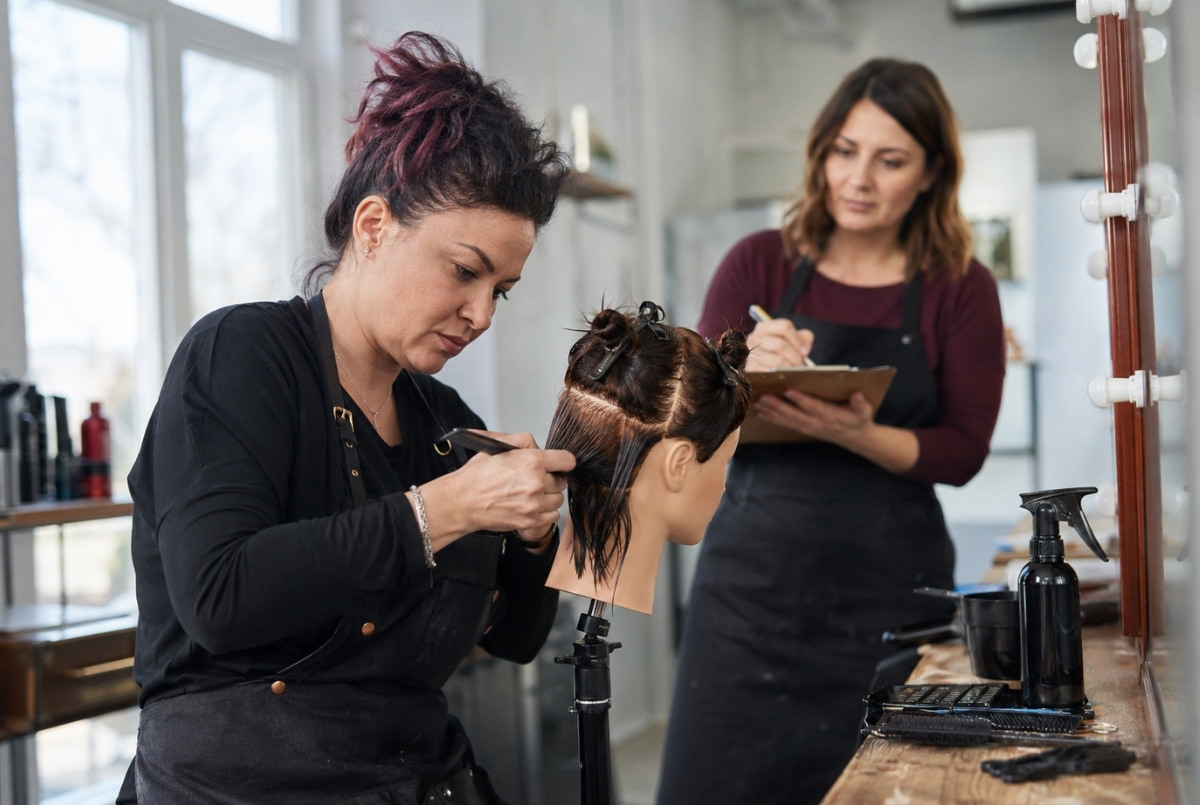
A difference in school hours may influence a transfer application, but it does not automatically create an hour-for-hour deficit that must be completed in another school.
For example, New York requires 1,000 hours for its cosmetology school pathway, while Georgia requires 1,500 hours for applicants completing a Georgia cosmetology program. However, the difference does not mean that every New York licensee moving to Georgia must return to school for another 500 hours.
According to the Georgia State Board of Cosmetology and Barbers, an applicant who is actively licensed in another state may apply by endorsement even if the applicant completed fewer school hours than Georgia requires.
This distinction is important. Initial education requirements describe how a new applicant qualifies within a state. Endorsement rules describe how that state evaluates someone who is already licensed elsewhere. Those two pathways do not always impose identical requirements.
Depending on the destination state, an applicant with fewer original school hours may qualify through one of the following mechanisms.
1. Recognition of an Active Out-of-State License
Some states place greater weight on whether you already hold a current unrestricted license than on whether your original training-hour total exactly matches the state’s current school requirement.
California provides a clear example. Its board may issue a license through reciprocity without requiring the California written examination when the applicant holds a current out-of-state license that is active, unrestricted, and in good standing. The current requirements are explained in the California Board’s reciprocity guidance.
This does not mean education is irrelevant. The destination board may still review how the original license was obtained, especially if it was itself issued through reciprocity.
2. Credit for Verified Work Experience
Some states allow verified professional experience to compensate for part of a training difference or help an applicant qualify through an examination-based pathway.
There is no national conversion formula. Each state decides how much experience is accepted, how it is calculated, and which records are sufficient. California, for example, states that each three months of qualifying practice may count as the equivalent of 100 hours of training for certain out-of-state examination applicants. This formula appears in the California Board’s license requirements.
If your destination state accepts experience credit, it may ask for employer affidavits, tax records, pay statements, business records, or license-history documentation. Do not collect or submit these records unless the board’s application specifically requests them.
3. Supplemental Education
If the destination board determines that additional education is required, you may not have to repeat the entire cosmetology program. A state-approved school may be able to evaluate your previous transcript and accept eligible transfer hours.
However, neither the applicant nor the school can assume that every previously completed hour will transfer. The destination board’s rules and the receiving school’s approved transfer policy determine how much credit can be awarded.
Before enrolling, ask the destination board whether supplemental hours are required, which subjects must be completed, and whether the education must take place at a school approved by that state. Whenever possible, obtain the answer in writing before paying tuition.
4. State Law or Additional Examinations
In some cases, the issue is not the total number of hours but whether the applicant has demonstrated knowledge of the destination state’s laws or passed an acceptable professional examination.
Nevada requires reciprocity applicants to pass its state-law test. Georgia may require an additional examination if the applicant cannot document passing an accepted written and practical examination. Other states may require only a theory test, a practical test, a jurisprudence test, or a combination of examinations.
These requirements are separate from school-hour totals and should be checked early in the relocation process.
Why Hour Requirements Tell Only Part of the Story
It is tempting to compare two numbers and assume that the difference determines whether a license will transfer. In reality, boards may also evaluate license status, years of practice, original examinations, license title, and scope of practice.
A cosmetology license issued by one state may not authorize exactly the same services as a similarly named license elsewhere. Nevada, for example, warns that it does not recognize certain Florida Full Specialist credentials because their training and scope are not comparable to Nevada’s separate nail-technology and esthetics licenses.
This is why applicants should compare license categories and legally permitted services, not just total school hours.
Current State Examples
The following examples demonstrate how differently states can evaluate out-of-state professionals:
- Georgia: The Georgia State Board of Cosmetology and Barbers states that Georgia does not reciprocate with other states. An actively licensed professional in good standing may instead apply by endorsement, including someone who completed fewer school hours than Georgia requires. Additional examinations are generally not required when the applicant can prove that they passed a national or state-approved written and practical examination in English. If the applicant has held licenses in multiple states, Georgia requires verification from every state in which the applicant was licensed. Georgia licensees generally complete five continuing education hours for renewal, although the state provides exemptions for certain licensees. Under the current Georgia rules, three of the five hours must cover approved health and safety education, while the remaining two may cover approved professional subjects.
- Arkansas: Arkansas uses a 1,500-hour education requirement for its initial cosmetology school pathway, but out-of-state professionals should follow the separate reciprocity process published by the Arkansas Department of Health Cosmetology Section. Applicants should use the current reciprocity form rather than assuming that the initial 1,500-hour requirement automatically applies as an hour-for-hour deficit. Current Arkansas testing information also includes a state-law component, as shown in the Arkansas cosmetology candidate bulletin. Because examination and documentation requirements may depend on how the original license was obtained, applicants should obtain an individual determination from the Cosmetology Section before completing additional school hours.
When You May Have to Take Another State Board Exam
Whether you must take another written, practical, or state-law examination depends on the destination board—not simply on the company or organization that developed your original test.
Many states use one or more examinations developed by the National Interstate Council of State Boards of Cosmetology, commonly known as NIC. However, NIC adoption is not uniform. A state may use the NIC written examination, the NIC practical examination, both components, or a different testing system.
Passing an NIC examination in one state does not guarantee automatic score acceptance in another. The destination board decides whether your previous examination satisfies its current requirements and whether official score verification is needed.
The NIC testing maps demonstrate the mixture of state boards and examination providers used across the country. Before moving, ask the destination board these questions:
- Which written and practical examinations do you accept for endorsement or reciprocity?
- Must the examination have been taken in English?
- Does the original board or testing provider need to send an official score report?
- Is a separate state-law or jurisprudence examination required?
- Will I need to retest if my original state did not require a practical examination?
Georgia, for example, does not require additional testing when an endorsement applicant can document passing a national or state-approved written and practical examination in English. Nevada, by comparison, requires its state-law test and may require other examinations depending on the applicant’s qualifications.
California illustrates why broad statements about “NIC states” and “non-NIC states” can be misleading. California stopped requiring practical examinations for its license types on January 1, 2022, as explained by the California Board of Barbering and Cosmetology. At the same time, qualifying out-of-state licensees may obtain a California license through reciprocity without taking the California written examination.
If you do need to test again, our cosmetology state board exam guide provides a refresher on written and practical testing formats. You should still obtain the current candidate bulletin for your destination state because the tested components and procedures may differ.
Why Your Original Examination Records Matter
Your license card may not identify which examination components you passed. If the destination board requires proof of a written, practical, national, or state-approved examination, you may need an official score report or a license certification containing that information.
This is especially important if you have been licensed for many years, your original testing company has changed, or you obtained your current license through reciprocity rather than examination.
Requesting these records before your move can help you determine whether additional testing is necessary while you still have access to your school, original licensing board, and examination provider.
A Step-by-Step Checklist for a Smoother Transfer

To keep your relocation organized and reduce the risk of an unexpected employment gap, follow a logical preparation timeline:
- Identify the Correct License Category: Confirm that your current license corresponds to the license you want in the destination state. Compare both the title and legal scope of practice.
- Read the Official Application Checklist: Visit the destination board’s website to review its current endorsement, reciprocity, or out-of-state application requirements.
- Confirm Your Examination History: Determine which written and practical examinations you passed and whether the destination board accepts them.
- Request Official License Certification: Follow the destination board’s instructions for online verification or direct certification from every relevant licensing state.
- Gather Additional Records Only When Required: These may include school transcripts, curriculum records, examination scores, name-change documents, employer affidavits, tax records, disciplinary orders, or certified translations.
- Ask How Hour Differences Are Evaluated: Do not enroll in supplemental education until the board confirms that additional hours are necessary and explains how many hours will be accepted.
- Submit the Application and Required Fees: Include every required form and monitor communications for deficiency notices or requests for additional information.
- Keep Your Existing License Active: When possible, avoid allowing your current license to expire before the destination license is issued. Many simplified transfer pathways require an active credential.
- Wait for Legal Authorization to Work: An application receipt, pending status, or exam approval does not necessarily authorize you to perform services. Begin working only after the destination license or a valid temporary permit has been issued.
Additional Options for Military Families
Active-duty service members and military spouses may qualify for expedited processing, temporary recognition, reduced fees, or other portability protections. These pathways are separate from ordinary reciprocity and endorsement rules.
Federal and state protections depend on factors such as military orders, residency, license status, and whether the destination state considers the professions substantially similar. Military applicants should review both the destination board’s military guidance and any applicable federal portability rules before submitting a standard transfer application.
How Foundational Training Supports Career Mobility
Navigating transfer rules highlights a fundamental industry truth: your initial education and recordkeeping can affect your professional mobility for years to come.
Completing a program approved by the appropriate state licensing authority helps establish that your education met the requirements for your original license. Accreditation may offer separate educational or financial-aid benefits, but it does not guarantee that another state will accept every training hour or issue a license automatically.
A strong program does more than prepare students to perform technical services. It builds knowledge of sanitation, chemical safety, professional conduct, client consultation, and the boundaries of a cosmetologist’s legal scope of practice.
Maintaining complete records is equally important. Keep copies of your official transcript, curriculum description, examination results, original license information, name-change documents, and continuing education certificates. These records may become difficult to obtain years after graduation.
If you are just starting out or planning your next professional move, exploring what to do after cosmetology school can help you align your education, licensing steps, and first professional experience with your long-term career goals.
Frequently Asked Questions
How long does it take to transfer a beauty license to another state?
There is no standard national processing time. The timeline depends on the destination board, the completeness of your application, license-verification procedures, examination requirements, and whether your history requires additional review.
Missing records, inconsistent names, licenses from multiple states, or unresolved disciplinary documents can extend the process. Check the destination board’s current processing notice before making employment commitments.
Can I work while my transfer application is being processed?
Only if the destination state has issued you a license, temporary permit, or another form of legal authorization that allows you to perform services.
An application receipt or pending portal status generally does not provide permission to work. Practicing without the required authorization can lead to fines, disciplinary action, or problems with your pending application.
What should I do if my original state required fewer hours?
Do not assume that you must immediately return to school. Ask the destination board how it evaluates actively licensed out-of-state applicants.
Depending on the state, you may qualify through recognition of your existing license, accepted examinations, verified work experience, supplemental school hours, or another endorsement pathway. Obtain a written determination before paying for additional education.
Do NIC examination scores transfer automatically?
No. Previous NIC examination results may satisfy another state’s requirements, but acceptance is not automatic. The destination board decides which examination components it recognizes and whether it needs official score verification or additional testing.
Does a cosmetology license cover esthetics and nail services in every state?
No. A cosmetology license commonly includes some hair, skin-care, and nail services, but the exact scope varies by state and may be narrower than the scope of a separately licensed esthetician or nail technician.
Advanced exfoliation, lasers, certain cosmetic devices, and deeper chemical treatments may require separate credentials or may be restricted to medical professionals. Always follow the scope-of-practice law of the state where the service is performed.
Will the Cosmetology Licensure Compact let me work in every member state?
Not yet. Although twelve states have enacted the compact, multistate cosmetology licenses are not currently available. Until the compact becomes operational, professionals must continue using each destination state’s existing licensing process.
Once implementation begins, eligibility will depend on factors including residence in a compact state, an active unencumbered home-state license, and payment of the required fees.
Build a Career That Can Move With You
At Atlanta Beauty Academy, we do not just train you for an exam. We prepare you to build practical skills, understand professional safety, and approach your career with long-term independence in mind.
With over 20 years of experience, our salon-ready curriculum supports students as they develop strong foundational skills, technical confidence, and respect for the licensing standards that govern professional beauty services. Although no school can guarantee that a license will transfer automatically to every state, beginning with complete training and maintaining accurate records can make future licensing applications easier to navigate.
Fill out the form below to connect with our admissions team, tour our modern campus, and learn more about preparing for a professional future in beauty.