You’ve likely spent hours perfecting builder gel extensions or scrolling through advanced nail art tutorials. You have the artistry down, but a persistent question remains as you eye a professional pivot:
"Do I need a certificate to be a nail technician?"
It’s a valid concern. In the current "gig economy," the line between hobbyist and professional often feels blurred. However, in 2026, that line is being reinforced by new federal safety standards and a consumer base that demands clinical-grade accountability. Moving from your kitchen table to a high-end salon isn't just about talent - it’s also about navigating the legal requirements for nail technicians to ensure your business is unshakeable. For those who are still in the early research phase, exploring a
beginner’s guide to launching a nail career in 2026 can provide the foundational context you need before diving into the legalities of licensure.
Key Takeaways
- License vs. Certificate: A certificate is an educational milestone; a nail technology license is the legal requirement to charge for services in 2026.
- The "Safety Premium": 22% of modern consumers now choose technicians based strictly on medical-grade sanitation credentials.
- Total Transparency: At Atlanta Beauty Academy, the Nail Technician program is $3,750 total, covering tuition, your professional kit, and all student fees.
- Federal Compliance: The 2026 full enforcement of MoCRA requires all professionals to understand product safety and chemical labeling.
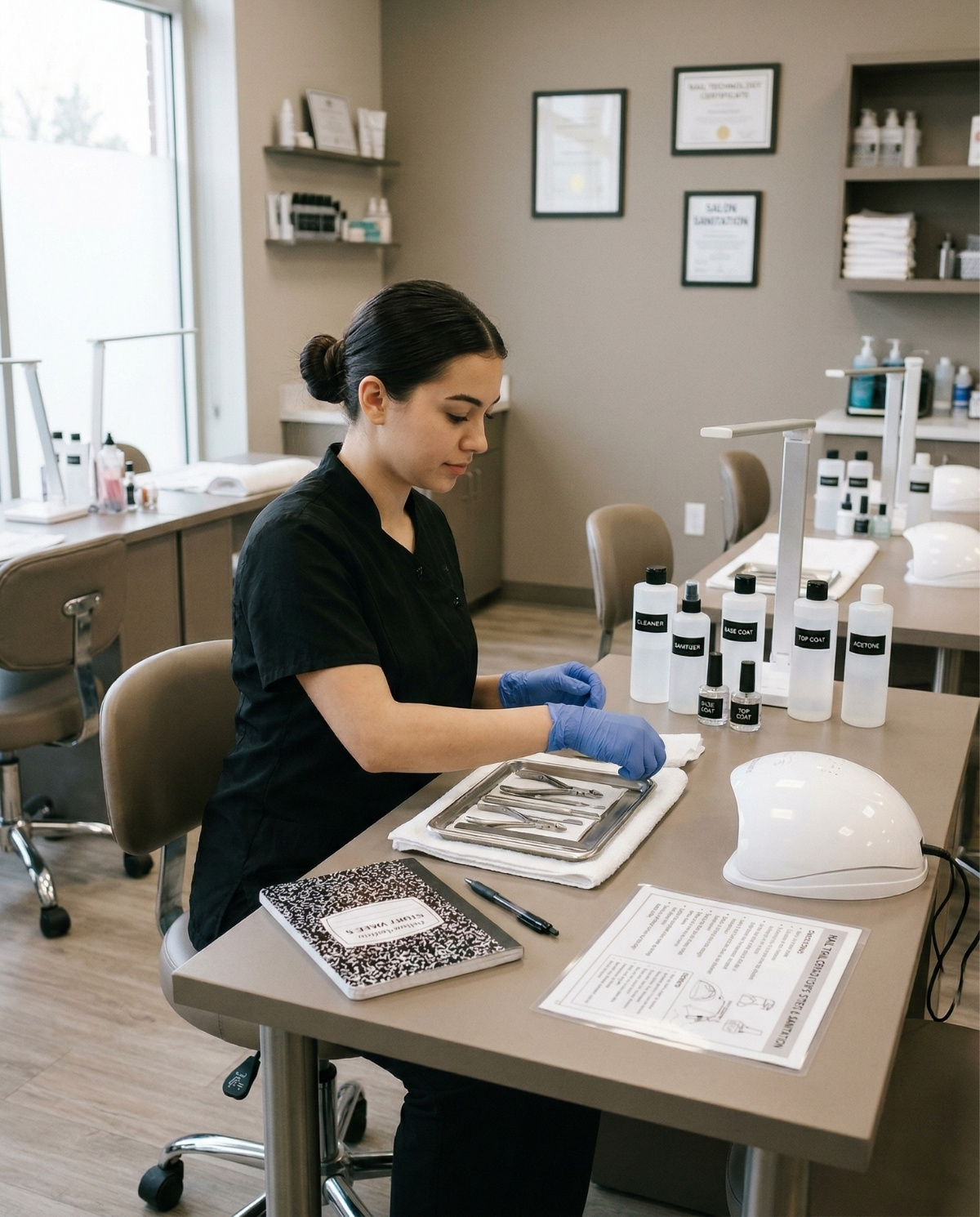
The Legal Blueprint: Why a "Certificate" Isn't a "License"
One of the most expensive mistakes a newcomer can make is confusing a diploma with a permit to practice.
Scope of Practice vs. Educational Milestones
When you ask, "Can I do nails with a certificate?" the answer depends on your definition of "doing nails." You can certainly practice on friends with a certificate of completion from an online workshop. However, to legally exchange services for money in a commercial setting, you must hold a nail technology license issued by your state’s Board of Cosmetology.
A nail technician certificate proves you finished a course; a license proves you are legally compliant with state health codes. If you start with a state approved nail technician program, your credentials gain "portability" through initiatives like the
Interstate Cosmetology Compact, which allows licensed professionals to move between participating states more fluidly in 2026 without retaking the entire board exam.
Federal Oversight: The 2026 Safety Shift
The landscape changed significantly this year with the full enforcement of the
Modernization of Cosmetics Regulation Act (MoCRA). The FDA now requires "professional-use" products to meet stricter safety substantiation.
According to the
U.S. Food & Drug Administration, federal oversight now demands that technicians understand the chemical volatility of the polymers they use. Being a "certified" professional in 2026 means you aren't just an artist; you are a safety officer. Operating without a state-issued license now carries higher federal liability than ever before.
The Education Path: Hours, Chemistry, and the "Final Boss"
Choosing a nail technology program is your first major business decision. Before you commit your time and tuition, it’s also helpful to
compare a specialized nail tech program against a full cosmetology license to see which career path better aligns with the services you actually want to offer.
Clock Hours vs. Competency
How long is a nail program? In 2026, most states have shifted toward a "competency-based" model, but you are still generally looking at 300 to 600 hours of training. If you are a "Fast-Tracker" wondering how long it takes to train as a nail technician, expect a 3-month sprint for full-time students or a 6-month marathon for those working part-time.
For those looking to "earn while they learn," a nail technician apprenticeship is a viable path in some states. However, be cautious: apprenticeship hours are often double the school requirements, and you miss out on the structured nail technology theory - like learning how to protect the lipid barrier during clinical-grade exfoliation - that is vital for passing the written state exams.
Prepping for the State Board
To beat the "Final Boss," top-tier manicuring schools now utilize AI-driven nail technology state board practice tests. These simulators mimic the 2026 exam format, focusing heavily on blood exposure incidents and chemical storage. If your school doesn't offer a rigorous nail technology exam prep, you’re essentially flying blind.
The Financial Blueprint: Tuition vs. Lifetime Value
Let’s address the "Debt Trap" anxiety.
How much is nail technology school?

Calculating Total Cost of Attendance (COA)
A common mistake is looking only at "tuition" and forgetting the other essentials required to actually graduate and work. For a high-quality, comprehensive education, you should look at the
Total Cost of Attendance (COA).
At
Atlanta Beauty Academy, we believe in total transparency. For our
Nail Technician program, the total investment is
$3,750. This isn't just a random number; it is a "Salon Ready" bundle that includes:
- Core Tuition: $2,600 for your expert-led instruction.
- Professional Kit & Books: A $600 value ($400 kit + $200 books) ensuring you have high-quality tools that meet school standards from day one.
- The Essentials: Registration, an online portal for modern learning, and your graduation fee.
By including the $400 professional kit in the COA, we ensure you aren't hit with unexpected expenses later. Buying these professional tools individually can be a significant added cost, so having them integrated into your program ensures you start your career with the right equipment.
Offsetting Your Investment
To make this career transition accessible, 2026 offers more paths to funding than ever before:
- Expanding Pell Grant Access: The federal landscape is shifting. Under the new Workforce Pell framework, the U.S. Department of Education is expanding access to short-term career training. While this expansion is slated to take full effect starting July 1, 2026, we recommend speaking with our financial aid office now to see how these evolving federal rules may apply to your enrollment.
- National Scholarships: Many students also look to organizations like Beauty Changes Lives, which offers a variety of scholarships specifically for nail technology students. These awards are designed to help the next generation of professionals enter the industry with less financial burden.
- Manageable Payment Plans: We understand that a lump-sum payment isn't always feasible. To help you maintain your lifestyle while you study, Atlanta Beauty Academy offers internal installment plans. We provide a minimum monthly payment option of $400, allowing you to pay for your education in steady increments as you progress toward your license.
The 2026 Career Outlook: High-Earning GEO Pockets
The 2026 market isn't looking for "cheap" manicures; it's looking for "safe" ones. According to recent data from
Business Research Insights, 22% of consumers now specifically seek out licensed technicians because they are worried about salon hygiene. This "Safety Premium" is a major driver of modern salon revenue.

The Salary Reality Check
When we look at what you can actually earn, the numbers for 2026 show a significant upward trend for licensed professionals. Based on
Indeed’s real-time data updated March 16, 2026, the financial landscape for nail technicians is diverse:
- The National Average: The average base salary for a nail technician in the United States is currently $23.68 per hour.
- The Earning Range: While entry-level roles may start around the $11.05 mark, top-tier professionals in the industry are commanding base rates as high as $50.73 per hour.
- High-Demand Pockets: In specific high-traffic luxury markets and specialized "boutique" areas, hourly rates can skyrocket even further - with some regions reporting specialized rates as high as $94.94 per hour.
- Total Compensation: It’s important to remember that these figures represent base pay. In the beauty industry, your total take-home pay is often significantly bolstered by tips, product commissions, and specialized service premiums.
By focusing on high-demand skills and maintaining your licensure, you move from the "average" bracket into the "high-earner" tier where you have the power to set your own worth.
Ready to Turn Your Passion Into a Professional Legacy?
You’ve seen the data, and you understand the 2026 legal landscape. Now, the only question is:
Where will you build your foundation?
At
Atlanta Beauty Academy, we don’t just prepare you to pass an exam; we prepare you to lead the industry. With
over 20 years of experience anchoring our curriculum, we’ve seen trends come and go, but our commitment to student success remains the industry gold standard.
We know the "Debt Trap" and "Imposter Syndrome" anxieties are real. That’s why our signature
Salon Ready approach focuses on the transition from the classroom to the chair. We bridge the gap between student life and professional reality by teaching:
- Business Sovereignty: How to manage your book and command "Safety Premium" rates.
- Chemical Literacy: Mastering the MoCRA-compliant safety standards.
- Speed & Precision: Developing the technical efficiency required to thrive.
Come see our 20+ years of experience in action. Feel the energy of our clinic floor, meet our seasoned instructors, and visualize yourself as the next success story in our legacy.
Your professional journey starts with a single conversation. Fill out the form below this article, and let’s map out your path to career freedom together.
FAQ: People Also Ask
What is the difference between a Level 2 and Level 3 nail technician certificate? Level 2 is your "Entry to Practice" (standard enhancements). Level 3 is "Mastery," covering complex electric filing, medical-grade sanitation, and advanced chemical composition.
Can I go to nail school online in 2026? Hybrid models are popular. You can complete your nail technology theory online, but you must complete your "hands-on" hours in a physical manicuring school or salon to qualify for licensure.
What is the "Interstate Compact" I keep hearing about? It's a 2026 initiative allowing licensed techs to work in multiple states without retaking the board exam. It makes your nail technology license a truly mobile asset.