

How to Get Your Esthetician License: State Boards, Exams, and Transfer Rules Explained
Navigating the licensing process is the first real test of your beauty career. You are not just learning how to map a face or apply a chemical peel; you are stepping into a tightly regulated professional field where training hours, exams, and legal scope of practice can change dramatically from one state to the next. From decoding endorsement rules to surviving the infection control portion of your state board, the bureaucracy can feel like a maze.
Let us cut through the confusion. Here is the exact, fluff-free breakdown of how to navigate schooling, pass your boards, and secure the legal freedom to build your practice wherever your license allows.
Key Takeaways
- Hours Vary Sharply by State: Required training can be as low as 220 hours in Florida for a Facial Specialist registration and as high as 1,000 hours in Alabama and Georgia.
- Online Theory Exists, But Hands-On Training Still Matters: Some schools offer theory online, but licensure still typically requires in-person practical training at a state-approved program and successful completion of required exams.
- NIC Exam Prep Still Revolves Around Safety: The NIC theory exam contains 110 items, with 100 scored, and NIC notes that blood exposure procedures are being updated beginning March 2026.
- Portability Is Improving, But It Is Not Automatic: Many states already allow endorsement or equivalency pathways, but the Cosmetology Licensure Compact is not yet active and currently applies to cosmetologists, not as a live esthetics reciprocity shortcut.
What Does It Actually Take to Become a Licensed Professional?
Required Training Hours and Why They Vary
You cannot legally perform professional skin care services without official schooling and the credential your state requires. When you compare esthetics requirements by state, the first thing you notice is the disparity in required training hours. That difference is not random. It reflects how each board defines training standards, testing requirements, and scope of practice.
Some states require fewer hours for more limited foundational skin care services. Others require significantly longer programs before you can sit for licensure. That is why you must carefully review the state-by-state school hours and license type before enrolling.
Here is a look at verified current requirements from several major states:
- Florida: 220 hours for a Facial Specialist registration, not a traditional esthetician license title.
- New York: 600 hours plus both the written and practical examinations.
- Arizona: 600 hours for an aesthetician license.
- Texas: 750 hours.
- Alabama: 1,000 hours.
- Georgia: 1,000 hours.
When figuring out how many hours you need for esthetician training, remember that the hour count is only the legal minimum for testing eligibility. It does not automatically mean you are clinically prepared for a competitive medspa or advanced skin care setting. A strong beauty school should help you meet your licensing requirement and build practical confidence under supervision.
The Truth About Distance Learning and Tuition
Juggling a job while looking into school leads many students to ask: Can I get my esthetician license online? Here is the realistic answer: some programs may let you complete theory online, but licensure still centers on approved training, hands-on practice, and board-required testing. In states such as Texas and New York, the pathway still requires formal schooling and state exams. So while digital coursework can support flexibility, a fully remote path to licensure is not the norm.
According to recent distance learning standards, theory classes may be offered digitally by some schools. However, hands-on practical training remains the part that separates a license-eligible graduate from someone who has only completed classroom instruction.
As for the financial investment, students frequently ask how much it costs to get an esthetician license. Tuition generally ranges from $4,000 to $12,000. If you are mapping out your long-term goals and want a broader look at the complete esthetician career path and true cost of education, it helps to view tuition as the foundation of your business. How much you invest in training often affects your clinical exposure, equipment access, and how comfortable you feel working with real clients after graduation.
Passing the State Board: Practice Tests and Exam Preparation
Surviving the Written Theory Exam
Your esthetician written exam is heavily weighted toward safety, sanitation, infection control, and scientific fundamentals, not just spa technique. You will see topics like microbiology, skin structure, product chemistry, and state law.
Students constantly want to know how many questions are on the esthetician exam. If your state uses the NIC theory format, the current bulletin states that the exam contains 110 items, with 100 weighted toward your final score. Some states use their own testing structure or vendor workflow, so always confirm the current bulletin for your jurisdiction.
Relying on a frequently updated esthetician written exam practice test is non-negotiable. Passing this requires disciplined esthetics theory exam practice, with special attention to sanitation, infection control, and any state-specific laws your board tests.
The Hands-On Practical Exam
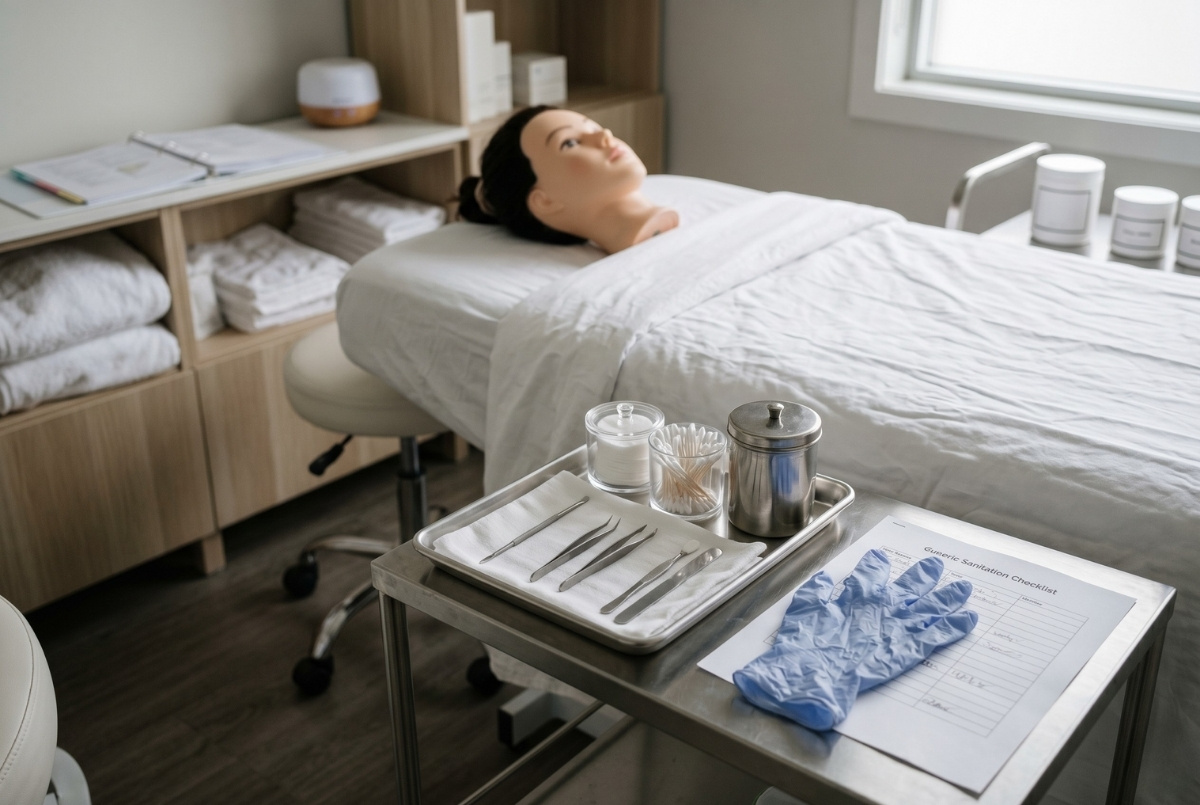
The esthetics practical exam is where many students feel the most pressure. Examiners are not looking for a luxurious spa performance. They are looking for safe procedure, organization, sanitation discipline, and correct responses to contamination risks.
This is exactly why understanding what esthetician school is really like day-to-day helps you build the muscle memory needed to perform sanitation steps without freezing under pressure.
Expert Insight: 2026 NIC Practical Exam Updates - As detailed in the NIC exam resources, blood exposure procedures are being updated beginning in March 2026 alongside exam revisions. That does not mean basic skills disappear. It does mean infection control remains central to practical exam success, and schools that drill these procedures consistently give you a major advantage.
If you are wondering what the passing score is for the esthetics exam, the honest answer is that passing standards vary by state and testing provider. Some states use percentage-based standards, while others use scaled scoring. Always check your current candidate bulletin rather than assuming one national cutoff applies everywhere.
Submitting Your Application and Background Checks
How to Apply After Passing Your Exams
Passing the tests does not automatically grant your credential. You must still complete the final application process through your state’s licensing agency.
For example, New York allows applicants to apply online and schedule exams through its licensing system, while Florida routes specialty registrations through the DBPR portal. Your school should help you assemble your transcript, proof of training, exam documentation, and government identification so nothing delays final issuance.
If you are unsure how to apply for an esthetician license after passing the exam, start with your state board’s official portal, not a third-party blog. That is where you will find the correct forms, fees, and current processing instructions.
Navigating Criminal History and Background Checks
Many prospective professionals carry the heavy anxiety of a past record, wondering: Can you get an esthetician license with a felony?
The answer depends entirely on the state. Some boards review criminal history on a case-by-case basis. For example, Texas states directly that criminal convictions are reviewed individually, and the agency also provides a criminal history evaluation process so applicants can request review before applying.
That means a past conviction does not automatically end your career. What matters is full disclosure, the nature of the offense, how much time has passed, and whether your board sees the history as relevant to public safety. If you have a record, the smartest move is to review your board’s own criminal-history guidelines before you spend money on school or licensure.
Moving States and Building an Independent Career
Understanding Reciprocity, Endorsement, and Transfers
Your career should not be trapped in one zip code. If you plan to relocate, you need to understand how your next state handles endorsement, equivalency, or universal recognition.
What many people casually call “reciprocity” is often really licensure by endorsement. That means your new state reviews your current license, training hours, work history, and exam record instead of forcing you to start school from scratch.
For example, New York allows endorsement for applicants already licensed in another jurisdiction. Virginia and its licensing requirement summary also show that out-of-state applicants may qualify through endorsement or universal recognition, depending on their hours and experience. The key is simple: transfer rules are real, but they are not identical from state to state.
Expert Insight: The Cosmetology Licensure Compact - This is where a lot of online content gets ahead of the facts. According to the official Cosmetology Licensure Compact, the compact has reached the legislative threshold for activation, but it is not yet active for licensees. The commission is still building the infrastructure needed to operate it. It is also designed for cosmetologists, so it should not be presented as a current esthetician workaround for state-by-state endorsement.
Renewing Your Credentials and Going Solo
Maintaining your legal status is usually straightforward, but the renewal cycle and continuing education rules depend on your state. For example, Florida renews facial specialist registrations every other year. If you get married or otherwise change your legal name, many states also provide formal update procedures through their online licensing systems, such as California’s name change process.
Ultimately, securing this license gives you real professional autonomy. The current Bureau of Labor Statistics skincare specialist profile notes that skincare specialists usually work in salons and spas, and that some are self-employed. Whether your goal is to work inside a luxury spa, alongside a dermatologist, or in your own studio, licensure is the legal foundation that makes those options possible.
Ready to Master Your Craft and Build Your Legacy?
You now know exactly what it takes to navigate the licensing process. The next step is finding an education partner that sets you up for long-term success.
At Atlanta Beauty Academy, our goal goes far beyond helping you pass a written exam. We focus intensely on your future opportunities. Whether your ambition is to manage a luxury spa, partner with a clinical dermatologist, or open your own private skincare studio, we provide the advanced foundation to make it happen.
We developed our signature Salon Ready approach to completely bridge the gap between classroom theory and the real world. You train on an active, fast-paced clinic floor using the same medical-grade equipment you will find in top-tier facilities. This intensive, hands-on experience guarantees you graduate with complete confidence in your techniques, strict sanitation protocols, and client communication skills. You leave our doors truly ready to take clients on day one.
With over 20 years of experience, we have proudly guided thousands of passionate students into lucrative, independent beauty careers. We invite you to become part of that legacy.
Fill out the contact form below to connect with our career advisors. We can map out your required state hours, discuss your tuition options, and schedule a tour of our clinic floor. Your new career starts right here.
Frequently Asked Questions
Do you need a license to be an esthetician? In the United States, you generally need the appropriate state credential to legally perform professional skincare services. The exact credential title varies. For example, Florida uses a Facial Specialist registration rather than a standard esthetician license title.
How many questions are on the esthetician state board exam? If your state uses the NIC theory format, the current exam contains 110 items, with 100 scored. State-specific testing formats can still vary, so always confirm your current candidate bulletin.
How do I look up where to get my esthetician license testing done? Your state board or testing vendor will provide the scheduling path. For example, New York handles application and exam scheduling through its licensing system, while Georgia directs examination candidates to PSI.
How do I find specific esthetician license requirements by state? Go straight to the official regulator. For instance, getting an esthetics license in NY means checking the New York Department of State, while transferring credentials into Virginia means reviewing the Virginia Board for Barbers and Cosmetology.