


What Is Esthetician School Like? What You Learn, How Long It Takes, and How to Prepare
You may have spent years as a dedicated skincare consumer, reading ingredient labels and refining your own routine. Moving from the bathroom mirror to a professional treatment room is a major shift. This transition turns a personal passion into a licensed career, and many prospective students feel both excitement and a little academic self-doubt as they wonder whether they can master the clinical theory, sanitation standards, and hands-on skills the profession requires.
This guide moves beyond clichés to show you the structured, skills-driven reality of modern esthetics education.
Key Takeaways
- Industry Growth: Employment for skincare specialists is projected to grow 7% from 2024 to 2034, faster than average for all occupations.
- Science-Driven Training: Modern esthetics programs increasingly emphasize skin barrier function, ingredient literacy, sanitation, and client safety alongside traditional treatment techniques.
- Compliance Matters: MoCRA has raised the importance of cosmetic safety and labeling awareness across the beauty industry, while state boards continue to enforce sanitation, licensing, and scope-of-practice rules.
- Flexible Pathways: Approved programs can range widely by state, from 220 hours in Florida facial specialty training to 1,000 hours in states such as Georgia.
- Earning Potential: Income varies widely by location, specialty, business model, and clientele; BLS reports a median wage of $19.98 per hour for skincare specialists, while some advanced or highly specialized roles may earn significantly more.
What Is Esthetician School Like?
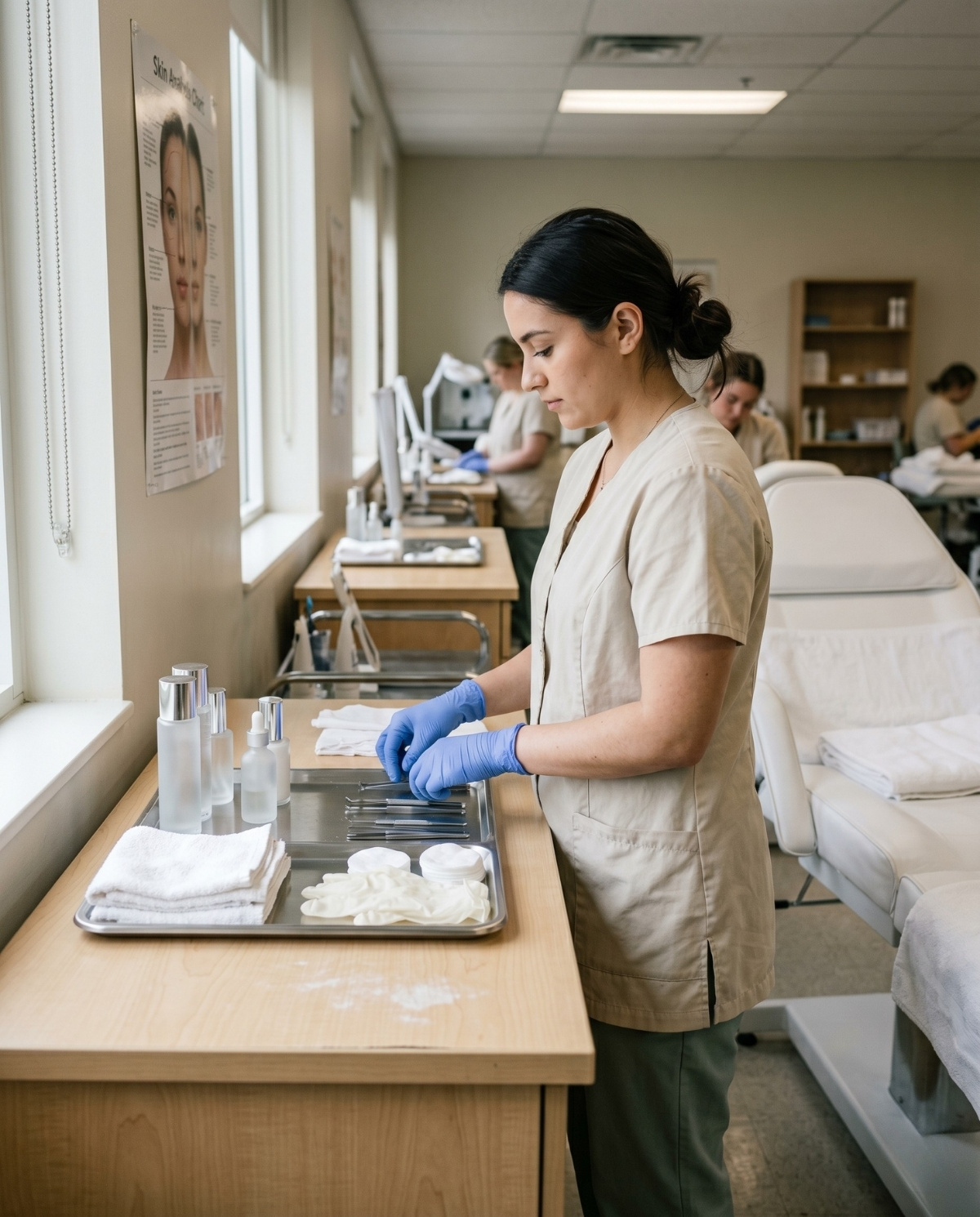
Modern esthetics training often feels less like a traditional lecture-based classroom and more like a professional clinic. A strong program blends theory with repetition: you study skin structure, infection control, product chemistry, and consultation methods, then apply that knowledge in supervised practice. Most days are built around a split between classroom instruction and hands-on student clinic work.
During training, students learn how to perform consultations, identify visible skin concerns within their scope, maintain sanitation standards, and deliver services safely and consistently. Programs commonly include facials, hair removal, brow and lash services, skin analysis, cleansing protocols, extractions, and retail/product education. Just as important, students learn the pace and discipline of professional practice, from tool disinfection and room setup to client communication and treatment documentation.
Demand for Faster, Lower-Cost Services
According to the U.S. Bureau of Labor Statistics, employment for skincare specialists is projected to grow 7% from 2024 to 2034. BLS also notes that demand is supported in part by services such as mini-sessions and mobile facials, which appeal to clients looking for convenience and lower-cost options.
The Science of the Barrier: What You Actually Learn
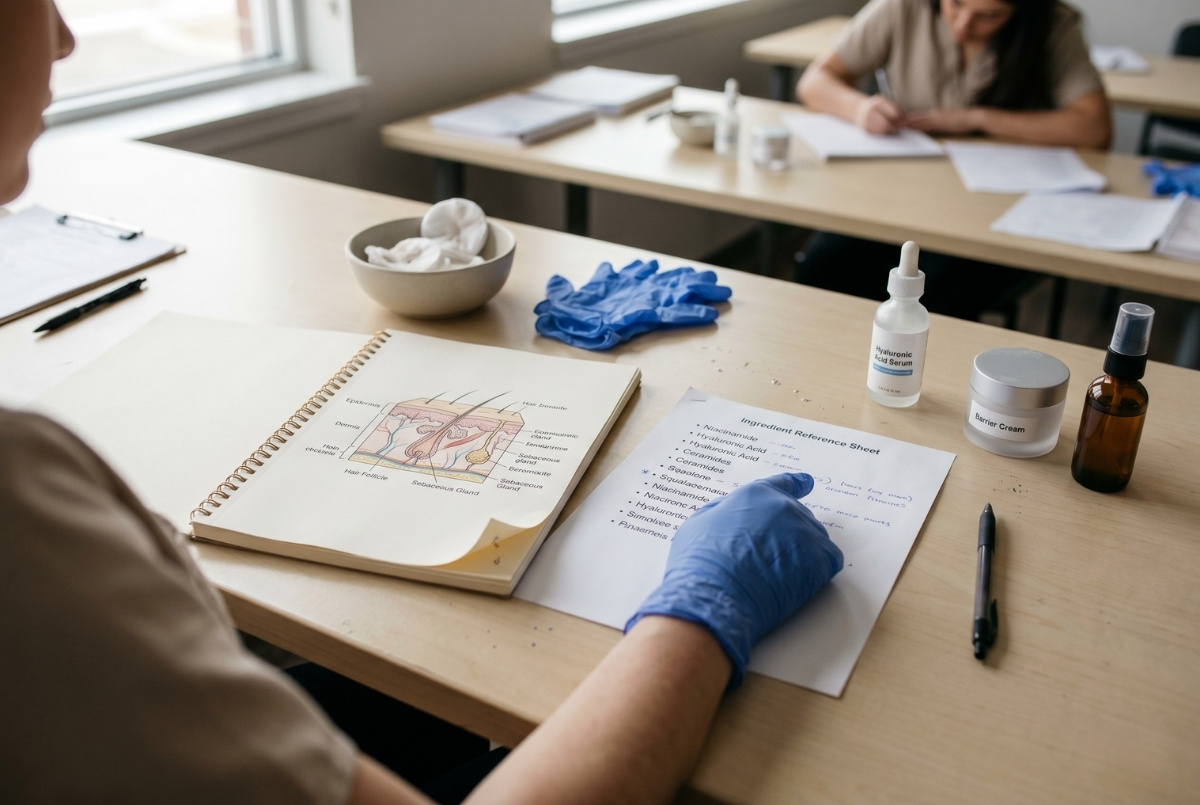
Many new students worry most about the hard science side of esthetics. In reality, that scientific foundation is what gives the profession its credibility. A quality program teaches not only how to perform services, but why certain products, ingredients, and treatment steps matter for skin health and client safety.
Biology, Chemistry, and Safety
Students typically spend significant time learning skin anatomy, barrier function, pH, product chemistry, ingredient interactions, contraindications, and sanitation. They also study when a visible condition may fall outside their scope and when a client should be referred to a physician or other licensed medical professional. Knowing these boundaries represents one of the most important parts of esthetics education.
Advanced Skill Development
Hands-on coursework usually covers cleansing methods, massage and facial movements, extractions, hair removal, lash and brow services, makeup fundamentals, and treatment customization. Students are trained to work precisely, protect skin integrity, and avoid unnecessary trauma. Even those who plan to focus on clinical-style skincare benefit from understanding how cosmetic products and professional-use products interact in real treatment settings.
The Logistical Roadmap - Hours, Costs, and States
The biggest logistical reality is simple: training requirements vary by state, and those rules shape how quickly you can graduate and apply for licensure.
- California: Esthetics remains a separate licensed category, while California schools commonly operate under the state’s post-SB 803 framework for revised beauty-program hour structures.
- Texas: 750 hours for an esthetician license.
- Florida: 220 hours for Facial Specialist; 400 hours for Full Specialist.
- Georgia: 1,000 hours for esthetician training.
- Arizona: 600 hours for aesthetics under current state requirements.
If speed matters to you, the fastest path depends on your state and your schedule. Some full-time programs can be completed in a matter of months, while others take closer to a year. Part-time evening or weekend formats can make school far more manageable for students balancing work or family. Theory may sometimes be offered in hybrid form, but state-approved practical training must still be completed in person.
Expert Insight: Compliance and Safety in 2026
The FDA’s Modernization of Cosmetics Regulation Act (MoCRA) has increased attention on cosmetic safety, recordkeeping, and adverse event oversight in the beauty industry. Estheticians primarily focus on safe work practices, recognizing reaction signs, and documenting incidents appropriately. Following state board rules, employer policies, and referral procedures ensures professional responsibility without necessarily requiring direct federal FDA reporting for every used product. Different obligations apply if an esthetician also owns or markets a cosmetic product as the responsible person.
Funding Your Education
Tuition varies significantly by school, location, program length, and included kit costs, but many esthetics programs fall somewhere in the several-thousand-dollar range. Checking with each school about what tuition covers, whether books and kits are separate, and if payment plans are available is a smart move. Not every school qualifies for federal aid, so students should verify that directly with the institution before assuming FAFSA eligibility.
For students watching costs closely, comparing total tuition, schedule flexibility, licensure preparation, and job-placement support can be more useful than looking at headline price alone.
Your First Day and Beyond
Before your first day, confirm your school’s admission requirements and your state’s training standards. In many states, students must meet minimum age and education requirements, but these rules differ. For example, Florida allows specialty registration applicants to qualify if they are at least 16 or already have a high school diploma.
Once enrolled, most students receive a professional kit containing textbooks, supplies, and practical tools used during training. Early practice may begin on mannequins or classmates, depending on the school and service type, before advancing into supervised clinic work with real clients. That transition is where confidence starts to build: you begin to connect theory, safety, and touch.
Your Final Hurdle
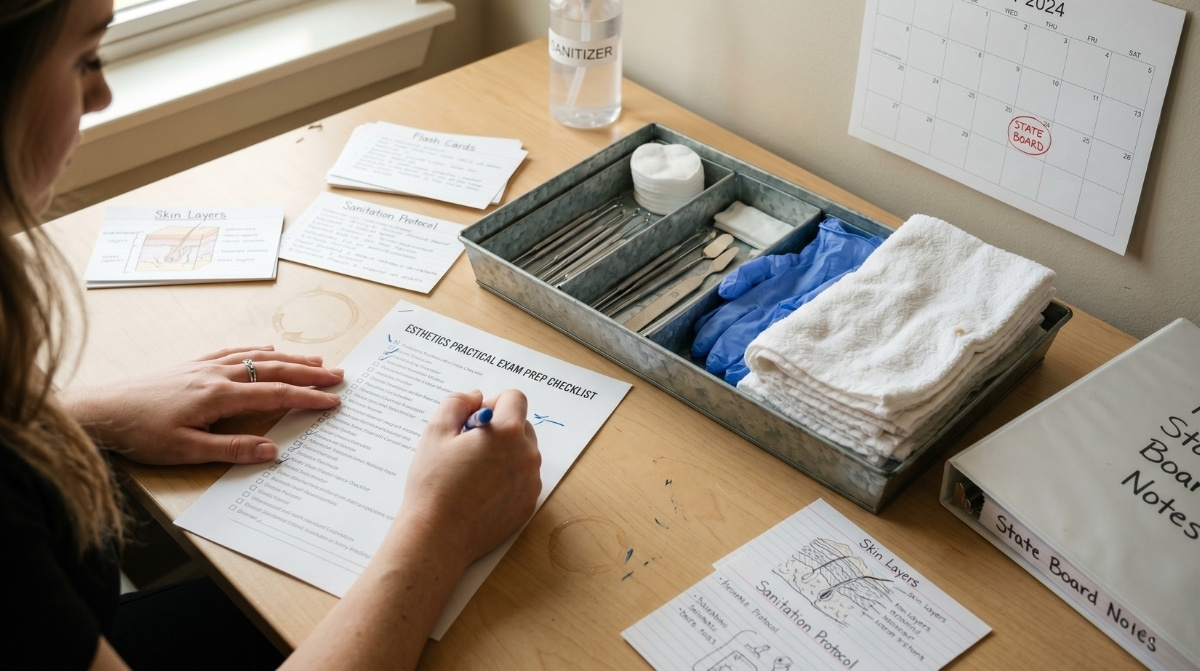
The last step is licensure. Depending on the state, that may involve a written exam, a practical exam, or both. Students usually spend the final portion of their program reviewing safety rules, infection control, service procedures, and state-law requirements. Passing the licensing process is what formally opens the door to legal practice.
Income after licensure can vary dramatically. According to the U.S. Bureau of Labor Statistics, skincare specialists had a median wage of $19.98 per hour in May 2025, with the highest-paid workers earning substantially more. Beauty Insurance Plus also points out that some specialized, luxury, or medically adjacent roles can reach much higher earnings, especially when commission, retail sales, or business ownership are involved.
Ready to Master Your Craft?
Choosing a beauty school involves more than satisfying a state-hour requirement. You are selecting an environment where you will build technique, discipline, and professional confidence. At Atlanta Beauty & Barber Academy, we focus on a “Salon Ready” approach designed to prepare students for the daily rhythm of real-world spa and salon work.
Whether your goal is to work in a spa, expand into advanced skincare services, or eventually build your own business, the right training environment matters. According to the school’s published information, Atlanta Beauty & Barber Academy brings more than 22 years of experience and a combined instructor experience of more than 80 years to its programs.
Proper training is the difference between simply learning procedures and building a lasting career. If you are ready to take the first step, the next move is to find a program that fits both your state requirements and your long-term goals.
Fill out the form below this article to schedule a tour of our campus or speak with an admissions coordinator about upcoming start dates. Your path toward licensure can start here.
FAQ: Professional Path Clarity
Can I attend school while working a full-time job? Many programs offer evening, weekend, or part-time schedules to make training more manageable for working adults.
Is it difficult to get accepted into esthetician school? Admission is usually based on meeting age, education, and school-specific enrollment requirements rather than on a competitive GPA.
Can a registered nurse attend esthetician school? Yes. Nurses sometimes pursue esthetics training to expand into skincare-focused or medically adjacent beauty settings, though the exact services they may perform depend on state law and licensure.
What distinguishes a basic esthetician from a master esthetician? That depends on the state. Some states use advanced or master esthetics designations with additional training and expanded service authority, while others do not use that license category at all.
Is a license required to perform services from a home-based studio? In most states, yes. Paid skincare services generally require proper licensure, and home-based operations may also need to meet local zoning, salon licensing, inspection, and sanitation requirements.