Key Takeaways
- More Than Hair: A complete cosmetology curriculum goes beyond cutting and styling to cover chemical texturizing, color theory, foundational skin care, nail care, and other beauty services.
- Science and Safety: You study anatomy, basic chemistry, infection control, product safety, and practical math. In the NIC Cosmetology Theory Examination, scientific concepts account for 35% of the exam.
- Business Skills: Professional training can include retailing, salon management, client service, and business fundamentals that prepare you for the realities of working independently or eventually managing a salon.
- State Requirements: Training requirements vary by state. Georgia and Arkansas, for example, both require 1,500 hours of cosmetology education, while the exact curriculum and licensing process differ between states.
Getting ready for a beauty career brings a mix of high hopes and quiet doubts. You picture yourself running a thriving salon or directing editorial shoots, yet you might silently worry about the reality of the training. Prospective students often fear the unknown workload and worry they will end up cutting basic layers all day without exploring their true creative passions. We completely understand those anxieties. If you are still on the fence, figuring out
how to decide if cosmetology is right for you can help you evaluate your long-term goals before committing. This guide breaks down the reality of the classroom, moving past the basic syllabus to show the blend of artistic technique, practical experience, science, safety, and professional skills you need to walk through our doors with confidence.
The Core Curriculum Behind the Art and Science

If you are wondering exactly what you learn from cosmetology school, the reality goes far beyond simple haircuts. A cosmetology program combines theory with practical training so you understand not only how to perform a service, but also why the technique works and how to perform it safely. At Atlanta Beauty Academy, our published
Master Cosmetologist program outline includes 1,500 hours covering hairstyling, haircutting, coloring, permanent waving, chemical relaxing, thermal styling, nail and skin care, anatomy, chemistry, bacteriology, sanitation, professionalism, retailing, equipment care, and salon management.
Hair remains a major part of the curriculum. You develop cutting and styling skills while learning how factors such as hair type, texture, density, facial shape, elevation, and design affect the finished result. The
NIC Cosmetology Theory Examination specifically includes haircutting and shaping, wet and thermal styling, natural hair styling, design principles, and procedures for different hair types and textures.
You also learn chemical texturizing, including permanent waving and chemical relaxing, by understanding how these services alter the structure of the hair. Color theory becomes another major component. Students learn formulation, lightening, color application, and how complementary colors can neutralize unwanted tones. The NIC theory blueprint even includes services such as foiling, balayage, color formulation, and color correction within its chemical-services content.
The Science Behind the Style
You might be surprised by how often math and science appear during a typical salon shift. Salon math is practical. Chemical products may need to be mixed according to specific manufacturer ratios, while accurate timing and application help produce predictable results and reduce unnecessary irritation or hair damage. Haircutting also uses concepts such as angles, elevation, over-direction, and proportion. Later in your career, business math can become useful when thinking about inventory, service costs, retail products, and profitability.
Science serves as the backbone of safe client care. According to the
National Interstate Council of State Boards of Cosmetology, scientific concepts make up 35% of the NIC Cosmetology Theory Examination. That domain covers infection control and safety, anatomy and physiology, hair, scalp, skin and nail conditions, basic chemistry, chemical interactions, chemical reactions, and the pH scale.
That knowledge has a practical purpose. You need to recognize conditions that may make a service unsafe, understand how cross-contamination happens, follow blood-exposure and disinfection procedures, and know how chemicals may interact before placing them on a client's hair or skin. Proper training does not mean you will encounter every possible salon situation in school, but it gives you a framework for recognizing risks, following professional procedures, and knowing when a service should not proceed.
Expanding Your Skills Beyond Hair
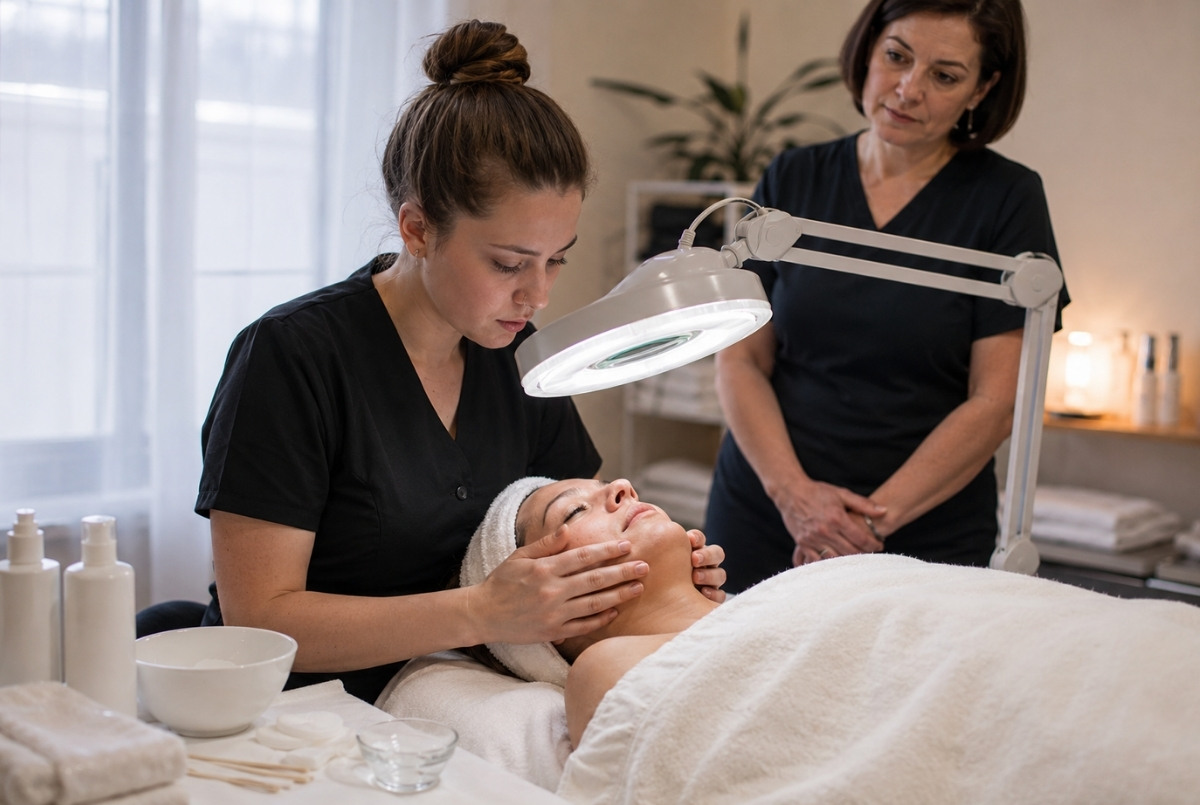
Highly creative students often fear getting stuck behind a styling chair when their true passion lies in other aesthetic fields. A common question we hear is whether you learn makeup in cosmetology school. Aspiring artists also want to know whether cosmetology students learn waxing and other hair-removal techniques.
The answer is that cosmetology education commonly reaches beyond hair, although the exact curriculum and legal scope of practice depend on the state and school. Atlanta Beauty Academy's program outline includes
80 hours of Basic Facial & Skin Techniques and
120 hours of Nail Care Techniques, while its practical applications include facials, makeup, and hair removal.
That gives students exposure to multiple sides of the beauty industry before deciding where they eventually want to concentrate their careers. You may practice makeup application, foundational skin services, hair removal, manicures, pedicures, and other techniques included in your program. Depending on the curriculum, hair-removal training can also introduce different waxing products and methods and the importance of choosing techniques appropriate for the treatment area and client.
This broad education is important because a cosmetology license has a defined
scope of practice, meaning the range of services the law allows that license holder to perform. The exact scope is not identical nationwide, so graduates should always follow the rules of the state where they intend to work.
How Skin Care Fits Into Cosmetology
Applying beautiful cosmetics is only part of what skin-related cosmetology training involves. Students also need a foundational understanding of skin structure, skin conditions, sanitation, contraindications, and safe product use.
The NIC Cosmetology Theory Examination dedicates
10% of its content to skin care and services. That section covers client skin evaluation, contraindications, infection-control procedures, basic facials, hair removal, makeup application, and the safe use of skin-care equipment.
At Atlanta Beauty Academy, the curriculum similarly includes Basic Facial & Skin Techniques rather than treating cosmetology as a hair-only program. Students can learn foundational procedures such as skin analysis, cleansing, basic exfoliation, facial services, makeup, and hair removal within the limits of their training and state scope.
It is also important to understand the distinction between cosmetology and specialized esthetics. A broad cosmetology education exposes you to skin-care fundamentals, but that does not automatically qualify every graduate to perform advanced esthetic or medical procedures. Specialized services may require a separate license, advanced education, medical supervision, or another credential depending on the state. Understanding those boundaries is part of becoming a responsible beauty professional.
The Business of Beauty

One of the most vital things to know about cosmetology school is that technical skill is only one part of building a sustainable career. You also need to understand the professional side of working with clients, products, appointments, and eventually your own business.
Atlanta Beauty Academy's published curriculum includes professionalism, retailing, salon management, and a 50-hour State Board Prep and Business Skills course. Those foundations become especially important once you begin developing a clientele or considering independent work. Building a professional reputation, retaining clients, keeping accurate records, understanding inventory, communicating your value, and marketing your services all become part of the job.
The
U.S. Bureau of Labor Statistics shows why that business knowledge matters. About
84,200 openings for barbers, hairstylists, and cosmetologists are projected each year, on average, from 2024 through 2034. In 2024,
48% of hairdressers, hairstylists, and cosmetologists were self-employed.
For professionals who operate their own salon or shop, BLS notes that responsibilities may include keeping business and inventory records, ordering supplies, arranging advertising, and hiring or supervising workers. In other words, being talented with a pair of shears is not the same thing as knowing how to run the business behind the chair.
That combination of technical and professional training can eventually support a surprisingly diverse range of
careers you can pursue with a cosmetology license, whether your long-term goal is salon work, independent services, management, or another path within your legal scope of practice.
Modern Salon Skills and State Licensing
The beauty landscape changes constantly, but strong cosmetology education is built around fundamentals that transfer across changing trends. Instead of learning only one fashionable haircut or coloring technique, you need to understand the principles that let you adapt your work to different clients.
Hair texture is a good example. The NIC national theory blueprint specifically requires knowledge of hair-care and hair-design procedures across different hair types and textures and includes natural hair styling such as braiding. Students also learn scalp evaluation and scalp treatments, helping them recognize when a client's hair or scalp condition may affect the service they provide.
Chemical services require another layer of understanding. Permanent waving, relaxing, coloring, and lightening can alter the structure or condition of the hair. Learning how chemical products work, how they interact, and how to follow manufacturer instructions helps you perform these services while reducing avoidable damage.
Modern professionals also work within more than one layer of regulation. The
FDA's Modernization of Cosmetics Regulation Act of 2022, commonly called MoCRA, significantly expanded federal oversight of the cosmetics industry. Among other provisions, it created requirements involving serious adverse-event reporting, facility registration, cosmetic product listing, and safety substantiation. Many of these legal obligations fall on manufacturers, processors, and the responsible persons behind cosmetic products rather than individual cosmetologists, but product safety remains highly relevant to the professionals who use those products every day.
Workplace safety is a separate issue. The
Occupational Safety and Health Administration warns that some hair-smoothing products may contain or release formaldehyde during use. Salons and beauty schools that use products containing or capable of releasing formaldehyde may be subject to OSHA's formaldehyde and hazard-communication requirements. This is one reason cosmetic chemistry and product-safety training matter beyond simply passing an exam.
Your curriculum also prepares you to meet state licensing requirements. Those requirements can vary substantially, so students should always check the rules where they intend to practice.
In Georgia, the current
State Board of Cosmetology and Barbers rules require a complete cosmetology school course to total
1,500 hours and take a minimum of nine months. The curriculum consists of 250 hours of Level 1 training followed by extensive service-application training, and students must complete the first 250 hours before performing clinical services on clients.
Arkansas likewise requires schools to provide cosmetology students with at least
1,500 hours of training under the
Arkansas Department of Health cosmetology rules. Its current
2026 Candidate Information Bulletin identifies the NIC Cosmetology Theory Examination as the written examination for cosmetologists. In that NIC national theory blueprint, scientific concepts account for 35% of the exam.
Once you complete your required training and licensing steps, understanding
what to do after cosmetology school can help you move from the classroom and state-board process toward your first professional opportunity.
Frequently Asked Questions
- How long does a typical program take to complete? There is no single national program length because states set different training requirements. In Georgia, a complete cosmetology school program must include 1,500 hours and take a minimum of nine months. Your actual completion time may be longer depending on the school's schedule, attendance, holidays, and whether you attend full time or part time.
- Do I need to buy my own tools before my first day? Do not assume you need to purchase everything before classes begin. Student-kit policies vary by school. Some programs provide or charge for a kit containing required tools, while others ask students to purchase certain items separately. Check your school's current enrollment materials and kit requirements before buying professional shears, mannequins, thermal tools, or other equipment on your own.
- Can I specialize in just one thing after graduating? Absolutely. A broad cosmetology education does not mean you have to offer every service you learned in school. Many professionals eventually concentrate on areas such as custom coloring, textured hair, bridal styling, makeup, or another niche permitted by their state license. Services involving lasers or other medical-aesthetic procedures may require additional credentials. In Georgia, for example, a master cosmetologist who wants to become an Assistant Laser Practitioner must meet separate Georgia laser-practitioner licensing requirements, including approved laser or IPL education.
Ready to Master Your Craft?
At Atlanta Beauty Academy, we do not just teach you how to prepare for a state board exam. Our Salon Ready approach combines hands-on experience with the scientific, safety, professional, and business foundations needed to enter the industry with confidence. Our Master Cosmetologist curriculum is designed to prepare students for licensing examinations as well as entry-level professional work.
With over 20 years of experience, we have helped students turn an interest in beauty into the foundation for a professional career. When you walk through our doors, you are not just starting classes. You are beginning the process of learning how to work safely, think creatively, serve real clients, and build skills you can continue developing throughout your career. Take the first step toward your dream today. Fill out the contact form below to schedule a campus tour!