What Nail Techs Should Know About Insurance, Taxes, and Business Licenses

Key Takeaways

  • Insurance Needs: General liability protects against common third-party accidents, while professional liability addresses claims connected to mistakes or negligence during nail services. Product liability may cover reactions to products you use or sell. Mobile technicians should also confirm whether their tools are protected in transit and at clients’ homes.
  • Tax Advantages: Nail technicians must report all business income and tips. For tax years 2025 through 2028, eligible professionals may deduct up to $25,000 in qualified voluntary tips from federal taxable income, subject to income limits and other IRS requirements. The deduction does not eliminate self-employment tax on those tips.
  • Licensing Rules: Your practitioner license allows you to perform regulated nail services, but owning a salon, home studio, or regulated mobile facility may require a separate establishment license, local business registration, zoning approval, and tax registration. Requirements depend on your state and business setup.
Stepping into the beauty industry as a professional nail technician is one of the most exciting creative moves you can make. If you are just starting out, reading a beginner nail guide can help you map out current industry trends and core skills. Once you understand a few foundational legal and financial rules, protecting your hard-earned income becomes much easier and sets you up for long-term independence.

Securing the Right Coverage: What Insurance Do You Actually Need?

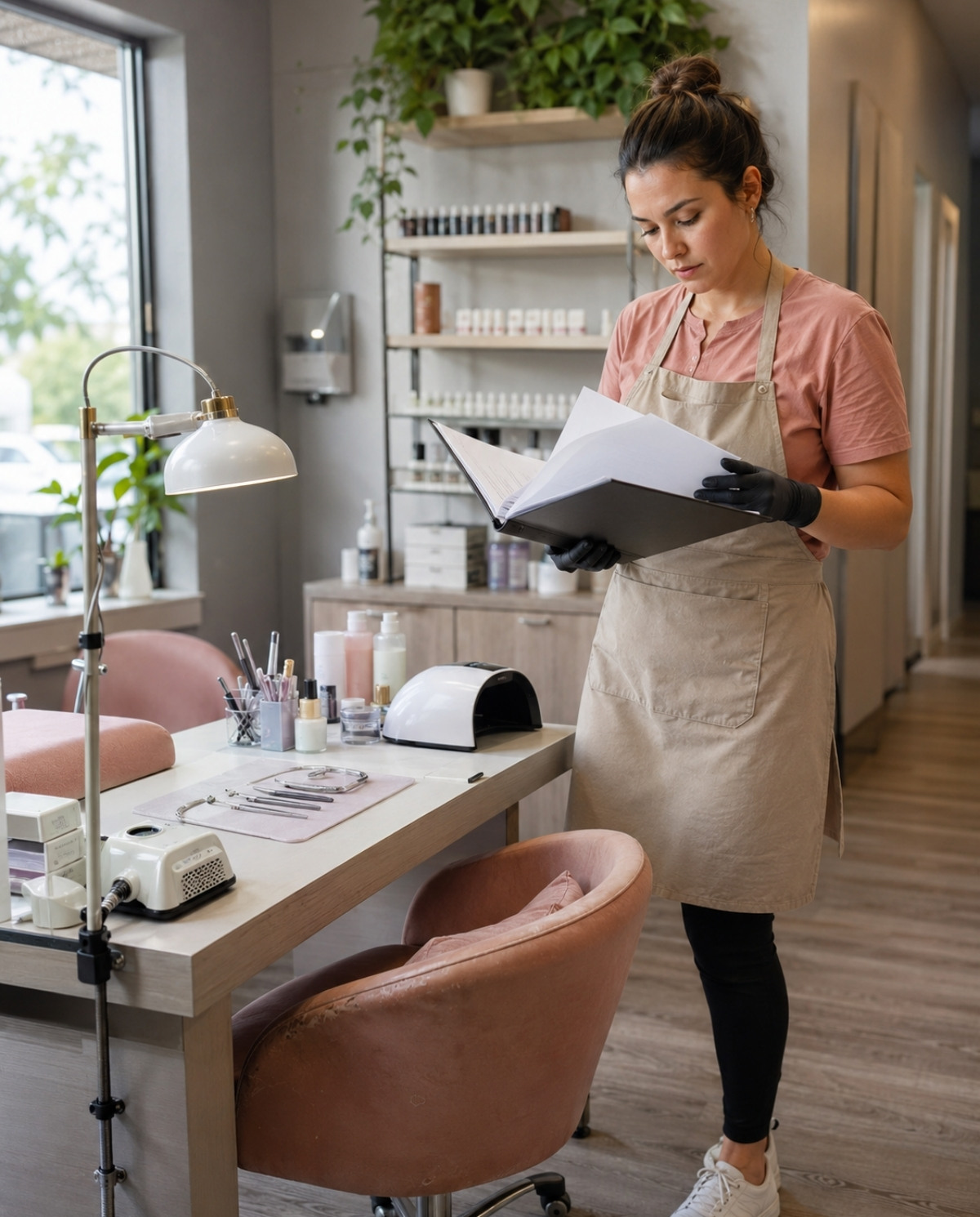
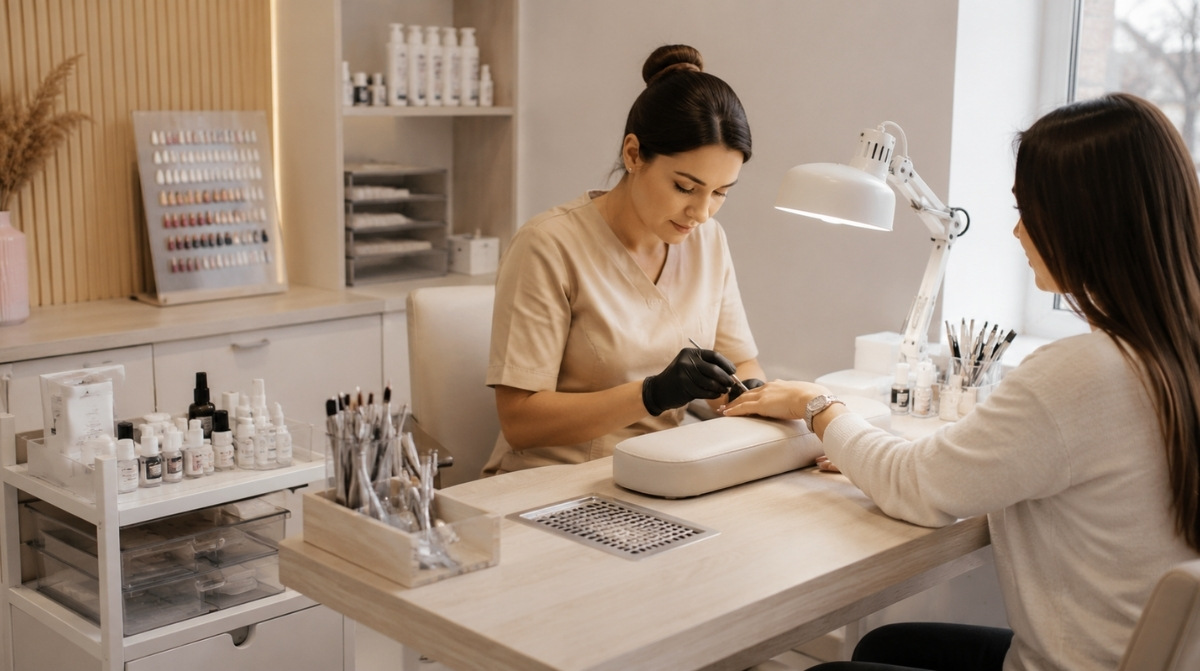
Nail technician comparing insurance policy documents beside a manicure table equipped with disinfected tools, gloves, an e-file, a curing lamp, secured electrical cords, and a clear client walkway. When you work with sharp tools, chemical products, and high-speed e-files, accidents can happen to even the most cautious beauty professionals. A client might experience an allergic reaction to a nail product, develop an infection that they believe resulted from a service, or slip on a wet floor in your studio. Proper insurance can help prevent one unexpected claim from wiping out your personal savings or interrupting your career. Professional liability insurance is not universally required by federal law for every nail technician. However, it may be required by a salon owner, booth-rental agreement, landlord, employer, client contract, or state or local rule. Even when it is not mandatory, it is one of the most important protections for an independent technician. When searching for nail technician insurance, it helps to understand the three main types of liability protection frequently included in beauty-industry policies:
  • General Liability: This covers many common third-party accidents that are not directly caused by the professional service itself. Examples include a client slipping in your workspace, tripping over a lamp cord, or having personal property accidentally damaged while visiting your business.
  • Professional Liability: Also called malpractice or errors and omissions insurance, this addresses covered claims alleging that a service was performed negligently or incorrectly. Examples may include a chemical burn, an avoidable cut, excessive nail plate damage, or an infection that a client alleges resulted from improper service procedures.
  • Product Liability: This may respond when a client claims that a product used or sold by your business caused an injury, such as an allergic reaction to nail polish, cuticle oil, adhesive, primer, or builder gel.
Coverage depends on the wording of the individual policy. General liability, professional liability, and product liability are sometimes bundled together, but they are not automatically identical across every insurer. Policy limits, deductibles, covered services, exclusions, and claim-reporting rules can all differ. For example, the liability package offered by Associated Nail Professionals combines general, professional, and product liability for qualifying members. Its policy also includes legal defense for covered losses, offers additional-insured endorsements, and uses occurrence-form coverage. Occurrence-form coverage can be particularly valuable because it generally responds based on when the covered incident happened, even if the client files the claim later. Claims-made policies commonly require the policy to remain active when the claim is filed. Because these details can significantly affect protection, do not choose a policy based on price alone. Many beginner booth renters purchase insurance simply because their salon lease requires proof of coverage. However, before buying a policy, confirm that it covers every service you perform, including manicures, pedicures, gel enhancements, acrylic services, e-file work, and off-site appointments where applicable. You should also check:
  • Whether professional and product liability are included.
  • Whether services at clients’ homes are covered.
  • Whether the policy protects you when renting a booth.
  • Whether your salon owner or landlord can be added as an additional insured.
  • Whether legal defense costs reduce your policy limit or are paid separately.
  • Whether the policy is occurrence-form or claims-made coverage.
  • Whether any advanced services, products, or techniques are excluded.

Managing Insurance Costs and Coverage Options

A common concern among new technicians is the ongoing cost of running an independent practice. Nail technician insurance can be relatively accessible, but the final cost depends heavily on the type of policy, your location, your services, your revenue, the value of your equipment, your claims history, and the coverage limits you select. According to current policy-purchase data from Insureon, nail technicians and salon businesses purchasing coverage through its marketplace pay median costs of approximately:
  • General Liability: $48 per month or $579 per year.
  • Professional Liability: $47 per month or $567 per year.
  • Business Owner’s Policy: $91 per month or $1,086 per year.
These figures are market medians from businesses that purchased policies through Insureon, not guaranteed quotes for every technician. Professional-association plans and limited individual policies may cost less, while a salon with employees, expensive equipment, higher revenue, or additional services may pay considerably more. A Business Owner’s Policy, commonly called a BOP, usually combines general liability with commercial property insurance. It can protect salon furniture, inventory, computers, lamps, and other business property at the insured location. However, a BOP does not automatically include professional liability, commercial auto coverage, workers’ compensation, or unlimited protection for equipment that regularly travels away from the listed salon. If you plan to offer mobile services, your insurance needs change. General liability may cover certain off-site bodily injury and third-party property claims if mobile services are included in the policy. Professional liability may address covered service-related allegations. However, neither coverage should be assumed to protect your own e-files, lamps, gel systems, and travel kits from theft or physical damage. Commercial property insurance generally focuses on equipment at the location listed on the policy. Inland marine insurance, sometimes called tools-and-equipment coverage or an equipment floater, is designed for business property that travels between locations or is stored off-site. Mobile nail technicians should ask an insurance agent whether their policy protects equipment:
  • While being transported between appointments.
  • While temporarily stored inside a vehicle.
  • While being used inside a client’s home.
  • Against theft, fire, vandalism, and accidental physical damage.
Inland marine coverage is not automatically mandatory for every mobile technician. However, if your existing policy does not protect portable equipment away from your primary business address, an inland marine endorsement or separate equipment policy may be necessary. A commercial auto policy is also different from equipment insurance. Commercial auto coverage can protect a vehicle used for business, subject to the policy terms, but it should not be assumed to insure every professional tool stored inside that vehicle.

Tax Basics: How to Keep What You Earn Legally

Tax season does not have to be stressful. Once you shift from being an employee to working for yourself, understanding how to file taxes as a nail technician comes down to accurate record-keeping, separating business and personal expenses, and knowing what counts as taxable income. As an independent technician or booth renter, your service income and tips are generally reported as business income. The IRS tip rules require self-employed workers to include tips in their gross business receipts, usually reported on Schedule C with the rest of their business income. You may also be responsible for federal income tax, self-employment tax, state income tax, and local taxes, depending on where you live and operate. When learning how to pay taxes as a nail technician, setting aside 25% to 30% of your weekly net profit can be a useful starting habit. However, this percentage is only a budgeting rule of thumb—not an official tax rate. The amount you actually need depends on your total profit, filing status, deductions, credits, state taxes, and other household income. Use Form 1040-ES guidance or work with a qualified tax professional to calculate an amount that fits your situation. The best way to lower your taxable business profit legally is to keep careful records of ordinary and necessary business expenses. Common nail technician tax write-offs may include:
  • Professional Supplies: Gel polish, acrylic products, tips, forms, disposable files, gloves, lint-free wipes, e-file bits, and salon-appropriate disinfectants.
  • Equipment: E-files, UV or LED curing lamps, manicure tables, dust collectors, pedicure equipment, storage furniture, and business computers. Depending on the cost and tax rules, some equipment may need to be depreciated or deducted through another allowed cost-recovery method.
  • Occupational Expenses: Booth rent, salon utility contributions, business insurance premiums, license renewal fees, and payment-processing fees.
  • Marketing and Administration: Booking software, business cards, website hosting, business phone expenses, photography, and social media advertising.
  • Qualified Education: Continuing education and advanced workshops may be deductible when they maintain or improve skills in your existing nail business. According to IRS education rules, training that meets minimum entry requirements or qualifies you for a completely new trade or business generally does not qualify as a work-related education deduction.
  • Qualified Business Travel: Travel to a trade show, convention, or educational event may be deductible when it has a genuine business purpose and satisfies IRS travel rules. Personal trips and ordinary commuting are treated differently.
Keep receipts, invoices, appointment records, mileage logs, bank statements, payment-platform reports, and daily records of cash and electronic tips. A business deduction reduces taxable business income; it does not mean the government reimburses the full purchase price.

Understanding the New Federal Tip Deduction

Beauty-industry resources from Paul Mitchell Schools and Aveda Arts have highlighted the new federal deduction for tipped professionals. Current IRS guidance confirms that eligible employees and self-employed workers may deduct up to $25,000 in qualified tips for tax years 2025 through 2028. Nail professionals are specifically included in the IRS occupation list under manicurists and pedicurists, which includes nail technicians. However, “no tax on tips” does not mean that every tip is completely tax-free. Important limitations include:
  • The payment must be a qualified voluntary tip. A mandatory service charge is not treated as a tip for this deduction.
  • All tips must still be reported as income.
  • The maximum deduction is $25,000 per federal return.
  • For a self-employed technician, the deduction cannot exceed the net income from the business in which the tips were earned.
  • The deduction begins phasing out when modified adjusted gross income exceeds $150,000, or $300,000 for married couples filing jointly.
  • Married taxpayers must file a joint return to claim the deduction.
  • The taxpayer must have a valid Social Security number that is authorized for employment.
  • The deduction is available whether the taxpayer itemizes deductions or takes the standard deduction.
  • Qualified tips remain subject to Social Security, Medicare, or self-employment tax as applicable.
Accurately reporting cash and electronic tips is a legal requirement, not an optional strategy. Complete records may also make it easier to document your income when applying for an apartment, auto financing, a business loan, or future salon financing, although approval standards vary by lender and landlord. Independent technicians must also account for self-employment tax. The basic rate is 15.3%, consisting of 12.4% for Social Security and 2.9% for Medicare. According to the IRS SE tax rules, the tax generally applies when net self-employment earnings are at least $400, and the calculation usually applies to 92.35% of net self-employment earnings. The Social Security portion is limited by the annual Social Security wage base, while Medicare tax generally applies to all covered net earnings. Additional Medicare tax may also apply above certain income thresholds. Self-employed taxpayers can generally deduct the employer-equivalent half of their self-employment tax when calculating adjusted gross income.

Licensing and Business Setup: Setting Up Your Business Right

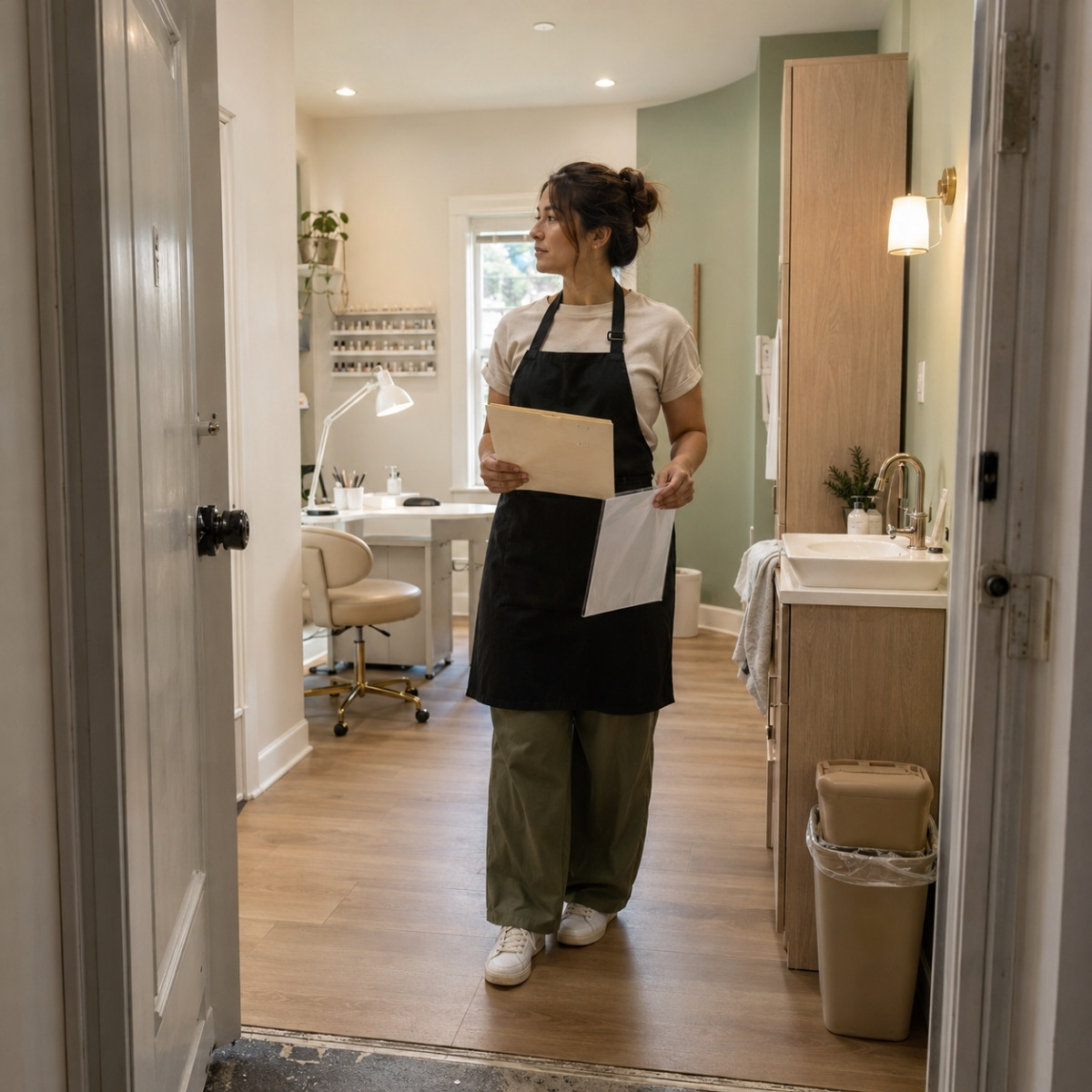
Nail technician holding a permit folder and blank credential sleeve while inspecting a separated home nail studio with a manicure table, handwashing sink, storage cabinet, covered waste bin, client chair, and clear walkway. Before you open your appointment book, make sure your business setup complies with state and local regulations. Getting these details right builds trust with clients and establishes your credibility as a trained professional. Many prospective technicians ask whether a nail technician needs a business license in addition to a personal practitioner credential. The answer depends on how and where the technician works. A personal practitioner license proves that you completed the required education or apprenticeship pathway, passed the applicable licensing examinations, and are legally qualified to perform regulated nail services. A business license, establishment license, tax registration, and zoning approval serve different purposes. According to SBA licensing guidance, licensing and permit requirements vary based on business activity, location, and government rules. A nail business may need several separate layers of approval:
  • Practitioner License: Authorizes an individual to perform nail services.
  • Salon or Establishment License: Authorizes a regulated physical salon, home studio, or qualifying mobile facility to operate.
  • Local Business Registration: May include a city or county business license, occupational tax certificate, or local registration.
  • Zoning and Occupancy Approval: May be required before receiving clients in a home or commercial space.
  • Tax Registration: May be necessary for collecting sales tax on retail products or registering business income.
  • Entity or Trade-Name Registration: May apply if you create an LLC, corporation, partnership, or fictitious business name.
An employee working inside a licensed salon does not normally obtain the salon owner’s business license. Similarly, a booth renter working inside an already licensed establishment may not need to hold a separate salon-establishment license personally. However, that technician may still need an active practitioner license, local registration, tax accounts, insurance, or other documents. Before setting up shop, review state-specific licensing requirements to understand training hours, examination rules, application fees, and facility requirements. Location rules vary across state lines:
  • In Georgia, the official nail curriculum requires 525 hours of training. The apprenticeship pathway requires 1,050 hours completed over at least eight months. A person opening a salon or home studio must receive a separate salon/shop license before opening, and the Georgia Board FAQ explains that the state salon/shop license is different from a city or county business license.
  • Georgia permits a salon to operate from a home when it satisfies state and local requirements. However, the state’s facility rules require the salon area to be properly separated from domestic space. Mobile units, carts, trailers, and motor homes are not licensed as roaming salons unless they meet all Board requirements and are anchored in a permanent location.
  • In Arkansas, the cosmetology rules establish a 600-hour manicure curriculum. A salon owner must also obtain the appropriate establishment approval and complete the required inspection process before opening. Arkansas separately regulates mobile salons, which must comply with the state’s licensing, equipment, sanitation, and facility requirements.
Because home and mobile salon rules can be highly specific, contact your state board and local zoning department before renovating a room, signing a commercial lease, or purchasing a mobile unit. A practical startup sequence may include:
  1. Complete a state-approved or state-licensed nail technology program or qualifying apprenticeship.
  2. Pass the written, practical, or other examinations required by your state.
  3. Obtain and maintain your individual practitioner license.
  4. Register your business, tax accounts, and trade name where applicable.
  5. Confirm city or county business-license and zoning requirements.
  6. Apply for a salon, home-studio, or qualifying mobile-facility license if you own or control the workspace.
  7. Obtain appropriate insurance before accepting clients.
These steps are a planning checklist rather than a universal national sequence. Some states use different license names, permit apprenticeship alternatives, require only certain examinations, or restrict mobile services. When learning how to become a self-employed nail technician, building a structured strategy keeps your momentum going. Writing a basic business plan for a nail technician does not need to be complicated. Outline your target client profile, list your monthly overhead costs, calculate the supply cost and labor time behind each service, and set service prices that leave room for taxes and profit. Your plan should include:
  • Monthly booth rent or studio expenses.
  • Insurance premiums and licensing costs.
  • Product and disposable supply costs per service.
  • Booking, payment-processing, and marketing expenses.
  • Weekly appointment capacity.
  • Cancellation and deposit policies.
  • Weekly and monthly revenue targets.
  • A reserve for taxes, slow periods, and equipment replacement.
Holding an active practitioner license does not automatically authorize every possible business setup. A home studio, separately owned salon, or mobile operation may require additional state approval, zoning clearance, inspections, and local registration. Performing regulated services without the required licenses or approvals may lead to fines, disciplinary action, closure orders, or other penalties. It may also create an insurance dispute if a claim involves unlicensed services, an undisclosed business location, or work that falls outside the policy’s covered scope. The exact consequences depend on state law and the wording of the insurance policy.

Ready to Build Your Salon-Ready Legacy?

Building a successful beauty business takes more than mastering art—it takes real industry knowledge. At Atlanta Beauty Academy, our hands-on, Salon Ready approach prepares students for multiple sides of the craft, from professional beauty techniques and sanitation to licensing preparation and foundational business awareness. With more than 20 years of experience shaping beauty professionals across Georgia, we do not just teach students; we help launch lifelong careers. Take the first step toward your independent future. Fill out our contact form below to explore our training options, tour our campus, learn how our programs support Georgia licensing preparation, and join a legacy of thriving beauty artists!

Frequently Asked Questions

Can I run a nail business out of my apartment if I only sell custom press-on nails?

Selling finished press-on nail sets without applying them directly to customers is generally treated more like a retail product business than an in-person nail service. As a result, a salon-establishment license may not be required in many jurisdictions. However, the rule is not universal. You may still need a local business registration, sales-tax permit, home-occupation approval, or permission under your apartment lease or homeowners association rules. If you manufacture, repackage, or include nail glue, polish, or other cosmetic products, review the FDA nail guidance and applicable labeling requirements. State consumer-product and tax rules may also apply. Before launching, confirm the requirements with your state cosmetology board, state tax department, and local zoning office.

What happens if I forget to pay my quarterly estimated taxes during my first year of self-employment?

Missing an estimated-tax payment may result in an underpayment penalty, even if you pay the full balance when filing your annual return. The penalty is generally calculated based on how much was underpaid and how long the underpayment remained outstanding. According to IRS penalty rules, many taxpayers can avoid the penalty when:
  • They owe less than $1,000 after subtracting withholding and refundable credits.
  • They paid at least 90% of the tax due for the current year on time.
  • They paid at least 100% of the prior year’s tax on time, subject to a 110% rule for certain higher-income taxpayers.
A person with no tax liability for the previous full tax year may not have to make estimated payments if all IRS conditions are satisfied. However, simply being in your first year of self-employment does not automatically create an exemption because you may still have had tax liability from wages or other income in the prior year. Estimated-tax deadlines are generally April 15, June 15, September 15, and January 15 of the following year. When a deadline falls on a weekend or federal holiday, it moves to the next business day.

Do I need a separate bank account if I operate as a sole proprietor?

A separate business bank account is generally not a federal legal requirement simply because you operate as a sole proprietor. However, it is strongly recommended. Separating business and personal funds makes it easier to track income, document deductions, reconcile payment-platform reports, prepare tax returns, and demonstrate business revenue. It can also make your business appear more professional when paying vendors, accepting client payments, or applying for financing. The SBA banking guide recommends opening a business account once you begin accepting or spending money as a business. If you operate through an LLC or corporation, maintaining financial separation is even more important for accurate records and business-entity formalities.

Laying the Foundation for Long-Term Success

Navigating insurance policies, tax rules, and local licensing might seem intimidating at first, but taking these steps gives you greater control over your creative career. When you protect your workspace, organize your finances, and comply with state-board and local requirements, you build a resilient business that earns trust from clients and industry peers. Mastering these business skills begins with a solid educational foundation. A high-quality licensing pathway does far more than teach you how to apply acrylics or execute nail art trends. It also introduces sanitation, client safety, professional standards, state regulations, and the daily habits needed to work successfully in a salon. If you are torn between focusing entirely on nails or offering a broader range of beauty services, comparing a nail and cosmetology program can clarify which route aligns with your career goals. By choosing a state-approved training pathway that prepares you for licensing requirements and real salon work, you can graduate with the technical skills, confidence, and professional knowledge needed to build a thriving beauty career.

How to Set Up the Ultimate Nail Technician Desk for Comfort and Profit

Key Takeaways

  • Ergonomics First: Nail technicians face significant ergonomic risks from prolonged forward bending and repetitive motions. In one study of 80 female nail technicians, 63.8% reported neck pain, reinforcing the importance of adjustable seating, proper client-hand positioning, supportive padding, and regular position changes.
  • Ventilation Compliance: N95 respirators can help filter airborne particles but do not protect against chemical gases or vapors. Effective source-capture ventilation is therefore critical, and Georgia's adopted mechanical code requires manicure and pedicure stations to exhaust at least 50 CFM per station.
  • Smart Station Layout: Positioning frequently used tools within comfortable reach based on your natural workflow and hand dominance reduces unnecessary movement, cord interference, and service interruptions.
  • True Rental Overhead: Independent booth rent may range broadly from about $100 to $500 per week, but rent is only one expense. Technicians also need to budget for products, insurance, payment processing, software, marketing, taxes, licensing, and other fixed and variable business costs.
  • State Training Requirements: Nail training requirements vary by state and by licensing pathway. Georgia's complete nail care school curriculum totals 525 hours, while Arkansas school rules prescribe a 600-hour manicure curriculum, making it essential to verify current requirements with the appropriate state licensing agency.
Turning your passion for nail artistry into a profitable business requires moving beyond basic polishing skills to master everyday salon operations. As you transition from practicing at home to servicing paying clients, choosing the right equipment and organizing your station keeps your business safer, more efficient, and easier to manage. Whether you are preparing for your professional licensing pathway or reviewing our comprehensive guide on nail technician licensing requirements, costs, and state certification rules, setting up your station correctly protects both your physical health and your bottom line.

Choosing the Right Foundation: Tables, Desks, and Ergonomics

Your workstation is the operational hub of your daily business. Because you may sit across from clients for hours at a time, selecting professional furniture involves critical health and workflow factors that go far beyond aesthetic appeal. Nail technician adjusting an ergonomic chair beside a compact manicure desk with comfortable client seating, clear legroom, a padded hand rest, task lighting, and accessible tools.

Build the Station Around Your Body

Rather than relying on one universal table height, focus on creating an adjustable working position that fits your body. The Occupational Safety and Health Administration's nail salon ergonomics guidance recommends using an adjustable chair with proper back support, keeping your feet supported, positioning the client's hand or foot so you do not need to bend forward excessively, and adjusting your lighting so you can see detailed work without constantly leaning toward the table. A padded arm or wrist support can also reduce pressure from hard table edges during longer services. Long appointments require repetitive, fine-motor motions. Continuous forward bending, repetitive filing, and resting the wrists or forearms against hard surfaces can place stress on muscles, joints, tendons, and nerves. A 2022 occupational ergonomics study involving 80 female nail technicians found that 63.8% reported neck pain, the highest prevalence among the body areas evaluated. The study does not establish that every technician develops severe pain within a specific number of years, but it reinforces the occupational risks associated with repetitive motions and awkward working positions. Selecting adjustable nail technician furniture is therefore only one part of an ergonomic setup. OSHA also recommends raising or repositioning the client's hand or foot instead of repeatedly bending toward the work, adding padding where the arms contact hard surfaces, taking short breaks when possible, changing positions between tasks, and stretching between appointments. These small adjustments can reduce unnecessary physical strain during a long working day.

Choose Storage and Table Styles for Your Workflow

Storage design directly impacts sanitation compliance. Investing in a specialized desk for nail technician work with built-in drawers or closed storage gives you a designated place for properly cleaned and disinfected reusable implements. Under the Georgia State Board of Cosmetology and Barbers facility rules, disinfected implements must be stored in a clean, closed, airtight drawer or container labeled for clean implements, while used tools must remain physically separated until they have been properly cleaned and disinfected. Single-use supplies should also be stored cleanly and discarded after use as required. If you are currently building out your initial station equipment, explore our detailed breakdown of essential nail tech skills, procedures, and starter kit tools to ensure you buy the right gear from the start. Selecting the right nail technician table depends on your specific business model. Fixed salon tables provide stability and permanent storage for technicians working from one location. Conversely, if you offer mobile bridal services, house calls, or pop-up event manicures, a folding, portable table for nail technician work provides greater flexibility while still giving you a stable work surface. Whatever style you choose, your table should leave enough space to position the client's hands comfortably while keeping your primary tools within easy reach.

Health, Safety, and Ventilation Rules You Cannot Ignore

Filing artificial nail products and working with polishes, adhesives, primers, removers, and other professional products can expose technicians to airborne dusts, mists, and chemical vapors. Nail technicians may inhale these contaminants or experience skin and eye exposure, particularly when multiple products are used throughout a long workday. Effective ventilation and safe product handling are therefore essential parts of a professional salon setup. Organized nail technician workspace with files, buffers, brushes, cuticle tools, cotton pads, divided drawer storage, and neatly routed electrical cords during a manicure service.

Understand the Difference Between Dust Collection and Local Exhaust

A tabletop dust collector can help reduce particulate matter generated during filing, but not every dust collector is equivalent to a properly designed local exhaust ventilation system. Some units filter particles and recirculate air back into the room, while other systems capture contaminated air close to the work surface and exhaust it away from the breathing zone. Local Exhaust Ventilation, or LEV, is designed to capture contaminants close to where they are generated. According to the CDC and NIOSH guidance for nail technicians, local exhaust controls can include downdraft ventilated tables as well as portable units that filter air or exhaust it outdoors. The effectiveness of a particular system depends on its design, airflow, filter configuration, maintenance, and placement, so technicians should not assume that every built-in extractor automatically provides the same level of chemical exposure control.

Use Respiratory Protection Correctly

Respiratory protection also needs to be understood correctly. Surgical or procedure masks are not respirators and should not be relied upon for protection against chemical vapors. A fitted, NIOSH-approved N95 respirator can help filter airborne particulate matter generated during filing or buffing, but an N95 does not protect against hazardous chemical gases or vapors. The OSHA nail salon chemical hazard guidance emphasizes ventilation as one of the most important methods of reducing chemical concentrations in salon air. When respiratory protection against a particular chemical exposure is required in an occupational setting, the respirator must be appropriately selected for that hazard and used in accordance with OSHA respiratory protection requirements. Good ventilation also works best when combined with everyday chemical-control practices. OSHA recommends keeping chemical containers closed when they are not being used, using properly designed dispenser bottles, maintaining the salon's exhaust system, reviewing product Safety Data Sheets, and minimizing unnecessary chemical evaporation. Together, these controls reduce exposure more effectively than relying on a mask alone.

Meet Source-Capture Ventilation Requirements

For technicians and salon owners in Georgia, ventilation is also a building-code issue. Under the 2024 International Mechanical Code with Georgia Amendments, each manicure and pedicure station must have a source-capture system capable of exhausting at least 50 cubic feet per minute, or CFM, per station. The related Georgia mechanical exhaust provisions state that when a manicure table or pedicure station does not have a factory-installed exhaust inlet, the exhaust inlet must be positioned within 12 inches horizontally and vertically of the point where chemicals are applied. The system must operate continuously while the space is occupied. This means general building HVAC and a small recirculating tabletop dust collector should not automatically be treated as substitutes for required source-capture exhaust. Salon owners planning a new build-out or rental suite should confirm the applicable mechanical code, local amendments, permitting, and inspection requirements with the local authority having jurisdiction before signing a lease or installing permanent stations.

Designing a High-Efficiency Nail Station Setup

Speed, precision, and service flow stem from a disciplined workspace layout. Establishing a clean nail tech station setup reduces wasted movement, prevents tools and cords from crossing the active work area, and creates a more organized customer experience.

Arrange Tools Around Your Service Workflow

Organize your primary tools according to the sequence in which you actually use them. If you operate your electric file primarily with your dominant hand, position the control unit where the handpiece and cord can move naturally without crossing over your client or other equipment. Position your curing lamp where clients can comfortably insert and remove their hands without interfering with your active tool area. Keep the implements needed for the current service close enough to reach without repeated twisting or leaning. There is no reliable evidence that one specific hand-dominance layout automatically saves 10 to 15 minutes on every appointment. However, arranging frequently used equipment within a comfortable working zone can reduce unnecessary reaching, equipment repositioning, and workflow interruptions. The most efficient layout is one you can repeat consistently while maintaining safe posture and proper sanitation.

Create Clear Clean, Used, and Single-Use Zones

Maintaining an efficient nail technician set up also requires strict separation between single-use items and reusable implements. Under Georgia's current sanitation rules, reusable nonporous implements such as nail clippers, cuticle nippers, metal drill bits, reusable nail forms, and certain metal or glass files must be properly cleaned and disinfected after use. Clean implements must then be stored separately from dirty implements in designated closed storage. Single-use items cannot simply be disinfected and reused. Georgia specifically identifies items including buffers, emery boards, sleeves and sanders for electric files, orange wood or birch wood sticks, porous foot files, and other items that cannot be properly disinfected as single-use materials that must be discarded after one use. An autoclave is an acceptable processing method for appropriate implements under Georgia rules, but routine nail tools are not universally required to be autoclaved or presented to every client in sealed autoclave pouches. To learn more about practical disinfection routines, read our complete guide on nail salon hygiene protocols, infection prevention, and client aftercare. A useful daily workflow is to create clearly separated zones for clean implements, current-service tools, single-use supplies, chemicals, and contaminated implements waiting to be processed. Chemical products should remain properly closed and stored according to their labels and Safety Data Sheets rather than being placed in the same storage area as disinfected tools. Coordinated, professional furniture also contributes to a more polished client experience. When your workspace looks clean, organized, and intentional, clients can immediately see that sanitation and service preparation are taken seriously. Mastering these layout habits during foundational beauty school training also helps turn proper setup and breakdown procedures into a repeatable routine, allowing you to spend more attention on technique and client communication.

Taking the Entrepreneurial Step: Renting Salon Space

Graduating from employee status to managing your own workspace represents a major career milestone. Demand for licensed manicurists continues to expand, with national employment projections from the U.S. Bureau of Labor Statistics showing 7% employment growth for manicurists and pedicurists from 2024 through 2034. Successfully capturing this market requires understanding not only your weekly rent but the full cost and legal responsibility of operating independently. Complete individual nail station prepared between appointments with ergonomic chairs, a clean manicure desk, rolling storage, sanitized tools, task lighting, and tabletop ventilation.

Evaluate the Space Before Signing a Lease

When touring a potential nail technician room to rent, inspect the mechanical infrastructure carefully. Confirm that the space has properly installed electrical service for your professional equipment, adequate lighting, and access to any sinks, hot and cold running water, restrooms, or sanitation facilities required under state and local rules. Most importantly, verify the existing ventilation system before assuming you can simply place a manicure table in the room and begin operating. Installing compliant source-capture exhaust after construction can be significantly more complicated than planning for it during the initial build-out. Evaluating a dedicated nail technician space for rent also involves analyzing every clause in your agreement. Whether securing a private room or booking a shared booth, confirm whether your weekly rent covers electricity, water, guest Wi-Fi, laundry access, professional waste disposal, common-area cleaning, reception services, booking support, and other shared amenities. You should also determine which repairs or equipment upgrades are the landlord's responsibility and which costs fall on you.

Calculate the True Cost of Booth Rental

Published estimates for booth rental vary widely, with the ZipRecruiter booth rental overview placing typical rental figures in a broad range of approximately $100 to $500 per week depending on location and salon arrangements. This should be treated as a general market estimate rather than a fixed national average because rates can change substantially between cities, neighborhoods, salon brands, private suites, and full-service rental agreements. Beyond rent, independent technicians need to separate their expenses into fixed and variable costs. Fixed costs may include insurance, software subscriptions, business registrations, licenses, marketing, and recurring suite fees. Variable costs increase as client volume grows and can include professional products, disposable supplies, laundry, card-processing fees, and other service-specific materials. Instead of assuming every technician will spend the same additional amount each month, calculate your own break-even point based on your actual business model. One simple approach is to divide your recurring monthly fixed costs by the average amount each appointment contributes toward covering those costs after service-specific product expenses. This gives you a more realistic estimate of how many paying appointments you need before your business begins generating profit.

Understand Independent Work, Licensing, and Business Compliance

Data from the BLS Occupational Outlook Handbook shows that 28% of manicurists and pedicurists were self-employed in 2024. However, renting a booth does not automatically determine whether a worker is legally classified as an independent contractor. According to the Internal Revenue Service, worker classification depends on the actual facts of the relationship, including the degree of control over how the work is performed. Technicians operating as independent contractors are generally considered self-employed and may have responsibilities for self-employment and estimated taxes. State training and licensing requirements also affect your path to independence. Georgia's official nail care school curriculum requires a complete course totaling 525 hours of training. In Arkansas, the current Code of Arkansas Rules for cosmetology schools prescribes a 600-hour manicure training curriculum. Because training, examination, reciprocity, and licensing provisions can be structured differently from state to state and can change over time, prospective technicians should confirm the exact pathway that applies to them directly with their state licensing agency. Completing the required training and obtaining your individual professional license is also only one part of operating independently. Depending on your location and business structure, you may need to address salon or establishment licensing, business registration, tax obligations, zoning, building codes, mechanical ventilation requirements, insurance, and lease restrictions before opening your station to clients.

Starting Your Journey with the Right Foundation

Selecting compliant equipment, mastering ventilation standards, and managing independent overhead can feel overwhelming when navigating the beauty industry alone. That is why comprehensive, hands-on education is so valuable. A high-quality beauty school program goes beyond teaching polish application; it introduces students to the technical procedures, sanitation habits, safety practices, and professional routines required in a real salon environment. From understanding chemical safety and anatomical health to developing better station ergonomics and learning how salon operations work, structured training builds a stronger professional foundation. Completing a state-approved beauty program gives aspiring technicians the technical education and required training hours needed to move toward licensure while developing practical habits that can support long-term employment or independent career opportunities.

Ready to Build Your Salon Legacy?

Mastering station setup, ergonomics, sanitation, and state compliance is just the beginning. At Atlanta Beauty Academy, our Salon Ready approach focuses on hands-on training, professional development, and technical preparation for careers in the beauty industry. With a business history dating back more than 20 years according to the Georgia Secretary of State business record, the academy helps students build the practical foundation needed to pursue salon employment or explore independent career opportunities after meeting applicable licensing requirements. Your dream nail career starts with the right foundation. Ready to turn your passion into a professional path? Fill out the contact form below to schedule a campus tour, learn about available funding and payment options, and explore how professional beauty training can prepare you for the next stage of your career.

Frequently Asked Questions

What table size works best for a small nail studio space?

There is no single regulated table size that works for every technician. Many compact commercial nail tables fall within a range of approximately 36 to 42 inches wide and 16 to 20 inches deep, but the best size depends on your equipment, available floor space, ventilation design, and body position. Prioritize enough working depth for your lamp, e-file, and client hand support while choosing a setup that allows you to sit with proper back support and avoid prolonged forward bending.

How often should I replace the filter in a nail desk extractor fan?

Follow the maintenance schedule provided by the extractor manufacturer because filter designs differ significantly between systems. For applicable ventilated tables that use charcoal filters, OSHA's nail salon guidance recommends changing charcoal filters at least monthly and cleaning the catch basin at least weekly. High-volume filing may require more frequent maintenance. Remember that replacing a particulate or charcoal filter does not automatically make a recirculating dust collector equivalent to a code-compliant source-capture exhaust system.

Is booth rental better than working on commission for new graduates?

Neither model is automatically better for every new technician. A commission-based salon position may reduce some upfront business costs and may provide access to salon-generated clients, training, equipment, or supplies depending on the employer. Booth rental offers greater independence but typically shifts responsibility for rent, products, insurance, taxes, marketing, client acquisition, and other operating expenses to the technician. Before renting, calculate how many recurring clients you need to cover your fixed costs and review the agreement carefully.

What basic insurance does an independent nail technician need?

Independent nail technicians commonly consider professional liability insurance for claims related to professional services and general liability insurance for broader incidents such as accidental property damage or certain injuries occurring in the business space. Exact coverage needs depend on your business structure, services, state requirements, landlord, and rental agreement, so technicians should review their specific risks and any insurance requirements written into their booth or suite lease.

What Is a Medical Nail Technician? Training, Certification, and Career Path

Step away from the high-turnover salon hustle for a moment. Imagine walking into a workplace every morning where your advanced skills are truly respected, your environment is meticulously clean, and your clients view you as an important partner in maintaining their comfort and personal care. Many talented beauty professionals eventually reach a point where they feel stuck in a stressful cycle. Dealing with back-to-back client rushes, chemical fumes, and unpredictable tip-dependent wages can leave you feeling burned out. At the same time, the United States has a rapidly aging population, and the Centers for Disease Control and Prevention estimates that 40.1 million Americans had diabetes in 2023. Many older adults and people living with chronic health conditions need cautious nail and foot care that accounts for fragile skin, reduced sensation, circulation problems, and a greater risk of infection. This intersection of specialized beauty care and health-conscious personal care is creating an emerging professional path. Let's look at what is a medical nail technician and explore how advanced safety education may strengthen your professional credibility, expand your referral network, and support a more specialized career.

Key Takeaways

  • A Safety-Focused Specialization: A Medical Nail Technician, commonly called an MNT, is generally a licensed nail technician or cosmetologist who has completed private advanced education in infection control, chronic-condition awareness, risk screening, and appropriate medical referral.
  • A Private Certificate, Not a Medical License: MNT certification is not a separate government-issued healthcare license. It does not authorize diagnosis, wound care, medical treatment, or services prohibited under your original state beauty license.
  • Potential for a More Specialized Business: Advanced safety training may help technicians build trust, develop professional referral relationships, and offer more carefully structured services. However, there is no reliable national salary figure specifically for MNTs.
  • State-by-State Rules Still Control: Your permitted services, tools, sanitation procedures, and licensing requirements are determined by the state where you practice, regardless of any advanced certificate you earn.

What Is a Medical Nail Technician?

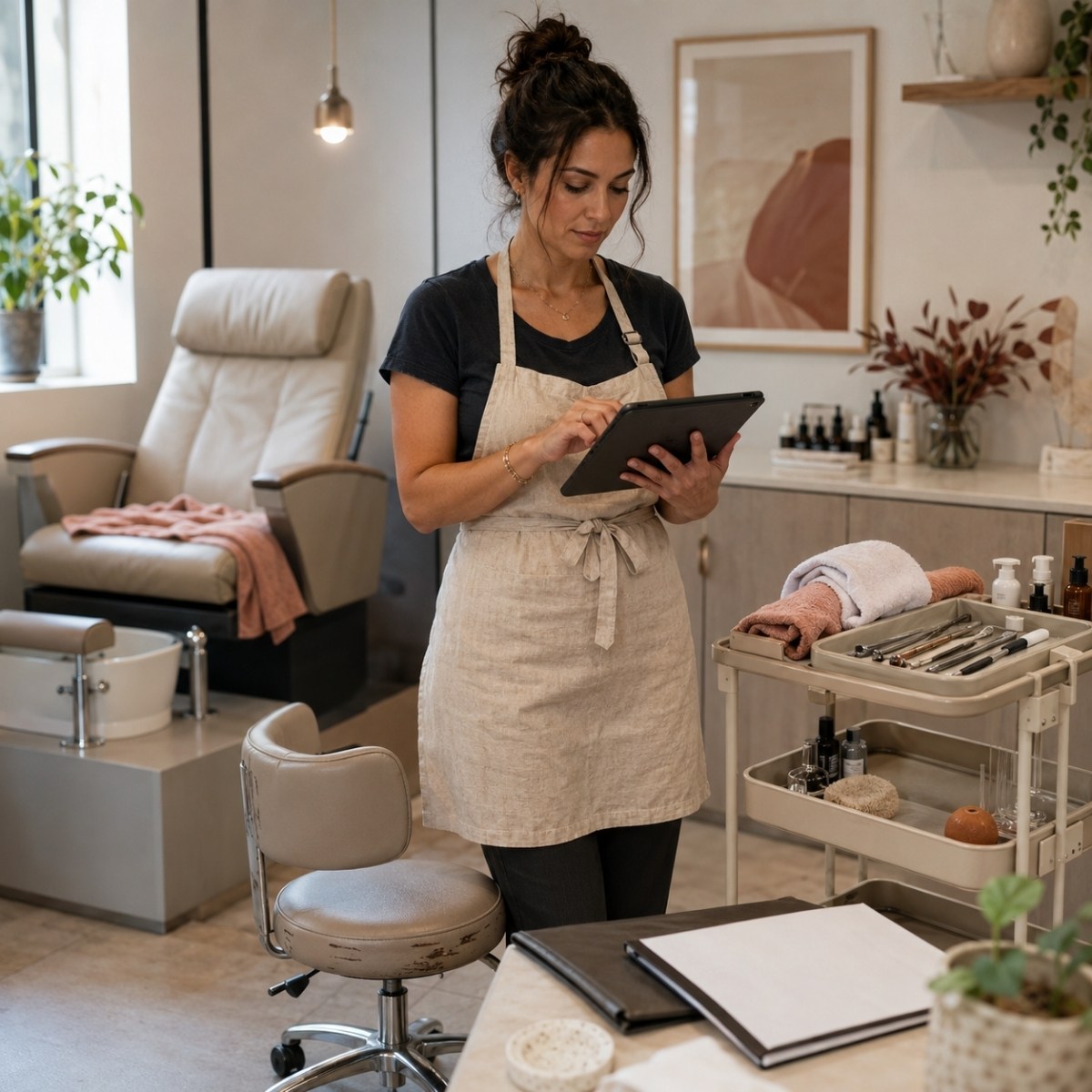
Independent nail technician checks her appointment schedule while preparing clean tools, fresh towels, and client records in a private suite. When you work as a specialized nail technician, your daily approach may look very different from a standard cosmetic salon routine. Stepping into the health-conscious side of the industry means prioritizing client screening, infection prevention, documentation, and anatomical knowledge alongside appearance and comfort. The term Medical Nail Technician is most commonly used for a licensed beauty professional who has completed additional private training related to elderly clients, people with diabetes, and individuals living with chronic health conditions. Despite the word “medical” in the title, an MNT remains a cosmetic nail professional unless that person separately holds a recognized healthcare license. In this role, your care centers around several highly specialized concepts:
  • Aseptic practices: According to the Centers for Disease Control and Prevention, asepsis means preventing contact with microorganisms. For a nail professional, this can include hand hygiene, careful workspace preparation, single-use supplies where appropriate, and properly cleaning and disinfecting reusable tools according to state rules and product instructions. Asepsis should not be confused with sterilization, which is a separate process intended to destroy all forms of microbial life.
  • Advanced Waterless Care: Some specialized providers use dry or waterless techniques to eliminate footbath-related cross-contamination and avoid prolonged soaking. As noted in guidance from Balance Health, waterless care is a common feature of medical-pedicure services. The National Institute of Diabetes and Digestive and Kidney Diseases also advises people with diabetes not to soak their feet because soaking may dry the skin. Waterless care is not a universal legal requirement, but it can be a practical risk-reduction method for suitable clients.
  • Conservative, Comfort-Focused Care: An MNT may perform careful cosmetic nail and skin maintenance that stays within the technician's state scope of practice. The exact services and tools allowed vary by jurisdiction. Thick, discolored, painful, infected, ingrown, or otherwise abnormal nails may require evaluation and care from a podiatrist rather than a nail technician.
  • Risk Screening and Referral: Advanced training helps technicians recognize when a service should be modified, postponed, or refused. Open sores, bleeding, swelling, unusual warmth or redness, blisters, suspected infection, and nails growing into the skin are examples of warning signs that may require medical referral. The technician observes and documents what is visible but does not diagnose the condition.
  • Careful Product Selection: Strong exfoliating products and chemical callus removers are not automatically appropriate for medically vulnerable clients. NIDDK warns people with diabetes against liquid corn and callus removers because these products can damage the skin and lead to infection. Product choices must match the client's condition, the manufacturer's instructions, and state scope-of-practice rules.
A common fear for newcomers is the pressure of working around medically vulnerable clients. It helps to understand exactly what this job is not. You are never expected to act like a doctor, podiatrist, or nurse. You do not diagnose nail disease, treat infections, provide wound care, perform surgery, or cut into living tissue. Instead, you use advanced training to reduce avoidable risks, maintain a clean environment, and recognize when a client needs a licensed healthcare provider. If you want to understand how strict safety standards translate to everyday practice, reading up on essential nail salon hygiene and infection prevention strategies offers a practical look at protecting clients and technicians from cross-contamination. The broader need for safe foot care is substantial. According to Mordor Intelligence, the global podiatry services market is estimated at $4.87 billion in 2026, and routine foot care accounted for 46.87% of the market in 2025. These figures describe the broader podiatry industry rather than the employment market for MNTs, but they help show how important routine foot maintenance is within overall foot health services. Some podiatrists may employ or refer appropriate clients to safety-trained nail professionals. However, these arrangements depend on state law, the doctor's policies, the technician's experience, insurance requirements, and the services the technician is legally permitted to perform. An advanced certificate may support professional collaboration, but it does not guarantee employment, referrals, or a particular income level.

How to Become a Certified Medical Nail Technician

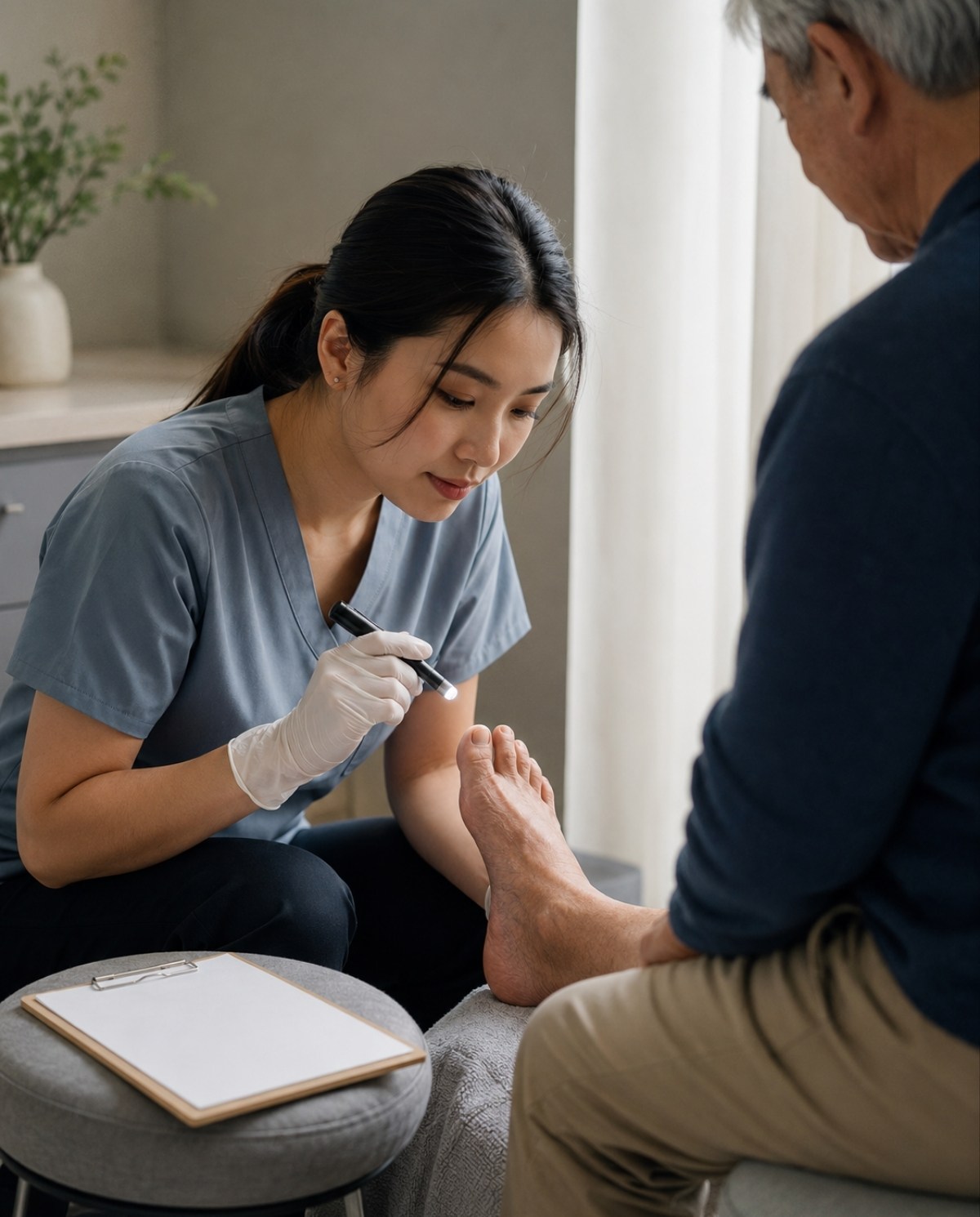
Nail technician uses a small penlight to visually screen an older man’s healthy feet before beginning a cosmetic nail service. Learning how to become a specialist in this field takes dedicated focus, but the journey can be structured to build your knowledge step by step. The first stage is establishing a strong foundation in nail anatomy, infection control, client consultation, product chemistry, and safe practical techniques. You must generally begin by completing a state-approved beauty program and earning the nail technician or cosmetology license required where you intend to practice. To get a complete breakdown of this baseline path, you can explore our comprehensive guide on nail technician certification requirements, costs, and licensing timelines to map out your initial steps. State regulations regarding foundational school hours differ significantly across the country. For example, the Georgia State Board of Cosmetology and Barbers requires a 525-hour nail-care curriculum divided between theory and practical service applications. Atlanta Beauty Academy's own Nail Technician program contains 600 hours of theory and practical training, exceeding the state minimum. Meanwhile, the Arkansas Department of Health requires 600 hours of manicure training. Choosing a high-quality beauty school for this step is essential because a strong understanding of nail anatomy, product chemistry, infection control, and service safety prepares you for later specialization. However, graduating from a nail program and receiving a state license does not automatically make someone an MNT. Medical Nail Technician is a private certificate rather than a nationally standardized license, so there is no single training sequence required throughout the United States. One widely referenced pathway is offered by Nailcare Academy. Its full MNT track includes:
  • Advanced Nail Technician, or ANT, education
  • Wellness Nail Technician, or WNT, education
  • A Medical Nail Technician internship preparation program
  • A documented 40-hour internship with a foot-care medical provider
The ANT and WNT programs are prerequisites for the internship in this specific training system. Other private schools or certificate providers may use different course names, prerequisites, clinical requirements, or credentialing standards. Before paying for advanced training, compare the provider's curriculum, instructor qualifications, hands-on requirements, internship support, assessment process, graduate policies, and eligibility rules. You should also verify whether your state permits the techniques, tools, and services taught in the course.

Can You Complete Your Advanced Training Online?

Many busy working professionals wonder how to become a certified specialist while maintaining a full work schedule. Some theory-based programs allow you to study topics such as anatomy, chronic-condition awareness, infection prevention, and client screening from home. For example, Nailcare Academy provides its ANT and WNT coursework online. Its complete medical nail technician online pathway also includes a separate 40-hour internship with a foot-care medical provider before the student completes the MNT process. This does not mean that every advanced nail program has the same clinical requirement. Because MNT is not a nationally regulated credential, online and hands-on requirements vary by provider. A useful program should clearly explain what is taught online, how practical competency is evaluated, what internship assistance is available, and whether applicants must already hold an active nail or cosmetology license. During supervised clinical exposure, students may learn how a medical office operates, how to communicate professionally with healthcare providers, how to document services, and how to recognize visible warning signs that require referral. They must still avoid diagnosing neuropathy, vascular disease, fungal infection, or any other medical condition.

What to Expect from Requirements and Regulations

Clear boundaries are what keep both you and your clients safe. If you ever experience imposter syndrome, remember that your scope of practice defines what your professional license legally allows you to do. An additional private certificate may increase your knowledge, but it does not change that legal boundary. Because MNT is not a separate government license, there is no single nationwide list of requirements. In the Nailcare Academy pathway cited above, advanced programs are intended for licensed nail technicians and cosmetologists, and students complete ANT and WNT training before beginning the MNT internship. Another provider may structure its certificate differently. The most important rule is that you must always follow the law of the state where the service is physically performed. An industry explanation published by Nailcare Academy confirms that an ANT, WNT, or MNT certificate does not expand or alter the technician's original state scope of practice. A technician has the same legal boundaries in a podiatry office that they would have in a salon. This distinction is especially important in Georgia. Under Georgia's facility and sanitation rules, cosmetology services may be performed only on intact, healthy skin and nails. A private advanced certificate does not allow a Georgia nail technician to treat an infected nail, work on an open wound, remove living tissue, diagnose disease, or perform a service that belongs within the practice of podiatry or medicine. Advanced education gives you something highly valuable: better judgment about when a client's condition may be unsafe for a cosmetic service. Knowing when to stop, modify, postpone, or refer a service is one of the most important skills an advanced technician can develop. Warning signs that may require medical evaluation include:
  • Open cuts, sores, ulcers, or active bleeding
  • Blisters, drainage, or suspected infection
  • Unusual redness, warmth, swelling, or inflammation
  • Severe pain or a sudden change in the foot or nail
  • An ingrown nail that has entered or broken the skin
  • Thick, yellowed, curved, or severely distorted nails in a client with diabetes or reduced sensation
  • A client who cannot adequately see, feel, or reach their feet
The National Institute of Diabetes and Digestive and Kidney Diseases advises people with diabetes to seek professional foot care when nails are thick, yellowed, curved, or growing into the skin, particularly when the person cannot safely trim them independently. A certificate may help demonstrate that you have pursued additional safety education, but it does not automatically shield you from liability. Technicians must still follow state regulations, maintain proper sanitation, document services appropriately, carry suitable professional insurance, obtain informed client information, and stay within their legal scope at all times.

Career Outlook and Financial Freedom: The Specialist Advantage

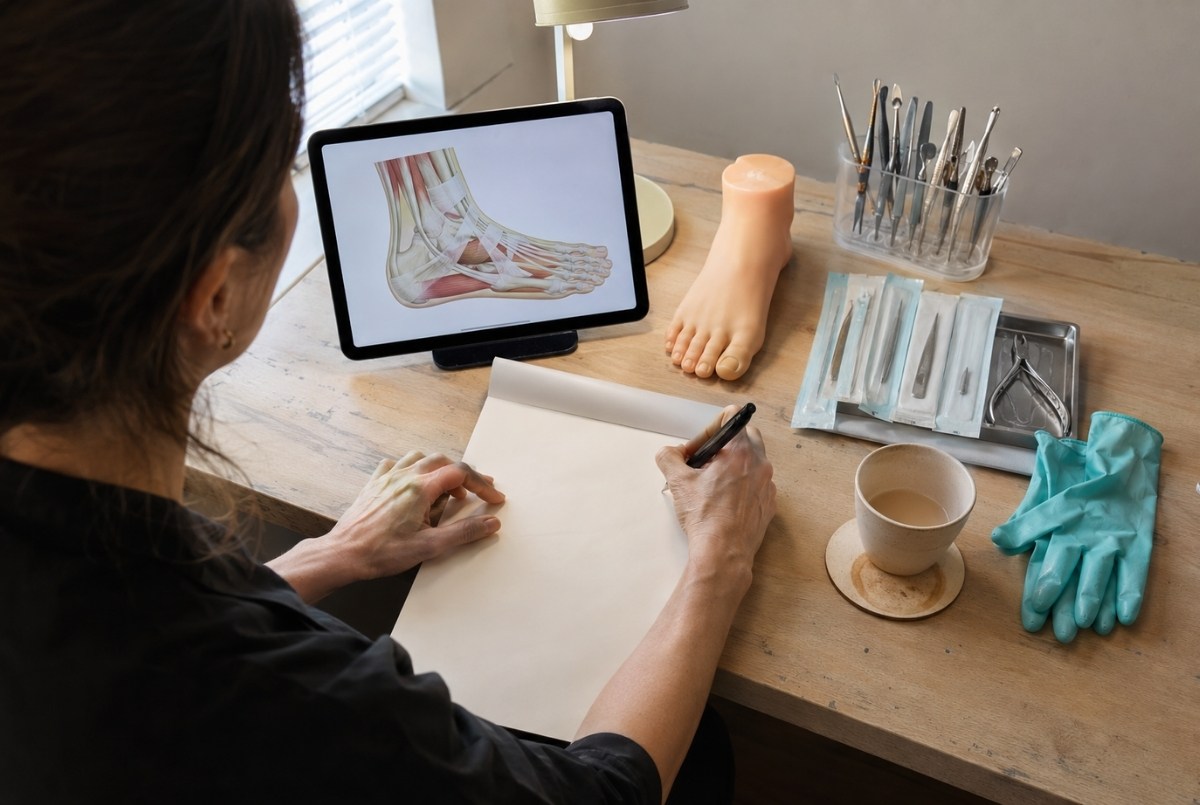
Adult nail professional studies foot anatomy and infection control beside a practice foot, gloves, disposable files, and sanitized nail tools. Specialization can help you step away from competing only on speed and low prices. When you develop stronger consultation, sanitation, documentation, and referral skills, you may be able to create a more focused service experience for clients who value safety and careful attention. However, there is currently no authoritative national salary database specifically for Medical Nail Technicians. MNTs are generally included within the broader manicurist and pedicurist occupation rather than tracked as a separate healthcare career. According to the U.S. Bureau of Labor Statistics, manicurists and pedicurists earned a median wage of $16.66 per hour in May 2024. Employment in the broader occupation is projected to grow 7% from 2024 to 2034, with approximately 24,800 openings projected each year. These federal wage figures do not include self-employed workers, which is an important limitation for anyone considering an independent suite or mobile business. A specialist's results may differ significantly depending on:
  • Local demand and competition
  • State scope-of-practice restrictions
  • Employee, booth-rental, or business-owner status
  • Appointment length and service pricing
  • Client retention and referral relationships
  • Rent, supplies, insurance, taxes, and payment-processing expenses
  • The technician's experience, reputation, and weekly booking volume
Advanced training may allow a technician to position services around careful consultation, lower client volume, longer appointments, and a more personalized environment. In some markets, that may support higher service prices than a basic walk-in pedicure. It does not guarantee an annual income of $80,000 or $90,000, and gross service revenue should never be confused with personal take-home pay. For example, a business may collect substantial annual revenue while still paying for rent, products, equipment, continuing education, insurance, licensing, marketing, taxes, and unpaid administrative time. A realistic career plan should calculate all of these costs before estimating income. The strongest financial advantage of specialization is not a guaranteed salary figure. It is the opportunity to build a business around expertise, trust, client retention, and a clearly defined service experience rather than competing only through low prices and rapid turnover.

Ready to Master Your Craft?

The path from a high-volume salon environment to an advanced nail-care specialization begins with a strong foundational education. At the Atlanta Beauty Academy, our Salon-Ready approach prepares students through nail anatomy, infection control, product knowledge, client consultation, and extensive practical training. Our 600-hour Nail Technician program exceeds Georgia's 525-hour minimum and helps students prepare for the licensing process and entry into the professional nail industry. After becoming properly licensed, graduates interested in medical-adjacent nail care may research reputable advanced private certificates and supervised learning opportunities. Advanced MNT education must be completed separately through an appropriate provider unless it is specifically included and documented within a school's approved curriculum. No private certificate replaces a state nail license or gives a technician permission to provide medical treatment. We don't just teach you how to prepare for the state board process. We help you build the foundational judgment, technical discipline, and professional habits needed to explore future opportunities responsibly. Fill out the contact form below to join a 20-year legacy of beauty education. Let us help you turn your passion into a skilled, respected, and safety-focused career.

Frequently Asked Questions

Is a Medical Nail Technician a licensed medical professional? No. An MNT is generally a licensed nail technician or cosmetologist who has completed additional private education. The certificate does not make the holder a doctor, nurse, podiatrist, or other licensed healthcare provider. An MNT cannot diagnose disease, prescribe treatment, provide wound care, or exceed the scope of the underlying state beauty license. Do medical nail technicians accept health insurance? Private cosmetic MNT services are normally paid out-of-pocket and are not independently billed to insurance by a nail technician. However, it would be incorrect to say that insurance never covers foot or nail care. According to Medicare, routine foot care is usually not covered, but medically necessary treatment and limited routine foot-care services may be covered in certain circumstances when Medicare's requirements are met and the service is furnished by an eligible healthcare provider or practice. Clients should confirm coverage directly with the clinic and their insurance company. What is the difference between an Advanced Nail Technician and a Medical Nail Technician? The definitions depend on the private certificate provider. In Nailcare Academy's system, an Advanced Nail Technician completes advanced education focused on salon safety, infection control, and professional practices. The ANT program is followed by Wellness Nail Technician education. Students then complete the Medical Nail Technician internship preparation program and a documented 40-hour internship with a foot-care medical provider. Therefore, in this particular system, an MNT is not simply an ANT who completes an internship; the WNT program is also part of the pathway. Can a medical nail technician treat fungus, ingrown nails, or diabetic foot problems? An MNT may recognize visible warning signs and refer the client to an appropriate healthcare provider, but the certificate does not authorize medical diagnosis or treatment. Whether a cosmetic service can be performed depends on the client's condition and the technician's state scope of practice. In Georgia, cosmetology services are limited to intact, healthy skin and nails. Can I move to a different state easily once I am licensed? Not automatically. Your advanced certificate may remain evidence that you completed additional education, but it does not authorize you to practice in another state. You must meet the destination state's endorsement, reciprocity, examination, education, and licensing requirements before providing services there. The Cosmetology Licensure Compact is intended to make interstate practice easier for eligible professionals in participating states. However, the official Compact website states that multistate licenses are not yet available. Eligibility will also depend on the professional's exact license type and home-state status. Until the system begins accepting applications, technicians must continue using each state's existing licensing or endorsement process.

How to Get a Job as a Nail Technician When You Have Zero Salon Experience

The classic career paradox can feel incredibly frustrating. You read job boards only to find that many salons ask for professional experience, but you cannot get that experience until someone hires you. When you are sitting at home with a brand-new license and a nervous hand, it is completely normal to face a wave of imposter syndrome. You might wonder if salon owners will even look at your application if you have only performed manicures on beauty school classmates or close friends. Every elite nail artist in the industry started exactly where you are standing right now. Landing your first job is not about faking a long work history, it is about shifting how you present your current value. Salon owners are not just looking for a long list of past employers. They are looking for safety, enthusiasm, teachability, customer service, and basic technical competence. This guide provides a clear, actionable roadmap on how to apply for a nail technician job, command attention from salon owners, and pass your first interview with total confidence.

Key Takeaways

  • The Market is in Your Favor: The U.S. Bureau of Labor Statistics projects 7% employment growth for manicurists and pedicurists from 2024 to 2034, with about 24,800 openings projected each year on average.
  • Skills Over History: Prior retail, food service, hospitality, or customer-facing work can translate directly into the client communication, time management, and retention skills salon owners need.
  • Safety is Your Selling Point: Understanding product labels, Safety Data Sheets, proper disinfection, ventilation, and ingredient risks helps you stand out as a responsible licensed beginner.
  • State Rules Vary: States set their own licensing, training, apprenticeship, and salon-safety rules. For example, Georgia recognizes a nail technician apprentice pathway, while Arkansas requires a structured 600-hour manicure curriculum.

Rewriting the Rules for Your Entry-Level Resume
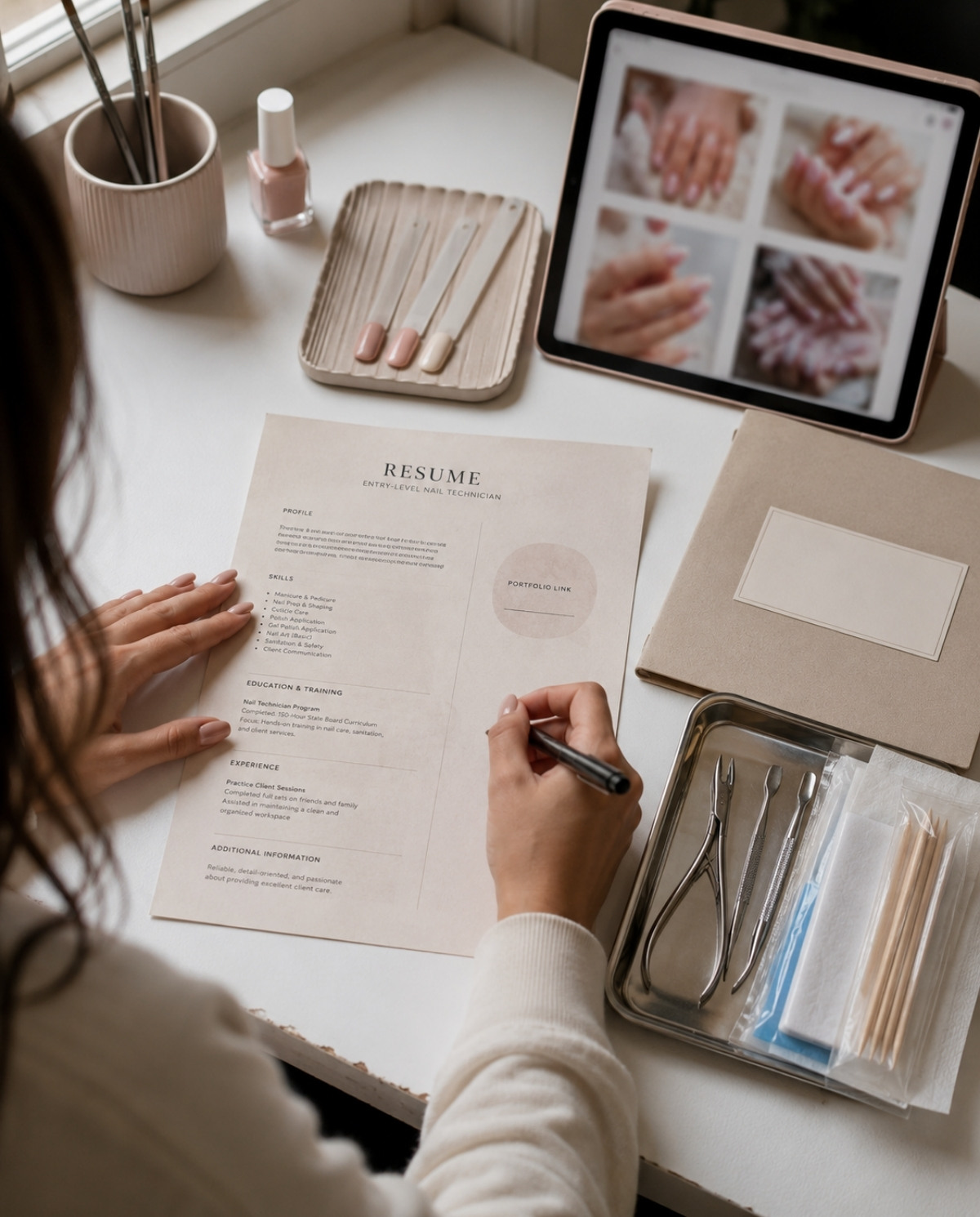
Beginner nail technician reviewing an entry level resume beside a tablet portfolio, polish swatches, license folder, and sanitized manicure tools. When you lack a traditional salon work history, your resume should not be a blank page or a collection of vague bullet points. Instead, treat your resume as a marketing document that highlights your technical potential and your foundational training. Building a clean CV for a junior nail technician, specifically tailored to showcase your skills without prior salon experience, requires focusing heavily on your educational milestones. A modern nail technician CV focuses on your technical potential, proving that entering the field with limited salon experience is not a barrier. If you attended a high-quality beauty school, your institutional hours are valuable. You should explicitly list your completed program, license or apprentice-license status, total training hours, clinic floor experience, sanitation training, and any advanced workshops you completed, such as e-file bit safety, structured gel application, or acrylic fundamentals. To help you structure this section accurately, you can review the professional nail tech blueprint 2026 essential skills procedures and your professional starter kit to align your resume with the specific operational skills modern owners look for. Your resume should also include a portfolio link, even if your portfolio is still small. A clean Instagram page, Google Drive folder, or simple digital portfolio with well-lit photos can prove that you understand shape, prep, polish control, and sanitation presentation. For an entry-level applicant, a small but organized portfolio is more persuasive than a long resume filled with unrelated filler.

Translating Transferable Skills to Your CV

If you have past experience in retail, food service, hospitality, or corporate administration, you already possess skills that salons need. Salon owners want to know that you understand client retention, time management, communication, upselling, and conflict resolution. For example, if you worked as a barista, do not just write "made coffee." Instead, write: "Managed high-volume customer orders under tight time constraints while maintaining strict health and safety protocols." If you worked in retail sales, highlight your ability to recommend products, manage payments, handle customer questions, and stay calm during busy hours. These experiences show that you understand the service side of the beauty industry, which makes you a lower-risk hire. When writing your introductory profile, drafting a strong objective for an entry-level nail technician is crucial. Your nail technician objective statement must immediately highlight your technical safety standards and your desire to grow within a structured team environment. A great example is: "Licensed Nail Technician eager to bring strong sanitation habits, modern gel-system knowledge, and client-first hospitality to an entry-level role at a growing salon."

The Fast-Growing Job Market

Many beginners assume they are competing for a tiny handful of slots against veteran techs. However, recent data from the U.S. Bureau of Labor Statistics shows that employment for manicurists and pedicurists is projected to grow 7% from 2024 to 2034, which is much faster than the average for all occupations. According to the BLS, this growth results in roughly 24,800 open positions each year on average over the decade. Many of those openings are expected to come from workers who transfer into other occupations or leave the labor force, including retirements. That does not mean every salon will hire any beginner immediately, but it does mean the market continues to create steady opportunities for properly trained, licensed applicants who can show professionalism from day one. The BLS also lists the median hourly wage for manicurists and pedicurists at $16.66 in May 2024. Actual income can vary widely depending on location, tips, commission structure, booth rental costs, client volume, and whether the technician is an employee or self-employed. For a beginner, this makes the first job valuable not only for pay, but also for building speed, confidence, repeat clients, and professional credibility.

Crafting a Compelling Cover Letter That Opens Doors

A resume tells an employer what you can do, but your cover letter tells them who you are. When writing a personalized cover letter for an entry-level nail technician position, your goal is to show deep enthusiasm for the specific salon you are targeting. Salon owners can spot a generic, copy-pasted template from a mile away. Your introductory cover letter for a trainee or junior nail technician position should focus on your passion, proving that launching a career with limited salon experience can actually make you highly teachable. Owners often prefer hiring eager beginners because they can be trained to fit the salon's exact brand standards, timing expectations, client-service style, and service protocols.

The Anatomy of a Perfect Application Intro

Start your cover letter by addressing the salon manager or owner by name whenever possible. Mention exactly why you want to work at their specific location. Perhaps you admire their commitment to nail art education, their reputation for clean work, their luxury pedicure menu, or their focus on natural nail health. Next, highlight your commitment to safety and scope of practice, which means understanding the legal boundaries of what your state license allows you to perform. For example, you can explain that you understand the difference between professional exfoliation and invasive skin removal, and that you only perform services on intact, healthy skin and nails within your training and state rules. This compliance is particularly critical if you plan to practice in states with detailed regulatory boards. For instance, the Georgia Board of Cosmetology and Barbers states that cosmetology services should only be performed on intact, healthy scalp, skin, and nails, and Georgia explicitly prohibits razor-like implements such as credo blades and razor-type callus shavers. Arkansas also enforces detailed rules around personal cleanliness, pedicure-spa disinfection, labeled containers, disinfectant use, and storage of cleaned items in dry, covered containers through the Arkansas cosmetology rules. Demonstrating that you understand how to implement strict nail salon hygiene aftercare preventing infections and protecting clients before you are even hired positions you as a highly informed professional. Conclude by explicitly stating your willingness to complete a practical technical test on a live model or practice hand to prove your current skill level.

Standing Out with Chemical Safety Insights

In the modern beauty landscape, salon owners face serious client-safety, worker-safety, and product-compliance responsibilities. According to the U.S. Food and Drug Administration, the Modernization of Cosmetics Regulation Act, known as MoCRA, expanded FDA authority over cosmetics and includes requirements such as serious adverse event reporting and safety substantiation for cosmetic products. For a nail technician, the point is not to pretend you personally carry every manufacturer-level MoCRA responsibility. The stronger point is that you understand the modern safety environment around cosmetic products. The FDA's cosmetic registration and product listing guidance states that a responsible person must list each marketed cosmetic product with FDA, including product ingredients, and provide updates annually. That kind of product visibility makes it more important for salons to buy from reputable suppliers, read product labels, keep Safety Data Sheets accessible, and take client reactions seriously. You can also stand out by knowing current ingredient warnings. For example, the FDA has warned that several cosmetic products marketed as gel nail polish removers were found to contain methylene chloride, also known as dichloromethane or methyl bichloride. FDA states that methylene chloride is prohibited in cosmetics at any level. Mentioning that you know how to check labels, avoid suspicious imported removers, and ask for Safety Data Sheets shows the salon owner that you are a responsible professional asset who helps protect clients and the business.

Building a Standout Nail Technician Portfolio From Scratch

In the beauty industry, visual proof of your talent often carries more weight than a piece of paper. Your digital nail technician portfolio acts as your real-world proof of talent. You do not need a massive book of paying salon clients to build an impressive portfolio. You can build your initial portfolio using beauty school practice hands, classmates, friends, and family members. The key is to showcase consistency, precision, and clean work rather than complex, messy nail art. Beginner nail technician using a mounted phone and ring light to photograph a clean manicure for a first professional nail portfolio.
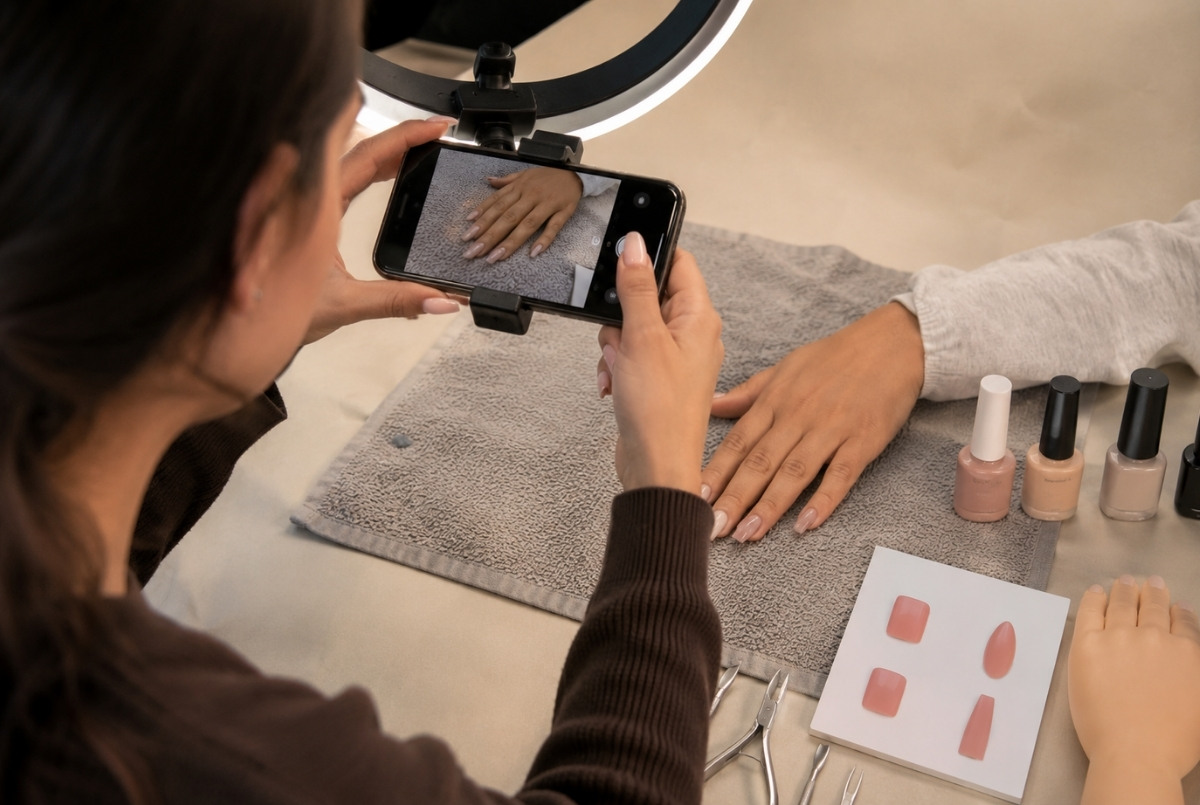
Curating Your Best Work

When taking photos of your work, avoid using aggressive filters or distracting backgrounds. Use a uniform, neutral background and bright, natural lighting or a clean ring light. Crop out messy towels, open containers, used files, or cluttered product bottles in the background. Your portfolio should display a variety of shapes, including coffin, almond, and square, and should feature clean polish application with no flooding into the lateral nail folds. Include close-up shots of high-quality basic manicures alongside your best nail art. This shows that you have mastered the foundational mechanics of nail care before trying to master complex designs. For each photo, add a short caption that proves professional thinking. For example, mention the service type, shape, product system, prep method, and whether the work was done on a practice hand or live model. A beginner portfolio becomes much stronger when it explains the process behind the result.

Showcasing Product Chemistry Knowledge

A sophisticated portfolio does not just show pretty colors, it demonstrates an understanding of product systems and client safety. As highlighted in a market trends analysis by Booksy Biz, modern salon conversations increasingly focus on cleaner positioning, ingredient awareness, and more specific product claims instead of vague "non-toxic" marketing language. This is where accuracy matters. HEMA-free and TPO-free products are often marketed as ways to reduce exposure to specific ingredients of concern, but they do not automatically make a service risk-free. The FDA's nail care product guidance explains that many nail products contain potentially harmful ingredients but may be safe when used according to directions. The British Association of Dermatologists has also warned about allergic reactions connected to methacrylate chemicals used in acrylic nails, gel nails, and gel polish. In your digital portfolio or during your interview, adding brief text captions that explain how you follow the manufacturer's lamp, cure-time, product-thickness, and application instructions proves you are an educated specialist, not just a casual hobbyist. Avoid claiming that any product is completely allergy-proof. Instead, show that you understand the real safety habits: avoid skin contact with uncured gel, cure correctly, do not casually mix incompatible lamps and gel systems, keep containers closed, and follow product instructions.

Mastering the Interview and the Practical Test
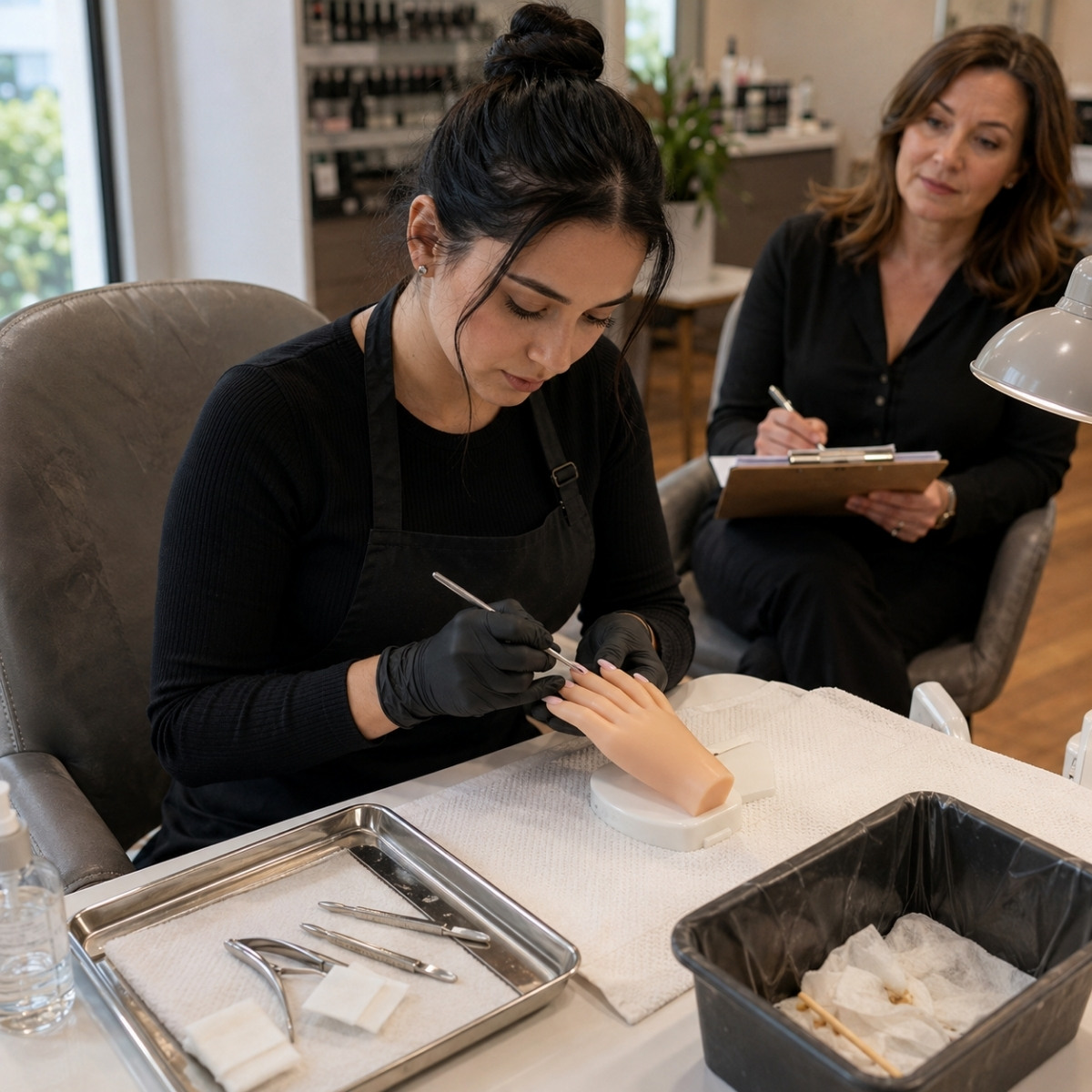
New nail technician performing cuticle area prep on a practice hand during a salon interview while a manager observes with a clipboard. Walking into a salon interview can feel nerve-wracking, but preparation is the ultimate antidote to anxiety. When preparing for typical interview questions for an entry-level nail technician, you should focus on practicing nail technician interview questions and answers before you walk through the door. Studying structured interview questions and answers for a modern nail technician allows you to script your responses so you do not freeze under pressure. Reviewing common interview questions for a beginner nail technician with answers prepared for a live panel helps you steer the conversation back to your strengths, your training background, your safety habits, and your dedication to the craft.

Handling Tough Questions About Experience

The interviewer will almost certainly ask: "Since you haven't worked in a commercial salon before, how do you handle a fast-paced environment?" Do not apologize for your lack of experience. Instead, answer confidently: "During my beauty school clinic floor hours, we worked under time limits to simulate a real salon environment. I learned how to manage my setup, perform a clear consultation, complete a clean service, and maintain sanitation protocols throughout the appointment. I know I still need to build speed, but I already understand how to stay organized, safe, and coachable under pressure." If the salon asks you to perform a practical audition, which is a live technical test on a model or practice hand, ask ahead of time what the salon wants you to bring. If you bring your own kit, make sure reusable implements are properly cleaned, disinfected, dry, and stored in a clean, covered container according to state-board rules. Keep disinfected tools separate from used tools, and do not reuse porous single-use items such as certain files, buffers, orangewood sticks, or toe separators unless your state rules and product instructions clearly allow proper disinfection. If you are interviewing in Georgia or Arkansas, remember that inspectors and salon owners care about visible sanitation habits. Georgia requires proper cleansing, disinfection, and storage of tools, while Arkansas rules require handwashing before each client, correctly labeled bottles and containers, proper pedicure-spa cleaning, and disinfectants used according to manufacturer labels. Throughout the audition, walk the evaluator through your steps, explaining how you protect the natural nail plate, avoid overfiling, prevent cross-contamination, and maintain a clean station.

Safe Workstation Engineering

One major occupational health concern for a professional nail technician is repeated exposure to dust, vapors, and chemical ingredients, especially in poorly ventilated spaces. The Occupational Safety and Health Administration advises salon workers and employers to choose safer products, read product information, use appropriate gloves, avoid surgical masks for chemical protection, and rely on good ventilation and work practices to reduce exposure. Ventilation standards can also appear in building-code requirements. The International Code Council explains that the International Mechanical Code requires source-capture systems at manicure and pedicure stations, with a minimum exhaust rate of 50 CFM at each station and exhaust inlets located close to the point of chemical application when factory-installed inlets are not provided. Exact requirements can vary by jurisdiction and build-out, so the safest approach is to treat ventilation as both a worker-safety issue and a local-code issue. During your salon walkthrough or practical test, showing immediate respect for downdraft tables, source-capture equipment, closed product containers, clean waste handling, and ventilation maintenance signals to the salon owner that you treat your career as a professional trade. It shows you value workplace longevity, client safety, and the health of everyone in the salon.

Ready to Master Your Craft?

Building a rewarding career begins with a foundation that salon owners trust. At Atlanta Beauty Academy, we do not just prepare you for state board exams, we use a hands-on, salon-ready approach that mirrors real-world salon environments. By training in sanitation, safety, state-board preparation, professional service flow, and hands-on technical skills, you can step off the clinic floor with the professional credibility that top salons actively seek. Your transition from an aspiring beauty enthusiast to a confident, high-earning artist starts here. Fill out the contact form below to tour our campus, meet our mentors, and see our 20+ years of education legacy in action. Let’s launch your beauty career together.

Frequently Asked Questions

Do I need a formal cosmetology or nail technology license to get hired at a reputable salon? Yes, in most situations, you need a valid state-issued license before performing manicures, pedicures, and nail enhancement services for compensation. The U.S. Bureau of Labor Statistics explains that manicurists and pedicurists must complete a state-approved cosmetology or nail technician program and pass a state exam for licensure. However, state pathways can vary. Some states also recognize regulated apprenticeship options. For example, under the Georgia apprentice rules, nail technician apprentice training requires 8 months and 1,050 hours, and apprentice hours cannot be combined with school hours. This means applicants should always check their current state-board rules before assuming one pathway applies everywhere. Attending a dedicated beauty school remains one of the clearest ways to build the training hours, sanitation knowledge, and legal foundation required for state-board readiness. What is the standard entry-level pay structure for an apprentice nail technician? Entry-level pay structures generally fall into three categories: hourly base pay, commission splits, or booth rentals. For a beginner with no prior salon experience, securing hourly base pay plus tips is usually the safest path. This structure ensures you are compensated for your time while you are building a loyal clientele and learning salon operations. Commission and booth rental can become attractive later, but they usually require an established client base, strong rebooking habits, and a clear understanding of expenses. According to the BLS, the median hourly wage for manicurists and pedicurists was $16.66 in May 2024, but real take-home income can vary widely based on location, tips, service pricing, schedule, product costs, and employment structure. Can you work as a nail technician while pregnant or dealing with respiratory sensitivities? Many people can work in nail care while pregnant or managing sensitivities, but they should take workplace exposure seriously and speak with a healthcare professional about their specific situation. Good ventilation, closed containers, nitrile gloves when appropriate, source-capture dust control, and careful product selection are more reliable than relying on a basic mask alone. The OSHA nail salon chemical hazard guidance specifically warns that surgical masks do not protect workers from gases, vapors, or particulates. OSHA also explains that NIOSH-approved N95 respirators can help with particulates such as dust from buffing or filing, but they do not protect against chemical vapors or gases. If vapor protection is actually required, the employer must evaluate exposure and follow OSHA respiratory-protection requirements, including proper respirator selection, fit testing, medical evaluation, and training.

Conclusion: Your Launchpad to Professional Credibility

Breaking into the beauty industry without prior salon experience comes down to a mix of confidence, strategic preparation, and excellent foundational training. By structuring a clean CV, showcasing a precise portfolio, and demonstrating an informed understanding of sanitation, product safety, state rules, and ventilation, you make it easier for salon owners to choose you. Your long-term career outcomes depend heavily on the strength of your initial foundation. Choosing a high-quality beauty school pathway gives you the technical precision, legal compliance knowledge, and professional credibility needed to move past entry-level roadblocks. With the right training, you can step out of the classroom and walk into a salon environment with confidence, humility, and professional pride.