How Much Do Barbers Make? Understanding Pay, Expenses, and Take-Home Income

Key Takeaways

  • Understand the wage benchmark: BLS reports a median barber wage of $18.37 per hour for May 2025, equivalent to approximately $38,210 annually at 2,080 working hours. These estimates include employee tips and commissions but exclude self-employed earnings.
  • Separate revenue from take-home income: Haircut prices and daily receipts do not show what you actually keep. Commission deductions, rent, supplies, processing fees, and taxes determine your final income.
  • Calculate before switching to booth rental: Rental becomes financially attractive when dependable service sales outweigh its additional costs. With a 60/40 commission split and $400 in additional weekly rental expenses, the simplified crossover is $1,000 in weekly service sales before personal taxes.
  • Plan taxes around profit: The standard 15.3% self-employment tax generally applies to 92.35% of net self-employment earnings after deductible business expenses, rather than gross service revenue.
  • Build sustainable earning power: Consistent client retention, services priced for their time and cost, profitable retail sales, and manageable local expenses can strengthen income without relying solely on more daily appointments.

What Government Wage Data Tells You About Barber Pay

When researching potential earnings, most prospective students turn to federal statistics first. If you look up the barber yearly salary, the U.S. Bureau of Labor Statistics Occupational Outlook Handbook reports a median hourly barber wage of $18.37 in May 2025. Multiplying that rate by 40 hours a week for 52 weeks produces an annualized equivalent of approximately $38,210. That calculation assumes full-time, year-round work; it is not a guarantee of what every barber earns. The median is the midpoint of the wage distribution, meaning half of the workers represented earn more and half earn less. It is different from the mean, or arithmetic average, and neither figure should be treated as a ceiling on your earning potential. The main limitation is who the wage survey covers. According to the BLS Occupational Employment and Wage Statistics methodology, wage estimates include employee tips and commissions but exclude self-employed workers and owners or partners in unincorporated businesses. Independent booth renters therefore fall outside these employee wage estimates. That distinction matters because a booth renter collects business revenue and then pays the expenses required to earn it. An employee's wages and a self-employed barber's total client receipts are different financial measures. Excluding self-employed earnings does not establish that all barbers earn a fixed percentage more than the published median. For career planning, use employee wage data as a benchmark, then build a separate estimate for your preferred work arrangement. Your client volume, service prices, expenses, and ability to retain customers determine how much of your incoming revenue becomes personal income.

How Haircut Prices and Client Volume Shape Your Income

To understand your earning potential, you need to break down the daily math. Your service revenue depends on how many appointments you complete and how much clients spend during each visit. Your income also depends on the time and expenses required to deliver those services.

Service Prices and Average Tickets

Many prospective students want to calculate how much do barbers make per cut before committing to school. Start by separating the price paid by the client from the amount the barber keeps. A $35 haircut generates $35 in service revenue, but the barber may receive only a commission share or need to pay rent and other business expenses from that amount. Haircut prices vary by location, service complexity, and shop positioning. Rather than relying on a single national price range, compare current menus at nearby shops offering similar services. Add-on services can increase your average ticket—the total amount a client spends during a visit. For example, a hypothetical $30 haircut combined with a $15 beard trim produces a $45 service ticket. Whether that combination improves your earnings depends on the extra time, supplies, and skill involved. A $30 haircut completed in 30 minutes generates $60 per service hour before expenses. A $45 haircut-and-beard appointment completed in 45 minutes generates the same $60 per service hour. The larger ticket increases revenue per client, but it does not automatically increase revenue per hour. This is why pricing should account for both the service's value and the time required to perform it safely and consistently.

Daily Volume and Realistic Appointment Capacity

A common question among beginners is how many cuts does a barber do a day to earn a stable living. There is no single reliable number for every barber. Appointment capacity depends on haircut complexity, consultation time, cleaning and disinfection, breaks, and how fully your schedule is booked. Consider an illustrative eight-hour workday with one hour reserved for breaks, cleaning, and administrative tasks. That leaves seven hours for appointments. At 45 minutes per appointment, you can accommodate approximately nine completed visits. Shorter appointments may allow more clients, while detailed services may require fewer. An open appointment slot does not generate revenue. Cancellations, no-shows, and quiet periods reduce the number of paid visits you actually complete, so a realistic income estimate should use expected completed appointments rather than assume every available slot will sell.

Daily Receipts and Hourly Earnings

Barber in a pale blue shirt sweeping hair clippings from the floor beside an empty black barber chair. If you evaluate how much does a barber make a day using ten completed appointments at a $35 average service ticket, your gross service revenue is $350. For planning purposes, if tips equal 15% to 20% of service revenue, they add $52.50 to $70. Total daily receipts would then range from $402.50 to $420 before commission deductions, business expenses, and taxes. This is an illustrative scenario, not a claim that every client tips within that range. When considering how much do barbers make an hour, count the entire workday. Across eight working hours, those receipts equal approximately $50.31 to $52.50 per hour in gross incoming revenue. That figure is not take-home hourly pay. Tracking completed visits, average tickets, and total working hours gives you a clearer picture of your business than looking at haircut prices alone.

Understanding Gross Revenue and Take-Home Income

There is a big difference between gross revenue—the money your services and product sales generate—and the income available for personal spending. For a self-employed barber, the financial calculation starts with service receipts, tips, and any retail revenue. You then subtract business expenses such as chair rent, supplies, payment processing, booking software, insurance, and equipment costs. What remains is business profit before personal taxes. For an employee, the starting point is the compensation paid by the shop, including wages or commissions and applicable tips. The shop's total service revenue is not the employee's income. Keeping these calculations separate helps you compare work arrangements accurately. A rental arrangement that produces higher receipts may still leave less money after expenses than an employee position with a dependable client flow.

Commission Pay and Booth Rental

Two common arrangements are commission-based compensation and fixed chair rental, although shops may also offer hourly wages, salaries, or combinations of pay structures.
  1. Commission-Based Compensation: Under an illustrative 60/40 service split, the barber receives $60 from every $100 in service sales, and the shop receives $40. The agreement should explain how tips are handled and which expenses the shop covers. Depending on the arrangement, those may include space, products, towels, booking systems, and marketing.
  2. Booth Rental: You pay an agreed rental fee for space and generally operate your own business. You retain your service receipts and tips but are responsible for the expenses assigned to you under the rental agreement, which may include supplies, payment processing, booking tools, marketing, and insurance.
Commission describes a payment method; it does not automatically establish whether you are an employee or an independent contractor. The IRS worker-classification guidance explains that classification depends on the actual relationship, including behavioral control, financial control, and the type of relationship between the parties. Before accepting either arrangement, ask which expenses are included, who sets prices and schedules, how tips are handled, and what responsibilities belong to you.

Calculating When Rental Makes Financial Sense

Transitioning to booth rental too early can reduce your income because rent remains due even during a slow week. However, there is no universal weekly sales figure at which rental becomes the better choice. For a simplified comparison with a 60/40 commission split, divide the additional weekly costs of renting by 40%. This estimates the service sales required for rental to match the commission arrangement before personal taxes, assuming equal tips and excluding other differences between the roles. If rent and additional rental expenses total a hypothetical $400 per week, the crossover is $1,000 in weekly service sales: $400 ÷ 0.40 = $1,000. At $600 in weekly service sales, the rental arrangement leaves $200 before taxes, while a 60% commission share produces $360. At $1,500 in service sales, rental leaves $1,100, compared with $900 under the commission split. These examples assume the $400 captures the additional rental expenses and that other conditions are equal. If processing fees or supplies increase with sales, include those variable costs in your comparison. Employee benefits, tax treatment, and access to shop-generated clients can also change which arrangement is financially stronger. The practical question is whether your dependable sales—not just your best week—can support rent and operating expenses.

Taxes, Tools, and Business Records

Barber reviewing a receipt and using a calculator at a worn wooden workstation, with an empty chair reflected in the mirror. As a self-employed barber, you generally pay self-employment tax in addition to applicable federal and state income taxes. The IRS explains that the standard self-employment tax rate is 15.3%, consisting of Social Security and Medicare taxes. That rate generally applies to 92.35% of net self-employment earnings after deductible business expenses, rather than to gross haircut sales. The Social Security portion has an annual earnings limit, and additional Medicare tax can apply above specified income thresholds. One-half of self-employment tax is generally deductible when calculating adjusted gross income. Your records should distinguish income from expenses, including rent, supplies, processing charges, and equipment purchases. Cash payments and cash tips still need to be recorded. The IRS tax guide for the cosmetology and barbering industry provides additional guidance on booth rental, tip income, and recordkeeping. Planning for taxes and tool replacement throughout the year helps you avoid treating every dollar in your account as money available to spend.

Building Income Through Retail and Local Demand

Increasing earnings is not only about completing more haircuts. Appropriate product recommendations, well-priced specialty services, and a strong understanding of your local market can create additional revenue.

Retail Sales and What You Actually Keep

Retail products such as pomades, beard oils, and shampoos can help clients maintain their results between visits. Product sales also create revenue without requiring another full service appointment. However, retail revenue is different from your personal earnings. Selling four $20 products generates $80 in sales. If you receive a hypothetical 10% retail commission, your earnings from those sales are $8. Across 20 working days at that same sales level, the commission would total $160. If you purchase and sell your own inventory, calculate profit after wholesale costs, payment fees, and other applicable selling expenses. Unsold or damaged stock also affects the return. The Grand View Research men's grooming products report forecasts a global market of $506.7 billion by 2033. That forecast covers a broad range of grooming products and distribution channels; it does not measure barbershop service revenue or predict an individual barber's income. For your chair, the useful opportunity is more specific: recommend products that fit the client's needs, understand your commission or product costs, and track the income those recommendations actually produce.

Location, Pricing, and Operating Costs

Geography affects your earning potential, but a higher local haircut price does not automatically produce higher take-home income. Rent, competition, appointment demand, and other expenses also matter. The Best Cosmetology Programs salary guide currently lists May 2025 median annual employee wages of $61,150 in Washington, $30,750 in Georgia, and $25,640 in Arkansas. These figures describe employed barbers, not the business revenue or profit of self-employed professionals. For a more direct comparison, use the BLS state and metropolitan wage tables and keep the occupation, data year, and wage measure consistent. State medians should not be treated as a forecast for a particular neighborhood or a newly licensed barber. Before choosing a shop or rental location, compare:
  • Service Pricing: Current prices for comparable haircuts and grooming services at nearby shops.
  • Client Flow: The appointments you can reasonably expect to complete, including slow periods and cancellations.
  • Operating Costs: Chair rent, supplies, processing fees, insurance, and any booking or marketing charges.
  • Client Retention: Whether your existing customers can conveniently reach the location and are likely to return.
A strong personal reputation and specialized skills can support premium pricing, but the financial goal is sustainable profit rather than the highest advertised haircut price.

How Quality Training Supports a Stronger Career

Navigating the financial realities of barbering requires both technical ability and business judgment. Training can help you develop the precision, sanitation practices, communication skills, and service consistency needed to earn client trust. This is why your choice of school matters. Alongside preparation for licensing, look for opportunities to practice consultations, improve time management, and understand the responsibilities of working in a shop. If you are currently evaluating your training options, review our breakdown of barber school costs, program length, and entry requirements so you can plan your education and its financial commitment. Useful areas to evaluate include:
  • Efficiency and Technique: Developing consistent cutting skills, safe tool handling, and work habits that support quality without rushing consultations or disinfection.
  • Client Retention: Learning how to understand client preferences, deliver repeatable results, and recommend a return schedule appropriate to the haircut and the client's needs.
  • Business Readiness: Understanding service pricing, work arrangements, expense tracking, product recommendations, and the limits of your licensed scope of practice.
Your scope of practice depends on your state and license type. For example, Georgia's barber curriculum rules distinguish Master Barber training, which includes chemical services, from Barber II training. To understand how training connects with licensing, check out our guide on passing your state board exam and getting licensed. Quality education gives you a foundation to build on. Your longer-term income also depends on experience, demand, client retention, and how effectively you manage the financial side of the work.

Frequently Asked Questions

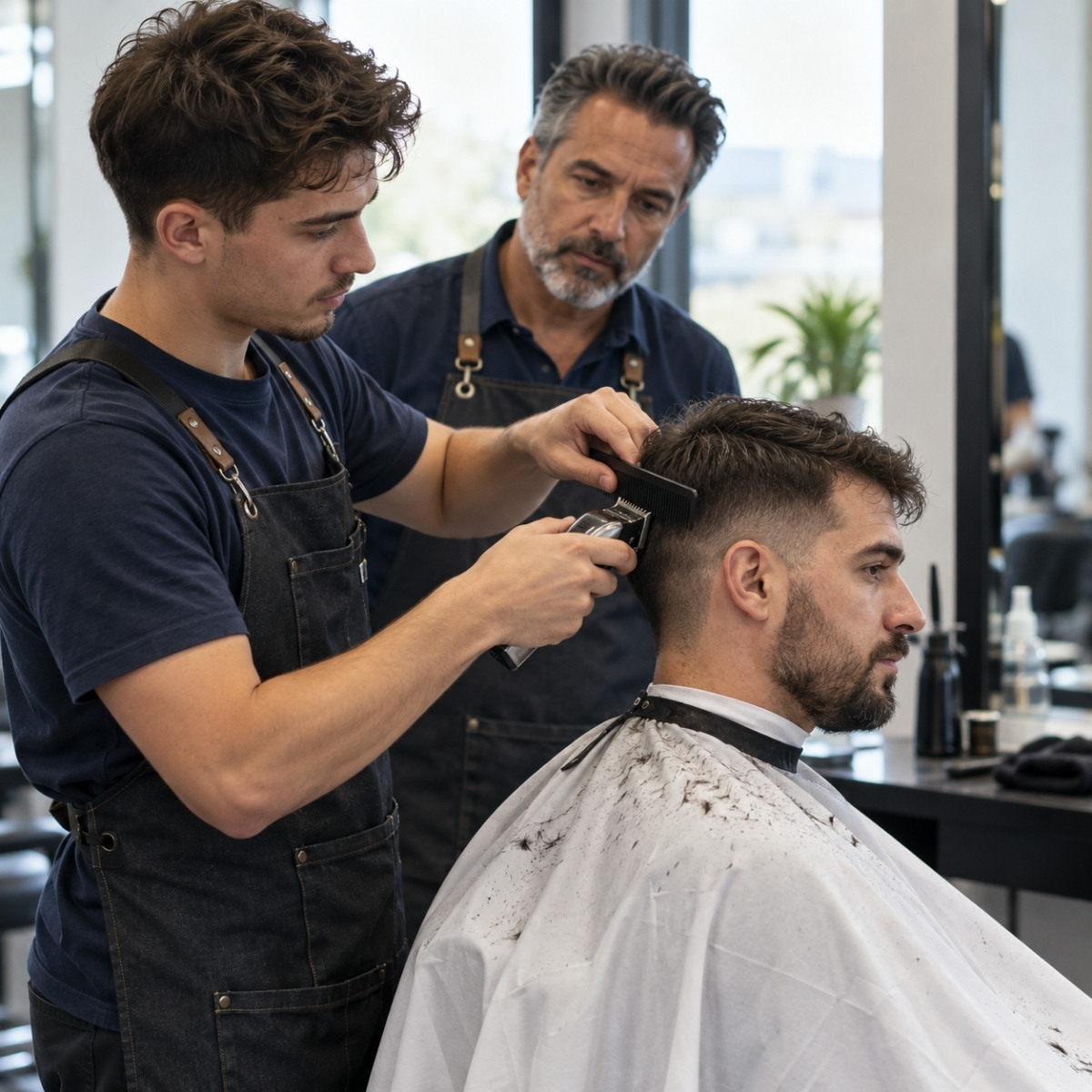
Barber trainee using clippers and a comb on a seated client while an instructor closely observes the haircut.

Do barbers make good tips?

Tips can add meaningfully to a barber's income, but the amount varies by client and visit. For an illustrative 15% to 20% tip on a $30 haircut, the gratuity is $4.50 to $6. Across ten appointments, that would add $45 to $60 if every client tipped within that range. Keep tip income separate in your records and avoid assuming it will be identical every day. BLS employee wage estimates already include tips, so you should not automatically add another tip percentage to those published wage figures.

How long does it take for a new barber to build a full client list?

There is no dependable universal timeline. Progress depends on your location, access to walk-ins, availability, service quality, and how often clients return. A more useful starting point is the size of the roster required to support your schedule. Ten appointments a day across five days means 50 weekly visits. If every regular client returns every two weeks, that workload requires approximately 100 active clients. At four-week intervals, it requires approximately 200. These are planning calculations that assume evenly distributed appointments and no cancellations. Tracking repeat visits and rebooking gives you a clearer measure of progress than relying on a fixed number of months.

Is barbering physically demanding?

Yes. Barbering involves prolonged standing and repeated use of the arms, hands, and wrists. The BLS occupational profile identifies physical stamina as an important quality because these workers spend much of their shifts on their feet. Adjusting the chair to a comfortable working height, using suitable tools, varying your posture, and allowing breaks can help manage physical strain. Persistent pain or numbness should be evaluated rather than treated as a normal requirement of the job.

What is the difference between a barber license and a cosmetology license?

Barbering commonly emphasizes haircutting, facial hair grooming, and shaving. Cosmetology generally covers a broader combination of hair, skin, and nail services. However, the legal boundaries vary by state and license type. In Georgia, Master Barber training includes coloring, permanent waving, relaxing, and chemical applications, while Barber II training follows a different curriculum. Before choosing a program or adding a service, check the requirements and permitted scope with the Georgia State Board of Cosmetology and Barbers or the relevant board in your state.

Ready to Master Your Craft?

Transitioning from an interest in barbering to professional work takes a career-ready foundation. At Atlanta Beauty Academy, our hands-on "Salon Ready" approach helps connect technical training with preparation for the professional environment. Build your skills in haircutting, grooming, sanitation, and client service while learning what it takes to enter the trade responsibly. A campus tour is also an opportunity to ask how the program prepares students for licensing, consultations, and the practical expectations of shop work. With more than 20 years of experience in beauty education, Atlanta Beauty Academy can help you explore your next step. Fill out our contact form below to schedule a campus tour and start planning your professional barbering career!

Opening a Barbershop: How to Plan the Business Before Signing a Lease

Key Takeaways

  • Ownership and Practitioner Licensing Are Separate: In many states, you can own a barbershop without holding a personal barber license. You must still obtain the required establishment license, use appropriately licensed practitioners, and meet any state-specific management requirements.
  • Budget Before Committing to a Lease: Existing salon or barbershop infrastructure may reduce build-out costs, but savings depend on its condition and suitability. Obtain contractor estimates and calculate the shop’s break-even point before signing.
  • State Requirements Matter: Georgia requires salon/shop owners to complete a board-approved health, safety, and sanitation course. Arkansas requires barbershops to operate under the personal supervision and management of a registered barber.
  • Worker Classification Depends on the Actual Relationship: Booth renters should operate independent businesses. Controlling their service prices, shifts, or working methods can create employee-classification risks, regardless of what their contracts say.
  • Technology Supports Revenue Management: Online booking, reminders, prepayment options, and clear cancellation policies can help manage appointments. Evaluate results using your own occupancy, cancellation, and revenue data.
Starting a personal care business can be a rewarding move, but jumping into a commercial lease before mapping out your strategy can lead to costly mistakes. Many prospective owners assume they must be licensed hair professionals to open a shop, yet states such as New York and Georgia distinguish establishment licensing from permission to perform barbering services. If you are exploring entering the trade yourself alongside your investment plans, taking time to review how to become a barber gives you a clear picture of the professional milestones and training required in this industry.

Understanding Barbershop Ownership Without a Barber License

If you lack technical haircutting experience, you might feel like an outsider entering the grooming industry. However, owning the business and providing regulated services are different responsibilities. The important first step is confirming how your state licenses the establishment, its practitioners, and anyone responsible for professional supervision.

Where Ownership Ends and Licensed Practice Begins

To build a legally compliant business, you must understand the distinction between an establishment license and an individual practitioner license. An establishment license authorizes operation of the shop under the applicable state requirements. An individual practitioner credential authorizes a person to perform services within that credential’s scope of practice. When prospective owners research how to open a barber shop, they often confuse these two frameworks. The New York State Division of Licensing Services explains that a Barber Shop Owner’s license does not permit its holder to practice barbering. Each person performing barbering services must hold the appropriate operator credential. New York also specifically prohibits apprentice barbers from owning a shop or renting space. For an owner who does not provide services, responsibilities can include brand development, finance, marketing, and business administration. However, ownership without a practitioner license does not remove the obligation to maintain a properly licensed establishment, meet facility and sanitation requirements, and arrange any professional supervision required by state law. If your goal is to own a barbershop without a barber license, do not perform regulated services such as haircutting, shaving, or line-ups unless you hold the appropriate credential. The legal boundary concerns the services you perform, rather than whether you physically handle a tool. Understanding scope of practice—the legally defined services a credential permits—helps protect your clients and your business. If you want to understand how your prospective staff earns their credentials, our guide on barbering licenses and state board exams explains the training, examination, and licensing process.

How Georgia and Arkansas Handle Shop Requirements

State regulations vary, so specific examples provide useful context for new owners:
  • Georgia Requirements: Georgia’s establishment application rules allow a person or persons to apply to operate a salon/shop without stating that each owner must hold a practitioner credential. Under Georgia Board Rule 240-12-.01, the salon/shop owner must complete a board-approved health, safety, and sanitation course. The business name must include “Salon” or “Shop,” and the establishment must be licensed before conducting business.
  • Arkansas Requirements: Under Arkansas Code §17-20-301, published by the State Board of Barber Examiners, a barbershop must operate under the personal supervision and management of a registered barber. The statute also prohibits allowing an unlicensed person to serve as a barber manager. A non-barber investor therefore needs to distinguish business ownership from the licensed professional management required to operate the shop.
These examples show why a single nationwide answer is insufficient. Before signing a lease, confirm whether your state requires a designated licensed manager, which credential qualifies, and what supervision arrangements are acceptable. Do not assume that the title “master barber” or a particular on-site staffing rule applies everywhere.

Plan Your Finances and Location Before Signing a Lease

A commercial lease creates ongoing obligations before the shop has an established client base. Begin by identifying candidate spaces and comparing an existing salon or barbershop setup with a raw retail shell. Then determine whether the proposed layout can meet licensing and building requirements, estimate the work involved, and test whether the business can support the resulting overhead. The strongest location decision combines construction feasibility, realistic revenue assumptions, and clearly negotiated lease terms.

Build a Complete Startup Budget

Building out a retail storefront can involve substantial mechanical, electrical, and plumbing work. Many first-time entrepreneurs budget for mirrors, waiting chairs, and paint while overlooking water-heating capacity, drainage, electrical upgrades, and other infrastructure needs. Plumbing costs can rise significantly when a space needs new supply lines or when concrete floors must be opened to install drainage. There is no reliable universal percentage to apply to every shop, so obtain estimates based on your actual layout and service plan. As a rough reference, Menubly’s barbershop startup-cost guide estimates that a full build-out may cost $15,000 to $50,000 or more. It budgets barber chairs and station equipment separately. Treat these figures as commercial-guide estimates rather than a national cost benchmark or a substitute for local quotes. To protect startup funds, consider “second-generation” spaces that previously operated as salons or barbershops. Menubly suggests that existing plumbing and electrical infrastructure may save $10,000 to $20,000. Actual savings depend on whether those systems remain usable and meet the requirements of your proposed business. A former pet-grooming location may also be worth investigating, but existing sinks and drains do not automatically make it suitable for human grooming services. Have the layout and infrastructure assessed before assigning any savings to your budget. Keep construction costs separate from other startup expenses, including lease deposits, licensing, equipment, initial supplies, signage, insurance, and launch marketing. Also prepare a cash-flow forecast for the period when rent and other bills are due but client volume is still developing.

Calculate How Much Business the Shop Needs

Prospective barbershop owner uses a calculator while reviewing construction plans and startup estimate sheets at a desk beside an empty barber station. A space can be affordable to renovate and still be too expensive to operate. Before signing, calculate the activity needed to cover ongoing costs. The U.S. Small Business Administration’s break-even calculator uses this formula: Break-even services = monthly fixed costs ÷ contribution per service For an employee-based shop, contribution per service is the average service price minus variable costs associated with that service. Depending on your pay structure, these may include commission, consumable supplies, and payment-processing charges. For example, a shop with $6,000 in monthly fixed costs and $20 in contribution per completed service would need 300 services per month to break even. Across 25 operating days, that equals 12 services daily. These are illustrative assumptions, not industry averages. Compare that target with the number of staffed chairs, realistic appointment lengths, opening hours, and expected demand. Include owner compensation and financing obligations in the wider cash-flow plan, and avoid counting tips collected for employees as shop revenue. For a booth-rental business, compare overhead with rent from realistically occupied chairs. Test what happens if one chair remains vacant or a renter leaves. Fixed weekly rent can make income easier to forecast, but only while chairs remain rented and payments are collected.

Check the Space and Negotiate Practical Lease Protections

When reviewing potential locations, look beyond basic foot traffic. Evaluate these factors before committing:
  1. Plumbing and Electrical Capacity: Have qualified contractors assess water supply, drainage, water-heating capacity, and the electrical load required by your proposed equipment. Existing hookups may need repairs or upgrades.
  2. Facility and Occupancy Requirements: Confirm that the proposed use is permitted and that the layout can satisfy applicable building, accessibility, fire, and board requirements. An existing salon setup does not guarantee approval for your business.
  3. Parking and Customer Access: Consider how clients will reach the shop, where they can park, and whether the entrance works for the customers you intend to serve.
  4. Approval Contingencies: Seek lease terms that address required approvals, the deadline for obtaining them, and termination rights if approval cannot be secured. Specify how deposits and prepaid rent will be handled rather than assuming every payment is refundable.
  5. Construction and Operating Terms: Clarify responsibility for code upgrades, landlord construction contributions, rent commencement, common-area charges, maintenance, and any restrictions on chair rental or subleasing.
For a Georgia location, the Board’s facility rules provide concrete checks involving separation from other spaces, equipment condition, hot and cold running water, restroom access, and license and inspection-report displays. Review these requirements while comparing locations. Discovering an unsuitable layout after signing can undermine the savings you expected from an existing space.

Choose Between Chair Rental and an Employee-Based Shop

Your staffing structure shapes revenue, management responsibilities, and tax obligations. In a genuine booth-rental arrangement, barbers operate independent businesses and pay to use space. In an employee-based shop, the business directs its employees and pays wages, commissions, or a combination of both. Neither model automatically produces better profits. Compare expected income with the costs and responsibilities that accompany each arrangement.

How Independent Booth Rental Works

Booth renters pay a weekly or monthly amount to use a chair or designated space. Indicators of an independent business include setting service prices and appointments, purchasing products, and taking responsibility for business expenses. The IRS guide for the cosmetology and barber industry identifies these factors when discussing booth renters. Its worker-classification examples are useful, but current tax-filing requirements should be checked separately. Chair rental can reduce the shop owner’s payroll administration and make rental income easier to forecast. However, the owner should not assume employee-style control over a renter’s shifts, pricing, or service methods. Facility sanitation obligations and appropriate premises rules still need to be addressed. A written rental agreement should clarify the space provided, rent, included utilities or supplies, access arrangements, insurance responsibilities, and termination terms. The actual working relationship must match the agreement.

How Commission and Hourly Employment Work

Employees work for the business. The shop can establish service prices, assign schedules, set lawful workplace policies, collect customer payments, and pay employees through an hourly, commission, or combined arrangement. This model gives the owner greater control over the customer experience, but it also creates payroll, employment-tax, recordkeeping, and wage-compliance responsibilities. Higher service revenue does not necessarily mean higher profit once labor and operating costs are included. Commission pay does not automatically remove minimum-wage or overtime obligations. The U.S. Department of Labor’s guidance on commissioned retail and service employees explains that the federal retail-service overtime exemption applies only when all its conditions are met. State requirements must also be considered. Track hours worked and evaluate the full compensation arrangement before relying on an overtime exemption.

Avoid Worker Misclassification
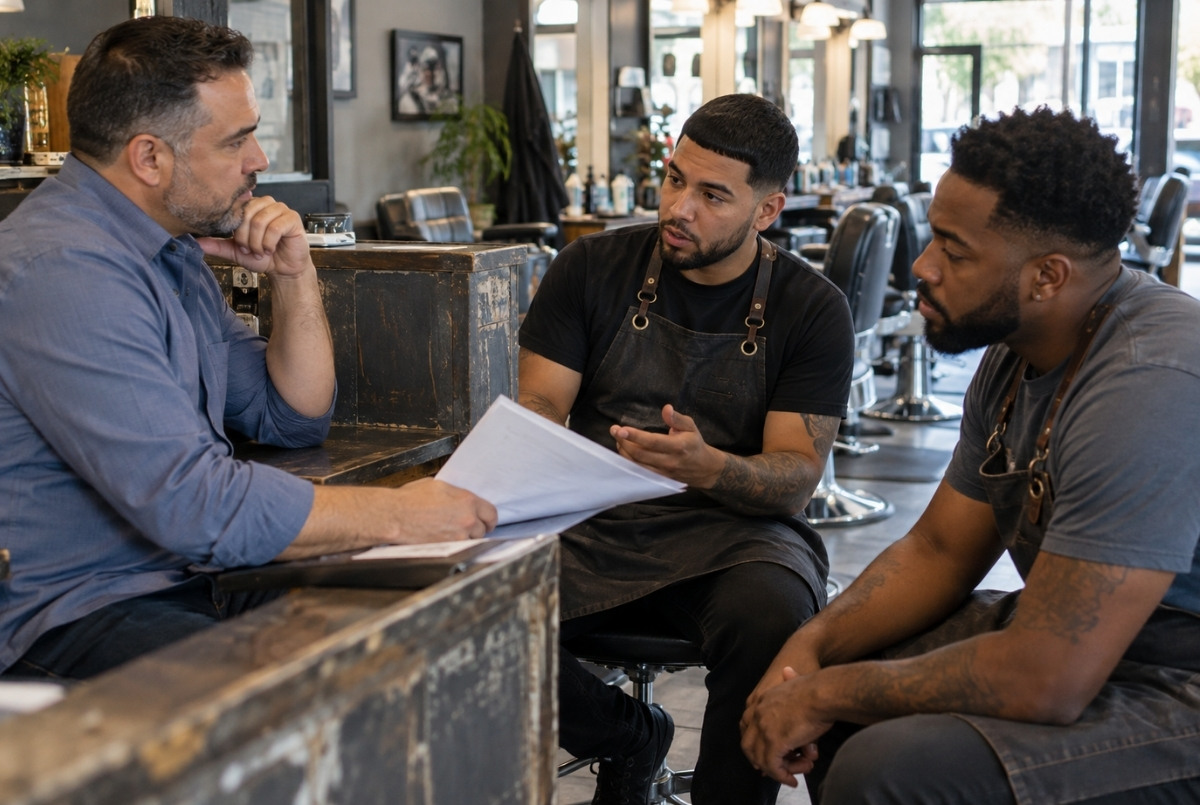
Shop owner and two barbers discuss paperwork near a reception counter with empty barber chairs behind them. A shop may have both employees and independent booth renters, but each relationship must be structured and operated appropriately. The risk arises when someone is labeled an independent contractor while the shop exercises the control associated with employment. According to IRS worker-classification guidance, the entire relationship matters. Behavioral control, financial control, and the nature of the relationship must be considered; no single factor automatically determines status. Dictating a renter’s service prices, assigning mandatory shifts, or directing how services are performed can weigh toward employee status. Calling someone a “1099 contractor” or signing a rental agreement does not settle the question. Misclassification can create employment-tax liability and other obligations under applicable wage, unemployment, and workers’ compensation laws. Also, renting a chair does not automatically mean the shop must issue the renter a contractor-payment tax form. Reporting obligations depend on the payments and arrangement.

Support Your Team With Reliable Operations

Managing licensed professionals when you do not share their technical background requires a clear understanding of your role. Focus on the business systems that help the shop operate consistently, while ensuring that any required licensed professional supervision is properly arranged. Reliable facilities, clear agreements, and useful technology provide a stronger foundation than trying to direct technical work outside your expertise.

Lead a Shop Where You Do Not Cut Hair

When learning how to own a barbershop without being a barber, focus on the operational friction that slows the business down:
  • Clarify Supply Responsibilities: In an employee-based shop, maintain the sanitation products, towels, neck strips, and other supplies the business provides. In a booth-rental shop, specify what the owner supplies and what each renter purchases independently.
  • Maintain the Facility: Keep equipment and building systems in good condition, arrange cleaning, and address maintenance problems promptly.
  • Support Customer Acquisition: Build a clear local presence through marketing, community outreach, and accurate business information. Coordinate shared promotions with renters according to their agreements rather than assuming control of their independent businesses.
  • Plan Professional Oversight: Where state law requires licensed supervision or management, arrange appropriate coverage and confirm what happens if the designated professional is unavailable or leaves.
Operational responsibilities should support your chosen staffing model. For example, centralized scheduling and shared supplies may fit an employee-based shop, while independent renters may maintain their own appointments and products.

Use Booking Technology With Clear Policies

Booking and payment software can help organize appointments, customer payments, and business reporting. Upmetrics’ barber-business trends article discusses the use of online booking, cashless payments, reminders, and management software. However, those trends do not establish a guaranteed percentage improvement in occupancy or profitability. Evaluate platforms against your actual operating model. An employee-based shop may need integrated scheduling and commission reporting, while a booth-rental business should assess how shared technology preserves renters’ independent arrangements. Cancellation protection also requires more than switching on a feature. Square’s cancellation and prepayment documentation distinguishes between full prepayment and holding a card for no-show protection. It also explains that cancellation fees are charged when the business chooses to enforce its policy. Set clear cancellation windows and fee terms, understand how customers see the policy, and confirm how the platform handles refunds and declined cards. A card hold is not the same as a paid deposit, and neither guarantees that every cancellation will produce recoverable revenue. Track completed appointments, no-shows, late cancellations, booked hours, and revenue per available barber hour. These measures show whether a system is helping your particular shop.

Build Business Knowledge Alongside Industry Knowledge

Barbershop owner checks a tablet appointment calendar at reception while a barber cuts a seated client’s hair in the background. Succeeding as a shop owner comes down to understanding regulatory requirements, managing financial risk, and supporting the people who deliver services. Technical skill is essential for practitioners, while owners also need to understand budgeting, agreements, customer acquisition, and operational responsibilities. Formal training can provide useful exposure to the trade, but it does not replace a location-specific financial plan or verification of establishment requirements. The Fortune Business Insights salon-services report identifies growing interest in men’s grooming as one contributor to market demand. That broader trend can help inform service ideas, but local customer research and realistic pricing assumptions should guide your own business plan. If you are weighing formal training for yourself or helping a future team member plan their education, reviewing details on barber school costs, duration, and entry prerequisites will clarify what to expect. Ask each school about its actual schedule and curriculum, including sanitation, licensing preparation, client communication, and any business-related instruction.

Frequently Asked Questions

Do I need a master barber on staff if I own the shop but do not cut hair?

Requirements vary by state, and “master barber” is not a universal management requirement. Arkansas requires a barbershop to operate under the personal supervision and management of a registered barber. Confirm whether your state requires a licensed manager, which credential qualifies, and what supervision arrangements are acceptable.

How long does it take to open a barbershop?

Opening can take several months, depending on lease negotiations, construction, permits, establishment licensing, and hiring. An existing space needing minor work may follow a different timeline from a raw shell requiring new drainage or electrical upgrades. Build your schedule around the approvals and construction steps required for your specific location.

Can I attend barber school part-time while running the business?

You can pursue training while owning a business if a school’s schedule fits your responsibilities. Confirm whether the program offers part-time attendance, how required hours are completed, and whether you have adequate shop management coverage while attending classes. Enrollment alone does not authorize you to provide regulated services.

What insurance should I arrange before opening?

Common coverages include general liability, business property, and professional liability insurance. General liability generally addresses covered third-party injury and property-damage claims, while professional liability addresses covered claims arising from services. Policy terms and exclusions matter. Wexford Insurance’s barbershop licensing and insurance overview provides a starting point for discussing coverage. Your lease may also impose specific insurance requirements. Workers’ compensation requirements depend on state law and employee count. According to the Georgia State Board of Workers’ Compensation, most employers with three or more regular full-time, part-time, or seasonal employees must carry coverage. Corporate officers and LLC members are included in that count even when they exempt themselves from coverage.

Prepare to Lead the Business and Learn the Craft

Opening a thriving shop takes capital, preparation, and an understanding of the industry you plan to serve. Before committing to a lease, confirm the licensing path, test the financial model, and decide how your team will operate. If you also want to develop hands-on skills, explore training at Atlanta Beauty Academy. Speak with our admissions team about the Salon Ready approach, available schedules, licensing preparation, and the business-related learning included in your chosen program. Whether your goal is to work behind the chair or build a multi-chair establishment, informed preparation helps you take the next step with confidence. Fill out the form below to connect with our admissions team and explore your training options.

Mortuary Cosmetology: Requirements, Specialized Techniques, and How to Enter the Field

Key Takeaways

  • Requirements Depend on the State: A cosmetology background provides useful skills for mortuary hair, makeup, and nail care, but a beauty license does not automatically establish permission to perform every service in a funeral home. Confirm the requirements with your state beauty board and funeral-service regulator.
  • Training Hours Vary: Georgia and Arkansas have 1,500-hour cosmetology school pathways. Georgia also offers a separate apprenticeship pathway requiring at least 3,000 hours over 18 months.
  • Different Ways to Work: Mortuary cosmetic work may be performed by funeral-home staff or outside specialists. Freelance and on-call arrangements are possible, but case volume, duties, and compensation should be discussed with individual establishments.
  • Products Match the Case: Mortuary cosmetics include translucent and opaque formulations. Product selection depends on skin condition, discoloration, and the desired appearance rather than a universal need for heavy, wax-based makeup.
  • Direct Outreach Helps: Building relationships with local funeral directors can help you learn about opportunities, required credentials, supervision, and the establishment’s preparation practices.
If you have ever felt a quiet tug toward a different kind of beauty career, you are not alone. For a stylist who wants to apply familiar skills in a different setting, desairology—the practice of cosmetic care for the deceased—offers a meaningful path. Your work can help preserve a person’s familiar appearance while supporting families during a difficult time. The setting brings responsibilities beyond ordinary salon work, however. Understanding licensing, preparation-room safety, specialized products, and the realities of local demand helps you approach this field with both compassion and a practical plan.

What Does a Mortuary Cosmetologist Do?

At its heart, mortuary cosmetology focuses on dignity, familiarity, and the wishes of the deceased and their family. The goal is not necessarily to make someone look younger or more glamorous. It is to create an appearance that feels appropriate to the person being remembered. Depending on your permitted scope, the condition of the remains, and the funeral establishment’s instructions, your work may include:
  • Haircare and Styling: Arranging, cutting, or styling hair to reflect the person’s usual appearance, along with beard grooming where appropriate and permitted.
  • Cosmetic Application: Matching skin tones, addressing visible discoloration, and applying foundation, lip color, or other cosmetics according to the requested appearance.
  • Nail Care: Cleaning, shaping, or polishing nails when requested and within the services you are authorized to provide.
Family photographs can provide a helpful reference, but a conversation about preferences matters too. A person who rarely wore makeup may need a different approach from someone known for a particular lipstick shade, hairstyle, or manicure. As a practical starting point, ask the funeral director which reference photograph best represents the desired appearance and whether there are specific cultural, religious, or personal requests. Mortuary cosmetic care is one of several specialized directions related to the career paths you can pursue with a cosmetology background. As with other specialized settings, foundational beauty skills may need to be combined with additional training and setting-specific requirements.

Understanding Licensing and Education Requirements

You should not assume that everyone who styles hair or applies makeup in a funeral home must first earn a four-year mortuary science degree. You also should not assume that a standard beauty license automatically authorizes every form of cosmetic preparation. The requirements depend on the state, the services involved, and how funeral-service laws apply to the work. For example, Florida’s Department of Business and Professional Regulation states that it does not regulate makeup or hair arranging on a deceased person in a funeral home. The agency directs people to the Division of Funeral, Cemetery & Consumer Services for further clarification. This guidance concerns those specific services and should not be treated as permission to perform all preparation tasks. Before choosing a training pathway, contact both your state beauty board and funeral-service regulator. Describe the exact services you intend to offer and ask about individual licensing, supervision, establishment requirements, and any tasks reserved for licensed funeral-service personnel. Request a written response when possible.

Building Your Cosmetology Foundation

If you choose the cosmetology pathway, a state-approved program can develop useful skills in hairstyling, makeup, nail care, color theory, and sanitation. For the school-based route, Georgia’s cosmetology curriculum requires 1,500 training hours over a minimum of nine months. Arkansas also specifies a 1,500-hour cosmetologist training requirement. Georgia’s Board additionally identifies an apprenticeship pathway requiring at least 18 months and 3,000 hours. These are general cosmetology requirements, not separate mortuary-cosmetology credentials. For a broader overview, our guide to cosmetology license requirements by state, training hours, and transfer rules can help you identify questions to confirm with the relevant board. When comparing schools, distinguish state approval from accreditation. For licensing purposes, confirm that the program is accepted by the board that will issue your license.

Knowing Where Your Responsibilities Stop

Cosmetic preparation and embalming are different activities. A cosmetology or barber license alone does not authorize embalming, and an external procedure should not automatically be considered permissible simply because it takes place on the surface of the body.
  • Cosmetologists and Barbers: May contribute services within their permitted scope, subject to state requirements and the funeral establishment’s policies. Barbering and cosmetology licenses have different scopes and should not be treated as interchangeable credentials for all hair, skin, and nail services.
  • Licensed Embalmers: Must meet the applicable state requirements for embalming. These may include approved funeral-service education, supervised experience, and examinations.
  • Specialized Courses and Certificates: Can help develop knowledge of mortuary products, presentation, and preparation-room practices. A private course certificate does not replace any license or authorization required for the services you intend to perform.
Georgia provides a concrete example of the embalmer pathway. Under the Georgia State Board of Funeral Service’s licensing rules, applicants must provide proof of graduation from an ABFSE-accredited funeral-service college or another college specifically approved by the Board, complete 3,120 apprenticeship hours, document assistance with embalming at least 50 bodies, and meet the required examination standards. The American Board of Funeral Service Education’s directory lists accredited funeral-service programs, including associate and bachelor’s degree programs. FINE Mortuary College’s resources also provide an overview of funeral-service licensing requirements, but the applicable state board remains the place to confirm current rules. If a case requires structural reconstruction, invasive preparation, or treatment beyond your approved responsibilities, refer it to the establishment’s appropriately authorized professional. Beauty training provides a foundation; it does not expand your legal scope.

How Mortuary Makeup Differs from Salon Makeup

Mortuary makeup calls for careful assessment rather than a single formula. The condition of the skin and the amount of correction needed influence which products and methods are appropriate. It is inaccurate to describe all post-mortem skin as non-porous or to assume that liquid cosmetics cannot work on it. Mortuary product ranges include different formulations, and heavy coverage is not always the best choice. For example, Dodge’s Aquachrome product instructions describe a water-based, translucent cosmetic intended for normal skin. The manufacturer recommends this type of coverage where substantial concealment is unnecessary because it preserves the natural skin tone rather than masking it. Several distinctions are useful when learning specialized cosmetic application:
  1. Translucent and Opaque Coverage: Translucent products can preserve natural appearance where little correction is needed. More opaque products may be appropriate when discoloration requires concealment. Coverage should match the case rather than default to the heaviest available foundation.
  2. Product Formulation and Application: Mortuary cosmetics vary in consistency, finish, and intended use. Follow the manufacturer’s instructions and obtain supervised training before using unfamiliar products. Airbrushing may be an option, but it is not a universal requirement.
  3. Cosmetics and Restorative Materials: Cosmetic coverage and rebuilding a feature with restorative materials are different tasks. Knowing how to apply foundation does not establish competence or authorization to perform reconstruction.
  4. Color and Viewing Conditions: As a practical quality check, assess the finished appearance under the lighting used for the viewing. Keep the family’s reference photographs and requested appearance in mind rather than assuming every chapel has the same lighting or requires the same color adjustments.
The Career Trend guide to becoming a mortuary makeup artist discusses the value of specialized product knowledge and sanitation training. For technical product decisions, manufacturer instructions and supervised instruction are more useful than general career advice alone. A strong understanding of color theory helps, but mortuary application is also about restraint. The aim is a familiar appearance, with only as much correction as the individual case requires.

Preparation-Room Safety Matters

A quiet working environment does not eliminate workplace hazards. Depending on your duties, you may encounter blood or other potentially infectious materials, contaminated equipment, or chemicals used in the preparation room. OSHA’s guidance for funeral homes explains that bloodborne-pathogen requirements depend on reasonably anticipated occupational exposure. OSHA also states that its formaldehyde standard applies to occupational exposure associated with embalming in funeral homes. Before accepting work, ask the establishment about:
  • Task-Specific Training: Which hazards are associated with your assigned services and what instruction you must complete.
  • Protective Equipment: What protection is appropriate for the work and who supplies it.
  • Chemical Safety: Where safety data sheets are kept and what ventilation or handling procedures apply.
  • Cleaning and Waste Procedures: How tools, surfaces, disposable materials, and contaminated items must be handled.
  • Exposure Response: Whom to contact and what steps to follow if an exposure occurs.
The applicable obligations depend on employment arrangements and exposure circumstances. For your own planning, the important point is to understand the establishment’s safety procedures before entering the preparation room, rather than relying only on salon sanitation habits.

What to Expect from Pay and Freelance Work

When evaluating a specialized career path, financial stability matters alongside personal meaning. Mortuary cosmetic work can be performed by funeral-home employees or independent specialists, but the arrangement and available case volume vary by establishment. The Indeed guide to becoming a mortuary cosmetologist identifies both employment and independent-contracting possibilities. That distinction matters because an annual salary estimate does not establish what a freelancer should charge per case. For context, ZipRecruiter’s “Mortuary Cosmetologist” salary page reported an estimated national average of $43,287 annually as of September 4, 2026, equivalent to approximately $20.81 per hour. Its separate “Mortuary Cosmetology” category reported $45,943 annually, or approximately $22.09 per hour, as of July 1, 2026. These are separate job-category estimates from different snapshots. They should not be combined into a standard hourly range or presented as verified starting wages, contractor rates, or guaranteed earnings. When discussing an opportunity, clarify how compensation will work:
  • Hourly Employment: Ask which duties the position includes, whether hours are guaranteed, and how availability or time outside scheduled work is handled.
  • Per-Case Contracting: Agree on the services included in the fee, who provides supplies, and whether travel, urgent scheduling, or additional work carries a separate charge.
  • Broader Funeral-Service Roles: Positions that include embalming, funeral directing, or other preparation duties have different responsibilities and licensing requirements. Their compensation should not be used as a direct benchmark for hair and makeup alone.
For a freelancer, a case fee is gross revenue, not take-home pay. Include travel, setup, cleanup, consumables, administration, and any applicable insurance or tax costs when assessing an offer. Before relying on this specialty as your primary income, ask local establishments about expected case volume and how they currently assign cosmetic work. Offering mortuary services alongside salon work may provide flexibility, but dependable income depends on the actual arrangements you secure.

Building Relationships with Local Funeral Homes

A direct conversation with a funeral director can tell you more than a job-title search alone. It helps you understand whether the establishment uses outside specialists, which services it needs, and what credentials or experience it expects. There is no verified basis here for claiming that fewer than 5% of opportunities are advertised publicly. You can still use job boards while making professional outreach part of your search. If you are exploring how to enter mortuary cosmetology, take a practical, respectful approach:
  1. Confirm Your Intended Scope: Check state requirements for the specific services you want to offer. Decide whether general cosmetology training, funeral-service education, or additional supervised instruction fits your intended role.
  2. Build a Relevant Portfolio: Use living models or mannequins to demonstrate natural makeup, skin-tone matching, restrained corrective work, and varied hairstyles. Show that you can reproduce an individual preference rather than applying one signature look to everyone. Do not use photographs of deceased people without appropriate authorization.
  3. Introduce Yourself Professionally: Request a brief meeting with a local funeral director. Share your training, permitted services, portfolio, availability, and interest in learning the establishment’s procedures.
  4. Ask About the Working Arrangement: Find out who currently handles cosmetic preparation, whether contractors are used, what supervision or training is required, and how supplies, scheduling, and payment are managed.
  5. Develop Setting-Specific Experience: Seek supervised instruction appropriate to your role before accepting unfamiliar cases. Respect the establishment’s limits on what you may observe or perform.
  6. Demonstrate Reliability and Discretion: Arrive as agreed, follow safety procedures, protect sensitive information, and communicate promptly if a request exceeds your competence or permitted scope.
For broader guidance on portfolios, licensing, and networking after graduation, read our guide to what to do after cosmetology school. Trust develops through consistent work and clear communication. A funeral director needs to know not only that you have technical ability, but also that you understand the family’s preferences, the establishment’s procedures, and the limits of your responsibilities.

Frequently Asked Questions

Is mortuary cosmetology emotionally demanding?

It can be. Some people find the work meaningful, while others find working around death and grieving families difficult. Before committing to the field, discuss the working environment with an experienced professional and consider an authorized observation opportunity where available. Think about your comfort with the setting, your personal boundaries, and the support you would use if a case affected you deeply.

Can barbers work with funeral homes?

Barbers may be considered for services such as haircuts, beard grooming, or shaving, depending on state requirements and the establishment’s policies. Confirm the rules for the exact services involved. A barber license should not be assumed to authorize every makeup, skin, or nail service.

Do I need a separate kit for mortuary work?

A dedicated kit is a sensible way to organize supplies and follow the establishment’s contamination-control procedures. Before buying equipment, ask which products the funeral home provides and which you are expected to bring. Airbrush equipment is not universally necessary, and unfamiliar products should be used only with appropriate instruction.

Does a mortuary-cosmetology certificate replace a state license?

A private training certificate documents completion of that course. It does not replace any state license, authorization, or employer requirement applicable to your services. Check the legal requirements first, then evaluate whether the course offers relevant practical instruction.

How should I price freelance services?

Start by defining the requested services and estimating the total time and costs involved, including travel and cleanup. Discuss local expectations with prospective funeral-home clients and put the agreed terms in writing. Broad salary estimates do not establish a standard per-case fee.

Start Building a Meaningful Career in Beauty

Exploring mortuary cosmetology begins with understanding the work, checking local requirements, and developing a strong technical foundation. For students choosing the cosmetology pathway, skills in hairstyling, color theory, skin science, and sanitation can support further specialized learning. At Atlanta Beauty Academy, our “Salon Ready” approach focuses on practical beauty skills and professional preparation. As you explore specialized settings, pair that foundation with the additional instruction, safety knowledge, and authorization your intended role requires. Whether your interests lead toward salon work or cosmetic services in a funeral-home setting, a thoughtful education plan helps you take the next step with clearer expectations. Fill out the form below to connect with our admissions team and explore how our cosmetology program can support your career goals.